Visual memory aid: common board textures
These examples are prompts for evaluating the board, not automatic action rules. Consider ranges, position, and betting action too.
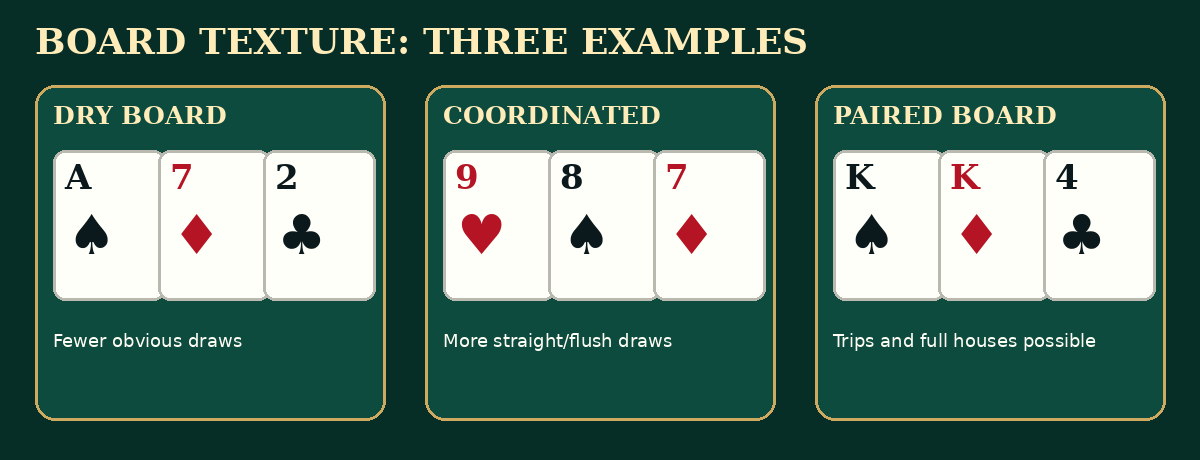
Learning to see the flop is the first step. Learning to recognize the kind of flop you are looking at is the next. A player who sees three cards but treats every flop as a completely new puzzle has to rebuild the decision from the beginning every time. A player who recognizes familiar board patterns has already organized much of the information before making a decision.
That distinction is central to memorizing poker. You are not trying to memorize every possible three-card flop. There are far too many combinations for that to be useful. Instead, you are learning to recognize the recurring structures that appear over and over again. Once those structures become familiar, hundreds of different flops begin to feel like variations of a much smaller number of patterns.
The most useful starting point is to classify the flop by its general texture. A flop may be relatively dry, coordinated, paired, draw-heavy, high-card, or low-card. These categories overlap. A high-card flop can also be coordinated. A paired flop can also contain a flush draw. A low-card flop can be extremely connected. The purpose of the categories is not to force every board into one box. The purpose is to give your memory a way to organize what you are seeing.
A dry board is one of the easiest patterns to recognize. Imagine a flop such as K♣ 7♦ 2♠. The cards are separated in rank, there is no obvious straight connection among them, and all three suits are different. There are relatively few immediate drawing possibilities. Compare that with J♠ T♥ 9♣, where the cards are tightly connected and several straight possibilities exist. You do not need to calculate every possible combination to understand that these boards are fundamentally different. Your memory should recognize the difference almost immediately.
Dry boards often make the relationship between the pre-flop action and the flop particularly important. If a player raised before the flop and the flop is relatively disconnected, the board may be easier for that player's range to represent than a highly coordinated board would be. This does not mean that every dry board should automatically be bet or that every coordinated board should automatically be checked. Those are decisions for later chapters. The memory task here is to recognize the board pattern so that the appropriate strategy can be retrieved more easily.
A coordinated board creates a different mental picture. Consider J♠ T♥ 9♣. The ranks are connected, and many hands can interact with the board through pairs, straight draws, two-pair combinations, and made straights. A board such as 9♠ 8♦ 7♣ has the same general characteristic. Even though the suits are different, the ranks create substantial connectivity.
When you see a coordinated flop, you should not need to stop and rediscover what connected means. Your memory should already associate connected boards with greater interaction between the board and possible hands. More possible draws exist, more hands can improve, and the strength of a single pair can be more complicated than it would be on a dry board.
This is where memorizing patterns becomes more useful than memorizing individual cards. You do not need a separate memory for J-T-9, 9-8-7, 8-7-6, and similar boards. They belong to a recognizable family. Once the family is familiar, a new example can be recognized as a member of that family.
Paired boards form another major pattern. A flop such as 8♣ 8♦ 4♣ immediately tells you something different from K♣ 7♦ 2♠. The board itself contains a pair. That means trips are possible, full houses can eventually develop, and the relationship between a player's hole cards and the paired board changes the way many hands should be evaluated.
Again, the point is not to memorize a single answer for every paired board. The point is to make the pattern recognizable. When you see a paired board, your mind should immediately register that the board is paired. That recognition becomes part of the information used in the next decision.
A draw-heavy board is another pattern that should become familiar. A flop such as A♥ 8♥ 3♣ contains two cards of the same suit, creating flush-draw possibilities. A flop such as J♠ T♥ 9♣ creates substantial straight possibilities. A flop such as 9♠ 8♠ 4♦ contains both connected ranks and two cards of the same suit. The more coordinated the board becomes, the more possible ways hands can connect with it.
The important memory skill is learning to notice what the board permits. You do not necessarily need to calculate every draw available before you can recognize the general pattern. Your first task is simply to see that the board has become draw-heavy or highly coordinated.
High-card boards deserve their own category because the ranks themselves affect the likely relationship between the board and the hands that entered the pot. A flop such as A♣ K♦ Q♠ contains three high cards. A flop such as K♣ 8♦ 2♠ has one high card and two lower cards. These are not identical situations, but both require your memory to recognize the importance of high cards.
The same principle applies to low-card boards. A flop such as 6♣ 5♦ 2♥ is much different from A♣ K♦ Q♠. Low boards can contain connected cards and draws even when they do not contain high cards. They may interact strongly with speculative hands, suited connectors, small pairs, and other parts of a player's range.
This is one reason the hand-group system from the earlier chapters remains important after the flop. The cards you started with did not stop mattering when the flop appeared. A small pocket pair, a suited connector, a suited ace, a premium hand, and a marginal offsuit hand all interact with the same board differently. Your starting-hand memory provides the first half of the picture. Your flop-pattern memory provides the second half.
Consider A♠ K♠ as an example. On A♦ 7♣ 2♥, you have top pair with a strong kicker on a relatively dry board. On K♦ 9♣ 4♠, you have top pair with a strong kicker on a different but still relatively dry board. On Q♥ J♣ 8♠, you have two overcards without a pair on a coordinated board. On 8♥ 7♥ 3♣, you have no pair, but the board creates a different set of possibilities because it is connected and two-tone.
The hole cards have not changed. The flop pattern has changed, and therefore the situation has changed. This is exactly the kind of relationship that the memory system is designed to make recognizable.
You should also learn to recognize combinations of patterns rather than treating the categories as mutually exclusive. A flop can be paired and two-tone. It can be low and coordinated. It can be high and relatively dry. It can be high and highly connected. It can be paired and draw-heavy. The purpose of classification is not to simplify poker by pretending that only one thing is happening. It is to give your mind a fast way to identify the major features of the board.
This is similar to the way starting hands were organized earlier in the book. AA, KK, QQ, AK, and other premium hands are not identical, but they belong to a recognizable group. JTs, T9s, 98s, 87s, and 76s are not identical, but they belong to a recognizable family of suited connectors. The same concept works with flops. You are learning families of situations rather than trying to memorize every individual situation.
That is why patterns are so powerful for memory. A single fact has to be remembered by itself. A pattern gives several facts a common structure. Once you recognize the structure, the individual details become easier to process.
The next important distinction is between recognizing a flop pattern and deciding what to do about it. These are not the same task. If you see a dry flop, you have recognized a pattern. You have not yet automatically decided to bet. If you see a coordinated flop, you have recognized another pattern. You have not automatically decided to check. The decision still depends on the rest of the situation.
Your position remains relevant. The number of opponents remains relevant. The action before the flop remains relevant. Your own hand remains relevant. The action on the flop remains relevant. A board pattern organizes the information; it does not replace the decision.
This is an important safeguard against turning memory into mechanical poker. The purpose of memorization is to make correct information available quickly. It is not to create a collection of automatic actions that ignore context.
A useful way to think about this is that the flop pattern changes the environment in which your strategy operates. Your starting hand tells you what you brought into that environment. Your position tells you where you are operating from. The pre-flop action tells you how the hand arrived at the flop. The board pattern tells you what the community cards have created. Together, these pieces produce the situation you must recognize.
This also explains why the flop should be remembered as part of the hand's story. Suppose you raised before the flop and one opponent called. The flop comes K♣ 7♦ 2♠. You should remember that you were the pre-flop aggressor, that one opponent called, and that the board is relatively dry. If the same opponent instead called your raise and the flop comes J♠ T♥ 9♣, the board is much more coordinated. The two hands did not arrive at the flop under identical circumstances.
The memory system becomes stronger when these details are connected rather than stored separately. You are not trying to memorize “dry flop” as an isolated definition. You are learning to see a dry flop when it appears inside an actual poker hand.
That is why visual practice is particularly effective. Deal three cards and identify the board pattern. Do not make a decision. Simply classify what you see. Then deal two hole cards and identify how your hand interacts with the board. Then add a position and a pre-flop action. Finally, add an opponent and an action. You are gradually increasing the amount of information without changing the basic recognition process.
You can also reverse the exercise. Start with a known pattern and generate several examples. For a dry flop, create K♣ 7♦ 2♠, A♣ 8♦ 3♠, Q♠ 6♥ 2♣, and similar boards. For coordinated flops, use J♠ T♥ 9♣, 9♣ 8♦ 7♠, and 8♥ 7♣ 6♦. For paired boards, use 8♣ 8♦ 4♠, K♣ K♦ 7♥, and 5♠ 5♦ 2♣. The purpose is not to memorize those examples. The purpose is to train your mind to recognize the common structure behind them.
Another useful exercise is to look at a flop for only a few seconds and then name the important features from memory. You might see A♥ 8♥ 3♣ and immediately recognize that the board contains an ace, two hearts, and a relatively disconnected structure. You might see J♠ T♥ 9♣ and recognize a highly connected board. You might see 8♠ 8♦ 4♣ and immediately register that the board is paired.
With repetition, the recognition becomes faster. Eventually, you should not have to consciously ask yourself whether a board is paired. You simply see the pair. You should not have to spend several seconds discovering that three cards are connected. You should recognize the connection almost immediately.
This is the same transition from recall to recognition that the earlier chapters established. At first, you deliberately study the categories. Then you deliberately identify them. Eventually, you simply see them.
There is another reason this matters. Players often become overwhelmed on the flop because they try to process every possible piece of information simultaneously. They see their cards, the board, the pot, the opponent, the bet size, the stack sizes, the possible draws, the possible hands, and the future turn and river cards all at once. The result is often confusion rather than clarity.
Pattern recognition reduces that overload. When you recognize the board as relatively dry, you have already organized several facts. When you recognize a paired board, another group of facts has been organized. When you recognize a coordinated, draw-heavy board, you have immediately identified a different environment. The pattern gives your mind a place to put the information.
This does not mean ignoring details. It means processing details in an organized way.
The same idea applies to boards that favor stronger made hands and boards that create uncertainty. Some flops interact naturally with the strong hands that a player would have represented through the pre-flop action. Other flops create many possible holdings and make hand strength less obvious. Recognizing this difference helps prevent the common mistake of treating every flop as equally straightforward.
A strong made hand on a dry board may be relatively easy to understand. A medium-strength hand on a highly coordinated board may require more attention. A missed hand on a board with few draws may have a different situation from a missed hand on a board where many draws are available. These distinctions are exactly what later flop decisions will build upon.
The key is to avoid jumping ahead. Chapter 11 taught you to see the flop. This chapter teaches you to recognize its pattern. The next chapters can then use that recognition to determine what the strategy calls for.
This sequence matters because memorization works best when information is layered. If you try to memorize a decision without remembering the situation that produces the decision, the decision becomes fragile. If you recognize the situation first, the decision has something to attach itself to.
Think about how this worked pre-flop. You learned position. You learned hand groups. You learned the actual hands within those groups. You learned opening ranges by position. You learned how to enter the pot and how to respond to raises. The decision became easier because each piece of information had a place in the system.
The flop should be learned in the same way. First recognize the board. Then recognize its pattern. Then recognize your hand in relation to that pattern. Then remember the action and position. Finally, retrieve the appropriate decision.
The objective is not to turn the player into a person who constantly labels everything. Eventually, the labels should become unnecessary. A skilled player does not need to say internally, “This is a coordinated board, therefore I am now looking at a connected flop pattern.” The player simply sees the board and understands what kind of situation it creates.
That is the destination of the memory system. The terminology is useful while learning because it gives you something to organize and practice. But the final goal is recognition.
When you see K♣ 7♦ 2♠, you should recognize the relative dryness of the board. When you see J♠ T♥ 9♣, you should immediately recognize the connectivity. When you see 8♣ 8♦ 4♣, you should notice the paired board. When you see A♥ 8♥ 3♣, you should recognize the two-tone structure and the possibilities it creates. When you see 6♣ 5♦ 2♥, you should recognize that the board is low and that its connected lower cards may interact with a different portion of the possible hands.
You are building a visual vocabulary for poker.
Once that vocabulary becomes familiar, the flop becomes easier to read without becoming simpler than it really is. You can recognize what matters without trying to calculate everything. You can see the structure before making the decision. You can connect the board to your hand, your position, and the action that brought you there.
That is the purpose of memorizing flop patterns. You are not memorizing thousands of flops. You are memorizing the small number of recurring structures that allow thousands of flops to become recognizable.
The more those patterns become part of your memory, the less often you will experience the flop as a completely new problem. You will begin to see familiar situations, and familiar situations are much easier to play correctly than unfamiliar ones. The ultimate goal is for the board to communicate its important information almost immediately, giving your existing strategy something clear and organized to work with.
CONTINUE YOUR STUDY
Want the complete advanced system?
The free book helps you build your memory foundation. Visit the official sales page to review Memorizing Advanced Poker for $49 and continue to checkout from there.