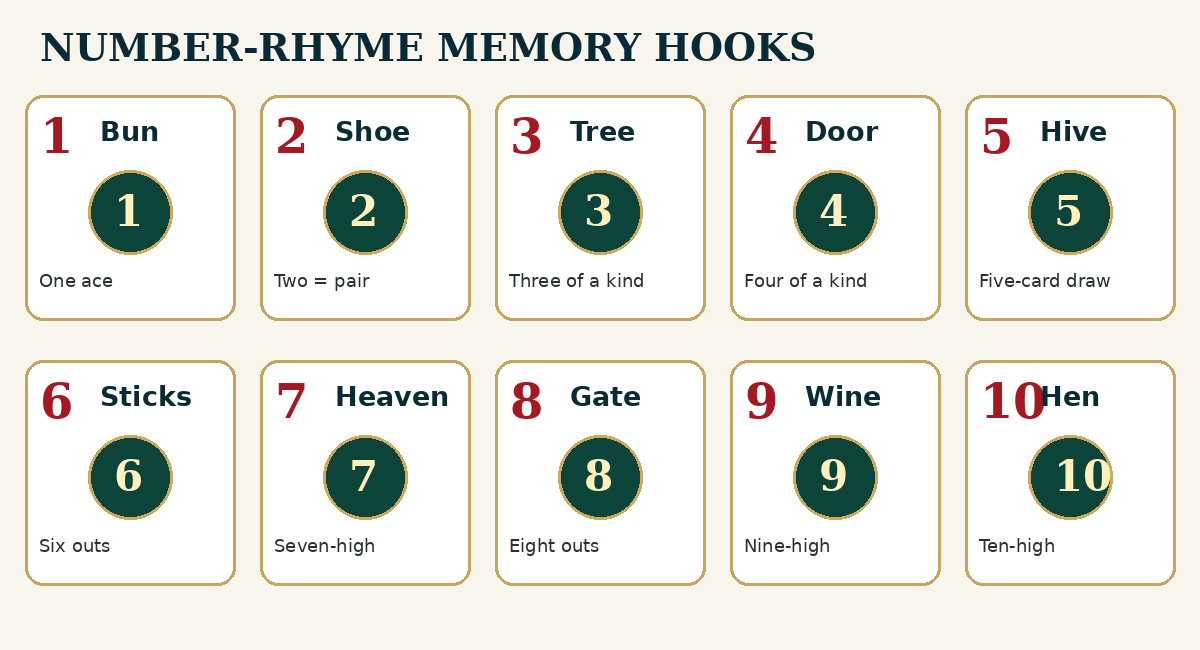
Visual memory aid: number-rhyme hooks
Use these as recall cues during practice. Associate each image with the poker concept you want to retrieve.
Position is one of the easiest concepts in poker to understand and one of the most important concepts to make automatic. Almost every player learns that acting later is generally an advantage. The difficulty is not understanding the idea. The difficulty is remembering to use it when the cards are dealt and a decision has to be made.
A player can know everything about position while studying and still sit down at a poker table and immediately focus on the cards. He sees ace-jack and thinks about ace-jack. He sees a pair of sevens and thinks about the pair. Someone raises and he immediately begins wondering whether his hand is strong enough to continue. Position may still be somewhere in his memory, but it is no longer part of the immediate decision.
That is the difference between knowing position and memorizing position.
Memorizing position means making your location at the table part of your immediate perception. You should know where you are before you begin analyzing what to do with your cards. You should know which players have already acted, which players remain behind you, and what your position means for the amount of information available to you. Eventually, this should require almost no conscious effort.
The purpose of memorizing position is not to make you think about position more. It is to make position easier to recognize so that you have more mental capacity available for the parts of the decision that actually require thought.
Position matters because poker is not played with cards alone. The same two cards can represent very different situations depending on where they are being played. A hand that is difficult to play from early position may become easier to play from late position. A hand that appears attractive when only one player remains behind you may be less attractive when several players can still act. The cards have not changed, but the decision environment has.
The first step in building position memory is therefore learning to see the table as a structure rather than simply as a collection of seats. The button establishes the basic reference point. The blinds establish the forced positions. The remaining seats fall into the order of action around the table. Once you understand that structure, your position becomes something you can recognize immediately rather than something you have to calculate every time you receive a hand.
This is especially important because position determines how much information you have before making a decision. When you act early, many players remain behind you and their intentions are unknown. They may fold, call, raise, or create an entirely different situation. When you act later, some or all of those players have already revealed information through their actions. You have more information before you must decide, and fewer players remain who can change the situation after you act.
That informational difference is one of the central reasons position matters.
The useful memory is not simply that late position is good and early position is bad. That is too crude to be useful. The better memory is that your position determines how much information you have before acting and how many players can still affect the hand after you act.
Once that relationship becomes familiar, the table begins to look different. You no longer see only your cards. You see your cards in relation to your position and the remaining action.
This is why position should become part of your recognition of every hand. Instead of seeing A-J as simply A-J, you begin to see A-J from early position, A-J from middle position, or A-J from late position. Those are different situations even though the cards are identical.
The same principle applies to every other starting hand. A pair of sevens is not simply a pair of sevens. Its practical value depends partly on where you are, what has happened before you, and what can happen after you act. A suited connector is not automatically playable simply because it is suited and connected. A marginal hand does not exist in isolation from the position in which you must play it.
This is where memory begins to change poker. Instead of memorizing a separate answer for every possible combination of hand and position, you remember the relationship between them. Your hand gives you one piece of information. Your position gives you another. Together they create the situation in which the decision must be made.
That relationship is far more useful than a collection of isolated rules.
Early position deserves particular attention because it creates an information disadvantage. When you act early, you have less information about what the other players intend to do. Several players remain behind you, and any one of them can alter the situation with a call or raise. You therefore have to make your initial decision while more possibilities remain unresolved.
This does not mean that every early-position hand should be played cautiously or that every strong hand should be treated differently simply because it is early. Position does not replace hand strength. It changes the environment in which hand strength must be evaluated.
Middle position creates a different environment. Some players have already acted, so you have received some information, but several players may still remain behind you. You are neither operating with the maximum uncertainty of acting first nor the informational advantage of acting near the end of the action. Middle position therefore needs to become a distinct part of your mental map.
Late position provides the greatest amount of information from the players who have already acted and generally leaves fewer players behind you. This can create opportunities that would not exist from earlier positions. A hand that is difficult to play when several opponents remain behind you can become more attractive when most of the table has already folded.
The important memory is not a command telling you exactly what to do from each position. The important memory is why the positions are different.
The blinds are also part of this mental map. They create special circumstances because money has already been committed before the player receives the next decision. The blind positions therefore cannot simply be treated as ordinary early or late positions. They are positions with their own relationship between previous investment, action, information, and the decision that follows.
Again, the purpose of memorization is not to create another collection of rules. It is to make the structure of the situation familiar.
One of the strongest habits you can develop is recognizing your position before allowing your attention to become absorbed by your cards. This does not mean deliberately ignoring your hand. It means establishing the environment before interpreting the hand.
When you receive your cards, you already know where you are. You know who has acted. You know who remains behind you. You know whether you are in an early, middle, late, or blind position. That information is already present before you begin deciding what your cards are worth.
This creates a natural order for your thinking. First you recognize where you are. Then you recognize what has happened. Then you consider what you hold. From there, you can make the appropriate decision.
The benefit of this order is that it prevents the cards from becoming the only thing you see.
Players frequently make the mistake of thinking about their cards first and trying to fit the rest of the situation around them. If they receive a hand they like, they begin looking for reasons to play it. If they receive a hand they dislike, they may dismiss the situation before considering whether position or action changes its value.
Position memory helps prevent this because it forces the hand to be seen as part of a larger situation.
This becomes even more important when players remain behind you. A common mistake is to think only about the players who have already acted. But the players who have not acted can be equally important. If several players remain behind you, your decision has to account for the possibility that one of them will enter the pot or raise.
When fewer players remain behind you, that uncertainty decreases. The difference is not merely that you are sitting in a different chair. You are operating in a different information environment.
This is why position is better remembered as a relationship than as a label.
The label might be “button.” The relationship is that most of the players have already acted, you have significant information about what they have done, and very few players remain who can act after you. That relationship is what actually matters to the decision.
The same principle applies when you are in early position. The label is “early position.” The relationship is that you have little information from the players who have yet to act and several players remain capable of changing the situation.
When position is remembered this way, it becomes much easier to connect it to the rest of your poker knowledge.
Position also provides an excellent example of the difference between recognition and recall. Recall requires you to deliberately retrieve information. Recognition occurs when the situation itself causes the information to become apparent.
A player who has to think, “What position am I in?” has not yet completely automated position recognition. A player who sits down, sees the button, sees the blinds, and immediately knows where he is has moved closer to automatic memory.
The goal of this book is to move important poker knowledge in that direction.
You accomplish this through repetition. Every hand provides another opportunity to recognize your position. You do not need to stop the game and turn every hand into a study exercise. Simply make position part of what you notice.
Before making a decision, recognize where you are. Notice who has acted and who remains. Then evaluate the hand.
Do this repeatedly.
Eventually the process becomes less deliberate. You stop reminding yourself to notice position because you simply notice it.
A useful way to practice is to mentally place yourself at different seats around a full table and identify the position from each seat. Move the button and repeat the exercise. Then combine positions with different starting hands. Imagine A-J from early position, then A-J from late position. Imagine a pair of sevens from early position, then the same pair from the button. You do not have to immediately determine the correct action. First recognize that the situations are different.
Once that recognition becomes easy, add the action that has occurred before you. Imagine being in middle position after a raise from an earlier player. Then imagine the same hand on the button after several players have folded. The cards may be identical, but the situation is not.
The purpose of these exercises is not to create homework for its own sake. It is to strengthen the connection between position and decision-making.
The more important training occurs during actual poker. Every hand gives you another repetition. You do not need to isolate position from the rest of the game. In fact, the memory becomes more useful when it is reinforced inside normal play.
As you play, notice your position naturally. Notice what it allows you to see. Notice how many players remain behind you. Notice how the action changes the information available to you. Then make your decision.
Over time, position begins to require less conscious attention.
That is the point.
Automatic does not mean that position stops influencing your decisions. It means that you no longer have to spend valuable mental energy reminding yourself that position matters. The information has become part of your normal perception of the game.
This is the larger principle behind memorizing poker. We are not trying to fill your mind with more information. We are trying to organize important information so that it becomes easier to retrieve when you need it.
Position is one of the first places where this becomes obvious. Once you know where you are without having to think about it, your starting hand can be evaluated in context. Once your hand and position are connected, your pre-flop decisions become easier to recognize. As the hand continues, the same principle can be applied to the flop, turn, river, aggression, folding, and discipline.
The objective is not to memorize a table diagram.
The objective is to reach the point where you sit down at a poker table and immediately know where you are, what information your position gives you, what uncertainty remains, and how your position belongs to the decision in front of you.
At that point, position has stopped being something you studied.
It has become something you remember.
CONTINUE YOUR STUDY
Want the complete advanced system?
The free book helps you build your memory foundation. Visit the official sales page to review Memorizing Advanced Poker for $49 and continue to checkout from there.