Playing-card recall practice
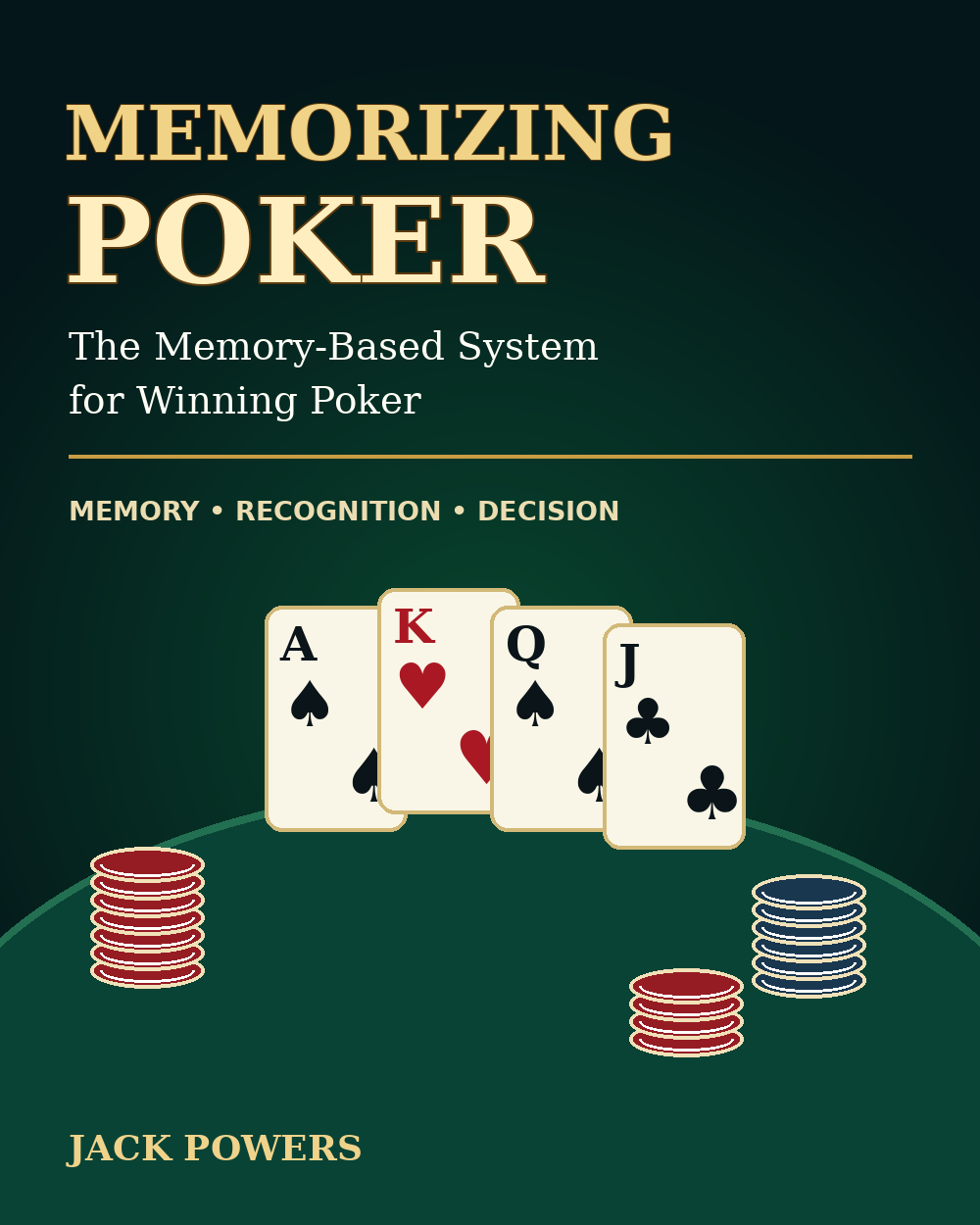
Use the cards below as a visual prompt: name the rank and suit, then explain what additional context you would need before making a strategic decision.
Starting hands are where poker strategy becomes concrete. Until now, you have been learning how memory works and why position matters. Now the cards themselves have to become part of your memory. You cannot play a basic poker strategy if you merely understand that some hands are better than others. You need to know which hands belong in your strategy, how those hands are grouped, and how the range changes as your position changes.
This is one of the most important chapters in the entire memory system because these are not abstract concepts that you will occasionally use. You will receive two starting cards every time you play a hand. The system therefore needs to make those two cards immediately recognizable.
The goal is not to memorize 169 starting-hand combinations as though they were 169 unrelated facts. The goal is to organize those hands into recognizable groups and then learn how those groups expand and contract according to position. Once that structure is in memory, individual hands become much easier to retrieve.
The first thing to understand is that there are six broad starting-hand groups in the system: Premium Hands, Very Strong Hands, Strong Playable Hands, Speculative Hands, Marginal Hands, and Folding Hands. These groups are not themselves final decisions. They are the structure that makes the actual ranges easier to memorize.
Premium Hands are the top of the starting-hand hierarchy. The core premium hands are AA, KK, QQ, AK suited, and AK offsuit. These are the hands that begin the hand with exceptional strength and are the easiest starting point for learning the system. Memorize them as one unit: AA, KK, QQ, AKs, AKo.
The next group is Very Strong Hands. This group includes JJ, TT, AQ suited, AQ offsuit, AJ suited, and KQ suited. These hands are extremely playable, but they are not identical to the premium group. Pocket jacks are not pocket aces. Ace-queen is not ace-king. The purpose of the grouping is to recognize that these hands belong near the top of the starting-hand structure while still understanding that their practical treatment can depend on position and action.
The third group is Strong Playable Hands. This group includes hands such as 99, 88, 77, AT suited, KJ suited, QJ suited, JT suited, AQ offsuit in appropriate situations, AJ offsuit in appropriate situations, and KQ offsuit in appropriate situations. These hands are strong enough to be useful, but their value depends more heavily on where you are and what has happened before the action reaches you.
The word playable is important. Playable does not mean playable from everywhere. It means the hand has enough value to enter the right pots under the right circumstances. A hand such as 88 may be a reasonable opening hand in one position and a different decision in another. The cards have not changed. The circumstances have.
The fourth group is Speculative Hands. These include small and medium pocket pairs, suited connectors, some suited one-gappers, and certain suited aces. Examples include 66, 55, 44, 33, 22, T9 suited, 98 suited, 87 suited, 76 suited, 65 suited, A5 suited, and A4 suited.
Speculative hands have less immediate strength than premium and strong hands, but they have the potential to make powerful hands. Small pocket pairs can make sets. Suited connectors can make straights and flushes. Suited aces can make strong flushes and can pair the ace. But potential is not the same thing as automatic playability. A hand that can become strong is not necessarily a hand that should always be played.
The fifth group is Marginal Hands. These include weak aces, weak kings, weak queens, weak jacks, lower offsuit connected hands, and some weak suited combinations. A7 offsuit is a good example. It contains an ace, but the seven creates a serious kicker problem. K8 offsuit and Q9 offsuit can create similar situations. These hands can sometimes have value, particularly when position improves, but they should not be treated as automatic playable hands.
The sixth group is Folding Hands. These are the weakest starting hands, particularly disconnected offsuit combinations with poor high-card strength and poor playability. Hands such as 72 offsuit, 83 offsuit, 94 offsuit, J3 offsuit, and Q4 offsuit are examples. You do not need to memorize every weak hand individually. Instead, learn to recognize what makes a hand belong near the bottom of the structure: low strength, poor connectivity, poor playability, and a limited ability to make strong hands.
This gives you the starting-hand ladder: Premium, Very Strong, Strong Playable, Speculative, Marginal, and Folding. The higher the hand sits on the ladder, the more naturally it fits into aggressive poker. As you move down the ladder, the hand becomes increasingly dependent on position and circumstances.
But there is an important warning. A hand group is not an action. You should never memorize, for example, “Group Two means raise.” The group tells you what kind of hand you have. Your position and the action before you determine what that hand means in the current situation.
This distinction is essential because the same hand can belong in different practical ranges from different positions. A starting hand does not have one permanent value at the poker table.
You also need to recognize the difference between suited and offsuit hands. The letter s means suited, meaning both cards are the same suit. The letter o means offsuit, meaning they are different suits. AKs and AKo are both ace-king, but AKs has additional flush potential. The same distinction applies to AQs and AQo, AJs and AJo, KQs and KQo, and JTs and JTo.
Suited does not mean automatically playable. A weak suited hand is still a weak hand. But suitedness gives a hand additional possibilities, and those possibilities become more valuable in the appropriate positions.
Pocket pairs deserve their own mental category. A pocket pair consists of two cards of the same rank, from AA all the way down to 22. The premium pocket pairs are AA, KK, and QQ. The high and medium pocket pairs include JJ, TT, 99, 88, and 77. The small pocket pairs are 66, 55, 44, 33, and 22. As the pair becomes smaller, its immediate strength decreases and its value becomes more dependent on the possibility of improving to a set or finding the right circumstances.
Suited connectors are another important pattern to memorize. JT suited, T9 suited, 98 suited, 87 suited, 76 suited, and 65 suited are examples. They are called connectors because their ranks are adjacent, and they are suited because both cards share a suit. They have the potential to make straights, flushes, two pair, pairs, and strong draws. Their potential is real, but their potential should not be confused with guaranteed value.
Suited aces deserve special recognition because they combine an ace with flush potential. A5 suited, A4 suited, A3 suited, and A2 suited are examples. A suited ace can make the nut flush when the board cooperates, and it can make a pair of aces. But a weak suited ace can also create a difficult situation when another player has a stronger ace. The fact that you paired your ace does not automatically mean you have a strong hand.
All of these categories are useful because they reduce the memory problem. Instead of looking at two cards as an isolated combination, you begin to see the structure immediately. AA is a pocket pair and a premium hand. T9 suited is a suited connector and a speculative hand. A7 offsuit is an ace with a weak kicker and belongs in the marginal part of the structure. 72 offsuit is a weak, disconnected hand that normally belongs in the folding category.
That recognition is the beginning of automatic poker.
But this book is not merely teaching you how to classify starting hands. It is teaching you how to play them. That requires ranges.
The basic opening situation is simple: everyone before you has folded, nobody has entered the pot, and the action is now on you. In this situation, your strategy is not to debate every hand. You identify your position, identify your starting hand, determine whether that hand belongs in the opening range for your position, and then follow the default action.
If the hand belongs in the range, you open. If it does not, you fold.
The ranges become progressively wider as your position improves. This is one of the most important structures you need to memorize. You are not memorizing six unrelated charts. You are memorizing a ladder in which the range expands as fewer players remain behind you.
From UTG, the opening range is the tightest normal range. The basic UTG range is AA through 77, AK suited through AJ suited, KQs, KJs, QJs, JTs, T9s, and AK offsuit through AQ offsuit. In compact form, the core memory is 77+, AJs+, KQs, KJs, QJs, JTs, T9s, and AQo+.
This range is tight because UTG has many players behind. When you enter the pot from the first position, several players still have an opportunity to wake up with stronger hands or put you under pressure. The strategy therefore requires stronger starting hands before you enter.
UTG+1 expands slightly. The range is AA through 66, AK suited through AT suited, KQs through KTs, QJs through QTs, JTs, T9s, 98s, AK offsuit through AJo, and KQo. The compact memory is 66+, ATs+, KTs+, QTs+, JTs, T9s, 98s, AJo+, and KQo.
Notice what happened. We did not simply add random hands. The range expanded by adding hands that have useful combinations of high-card strength, suitedness, connectivity, and pair strength.
Middle position expands again. The basic range is 22+, A9s+, KTs+, QTs+, JTs, T9s through 76s, 98s, 87s, AJo+, KQo, KJo+, and QJo. This is a noticeably wider range than the early-position ranges.
At this point, you should begin seeing the pattern rather than attempting to memorize the entire list as one giant block. Small pocket pairs have entered the range. More suited aces have entered. More suited connectors have entered. More broadway combinations have entered. The range is expanding because there are fewer players behind you.
The hijack expands further. The basic range is 22+, A2s+, K9s+, Q9s+, J9s+, T9s through 65s, J9s, T8s, 97s, 86s, AT o or better, KJo+, QJo+, JTo, and KQo. The exact combinations are less important than learning the structure: the hijack is substantially wider than early and middle position because fewer opponents remain behind you.
The appearance of small suited aces is particularly important. A2s through A5s become useful opening hands in these later positions because they combine an ace with flush potential. Again, the important point is not that every suited ace is equally strong. The point is that the positional advantage has expanded the range enough that these hands now belong in the basic opening strategy.
The cutoff expands again. The cutoff range includes 22+, A2s+, K8s+, Q8s+, J8s+, T8s+, 98s through 54s, 97s, 86s, 75s, A8o+, KTo+, QTo+, JTo, and T9o.
Now the effect of position should be obvious. From UTG, the strategy is highly selective. By the cutoff, many more suited hands, small pairs, suited connectors, and respectable offsuit high-card hands have become opening candidates.
The button receives the widest normal opening range. The button is different because everyone before you has folded and only the blinds remain. You have the best post-flop position, and you have received information from almost the entire table before making your decision.
The basic button range includes 22+, A2s+, K2s+, Q5s+, J7s+, T7s+, T9s through 54s, J9s, T8s, 97s, 86s, 75s, 64s, J8s, T7s, 96s, 85s, A2o+, K8o+, Q9o+, J9o+, T9o, and 98o.
This is intentionally wide. But wide does not mean unlimited. The button does not turn every starting hand into an opening hand. Hands such as 72 offsuit remain folds. The purpose of the button range is to take advantage of the combination of late position, information, only two remaining opponents, and the ability to act last after the flop.
The small blind requires a different mental rule. When everyone folds to the small blind, only the big blind remains, but if the big blind calls, the small blind will generally be out of position for the rest of the hand. Therefore, the basic strategy uses a raise-or-fold approach rather than building the beginner's strategy around frequent limping.
The practical small-blind range includes all pairs, all suited aces, most suited kings, most suited queens, most suited jacks, suited connectors, playable suited one-gappers, strong offsuit aces, strong offsuit kings, strong offsuit queens, and selected offsuit jacks and tens. The exact boundary can be refined as the complete strategy develops, but the important memorization rule is simple: if the hand meets the small-blind range, raise; if it does not, fold.
The big blind does not have a normal unopened-pot opening range in the same way because the small blind acts before it. If the small blind folds, the hand ends. If the small blind raises, the big blind is facing a raise. That means big-blind strategy belongs to the next part of the pre-flop memory system rather than to the normal opening-range ladder.
Now step back and look at the complete structure. UTG is tightest. UTG+1 is slightly wider. Middle position is wider again. The hijack becomes broad. The cutoff becomes very broad. The button receives the widest normal opening opportunity. The small blind has its special raise-or-fold structure. The big blind responds to the small blind's action.
That is much easier to memorize than hundreds of isolated decisions.
The most important thing is to understand why the range changes. Earlier position means more players remain behind you, so you need stronger starting hands before entering. Later position means fewer players remain behind you, and you have greater post-flop positional advantage, so more hands become profitable opening candidates.
The range expands because opportunity expands.
This also explains why the ranges are not symmetrical. You do not simply add the same number of hands every time you move one seat. Different types of hands benefit from position in different ways. A small suited connector can be unattractive from early position and useful from the button. A strong offsuit ace has more immediate high-card strength and can therefore enter earlier. A small pocket pair has set potential and can become more attractive when there are fewer players left to act.
The strategy is therefore based on playability, not simply on card rank.
Now comes the actual memorization process.
Do not attempt to memorize the entire opening structure in one sitting. Start with the top of the hierarchy. Memorize AA, KK, QQ, and AK. Then add JJ, TT, AQ, AJ suited, and KQ suited. Then add the next layer of pairs and suited hands. Once the strongest hands are automatic, begin learning how the range expands as you move through the positions.
You are building the memory from the inside outward.
Another useful way to memorize the ranges is to think in terms of families. Pocket pairs are one family. Suited aces are another. Suited kings are another. Suited queens and jacks form additional families. Suited connectors form another. Offsuit aces, kings, queens, and jacks form additional families.
This means that instead of trying to memorize a list such as A2s, A3s, A4s, A5s, A6s, and so forth as unrelated hands, you can learn that a particular position opens A2s and above. Your mind then recognizes the family and its boundary.
That boundary is what matters.
The same applies to pocket pairs. Instead of memorizing 22, 33, 44, 55, 66, 77, 88, 99, TT, JJ, QQ, KK, and AA as separate pieces of information, you can memorize a boundary such as 77+ or 22+. The notation compresses the memory.
The same principle applies to suited and offsuit ranges. AJs+ means AJs, AQs, and AKs. AJo+ means AJo, AQo, and AKo. KTs+ means KTs, KJs, and KQs. Once you understand the notation, a large number of hands can be stored as a single memory unit.
This is exactly what a memory system should do. It should compress information without losing the information you need to act.
You should also practice the ranges from both directions. Start with the position and recall the range. Then start with the hand and ask from which positions it belongs in the opening range.
For example, take 76s. You should recognize that it is a speculative suited connector and that it appears in later-position opening ranges rather than the tightest early-position range. Take AKo. You should recognize it as a premium hand that belongs throughout the opening structure. Take 72o. You should recognize immediately that it is outside the normal opening strategy even from the button.
This is how individual hands become automatic.
You should also practice hands that sit near the boundaries. These are more important than repeatedly reviewing hands whose classification is obvious. If you immediately recognize AA, there is little need to spend ten minutes testing whether AA belongs in your range. The difficult memory is usually closer to the edge.
A hand such as 66, A9s, K9s, Q8s, J8s, T8s, or 98o can force you to remember where the range boundary actually sits. Those hands are valuable training targets because they teach the shape of the range.
The goal is not to memorize a picture of a chart.
The goal is to look at a hand and immediately know where it belongs.
That distinction is important. If you stare at a starting-hand chart long enough, the chart itself can become familiar without the decisions becoming automatic. You may recognize colors and squares while still hesitating when the actual cards appear.
Real practice should therefore use actual hands.
Deal yourself two cards. Identify the position. Pretend everyone before you has folded. Decide whether the hand belongs in the opening range. Make the decision before looking at the answer. Then check your work.
Do this repeatedly.
Then change the position without changing the hand.
Then change the hand without changing the position.
Then alternate both.
Eventually, add the action branch. Instead of always practicing an unopened pot, imagine that someone has raised before you. This creates the next memory problem, which will be covered in the following chapters.
The key is that the starting-hand memory must survive changes in context.
You should not be able to recognize A9s only when you are looking at an opening chart. You should recognize A9s when the actual cards appear in front of you.
This is the difference between studying a range and possessing a range.
The complete pre-flop memory structure is therefore beginning to take shape. First, identify your cards. Second, recognize the hand group. Third, identify your position. Fourth, determine whether the pot is unopened. Fifth, compare the hand with the opening range for that position. If it belongs, open. If it does not, fold.
That is the basic opening decision.
There is no need to invent an answer at the table.
There is no need to ask whether you feel like playing.
There is no need to become emotionally attached to a hand because it contains an ace or because it is suited.
The range already gives you the default.
This is why the actual hands have to be in this book. Memorization without something specific to memorize is not a strategy. The reader needs to know the hands, know the categories, know the boundaries, and know how those boundaries change with position.
That is what turns the memory system into a practical poker system.
You should eventually be able to sit down at a nine-handed table and have the positional structure already in your head. When you look down at your cards, you should recognize the hand. When everyone folds to you, you should know whether that hand belongs in the range for your position. If it does, you open. If it does not, you fold.
The decision should become increasingly automatic.
The purpose of memorization is not to make you think more about starting hands. It is to make you think less about the basic decision because the correct information is already stored.
Once these starting hands and ranges become familiar, the next problem is what happens when the pot is no longer unopened. Another player may raise before the action reaches you. At that point, your opening range is no longer the correct reference. You need a different set of memorized responses.
That is the next stage of the system.
For now, the assignment is clear: learn the hand groups, learn the major hand families, learn the suited and offsuit distinctions, learn the pocket-pair structure, and memorize the positional opening ladder from early position through the button, with the small blind's raise-or-fold rule kept separate.
You are not trying to memorize poker.
You are memorizing the part of poker you need to recognize automatically.
CONTINUE YOUR STUDY
Want the complete advanced system?
The free book helps you build your memory foundation. Visit the official sales page to review Memorizing Advanced Poker for $49 and continue to checkout from there.