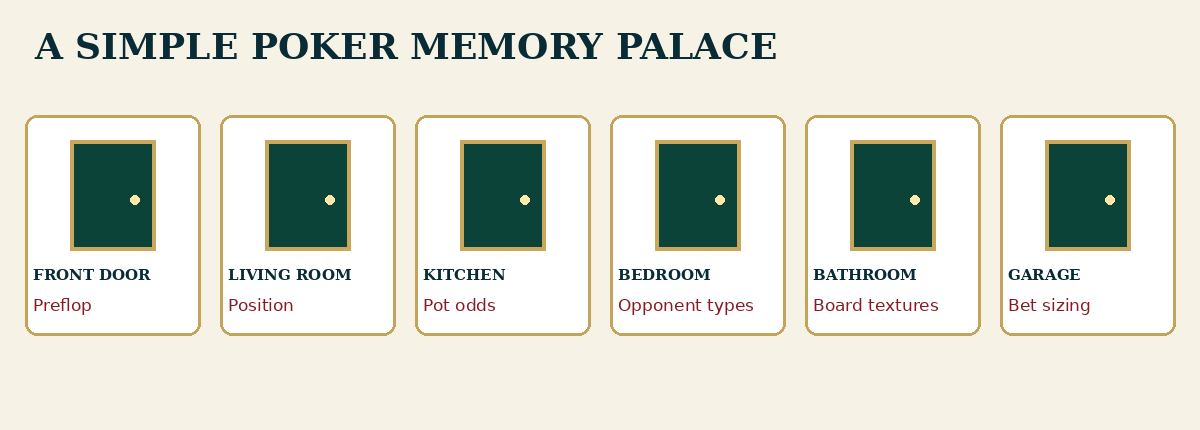
Visual memory aid: a memory palace
Assign a poker topic to a familiar location, then mentally walk through the locations in a consistent order.
Knowing which starting hands to play is not the same as being able to play them automatically. A player can study starting-hand charts, understand the relationship between position and hand selection, and correctly answer questions during practice while still hesitating when the cards are actually dealt. That hesitation reveals the next stage of the memory process. The information has been learned, but it has not yet become automatic.
Automatic poker does not mean playing without thinking. It means removing unnecessary thinking from decisions that have already been learned. When a situation is familiar and the correct response has been practiced repeatedly, there is little benefit in reconstructing the decision from the beginning every time it appears. The purpose of memorizing starting hands is to move those familiar decisions out of the slow part of the mind and into fast recognition.
Consider what happens when you look down at a very strong starting hand. You probably do not need to remind yourself what the cards mean, compare them with dozens of other possibilities, or search your memory for a rule. You recognize the hand immediately. The decision process begins from that recognition. The objective of training is to extend that same familiarity to a much larger portion of your starting-hand system.
The process begins before you look at your cards. Your position should already be known. You should not wait until you see your hand and then begin figuring out where you are sitting. Position was the subject of Chapter 5 because it provides the framework in which starting-hand decisions occur. If position has become automatic, one major part of the decision has already been completed before the cards are examined.
This changes the mental sequence of the hand. Instead of receiving two cards and then trying to solve the entire pre-flop situation at once, you already know your position. The cards arrive inside an existing context. You recognize the hand, connect it with that position, and retrieve the appropriate response.
That sequence is simple enough to describe, but repetition is required before it becomes natural. At first, the player may consciously think, “I am in middle position. I have this hand. What does my starting-hand system say?” There is nothing wrong with that during the learning stage. Conscious retrieval is part of building memory. The problem occurs when the player remains dependent on that deliberate process long after the information should have become familiar.
The goal is eventually to eliminate the internal conversation. You know where you are. You see the hand. The decision feels familiar.
This is similar to learning many other skills. A beginning driver consciously thinks about mirrors, pedals, signals, steering, speed, and traffic. An experienced driver still uses all of those things, but many of the basic actions no longer require deliberate thought. The driver's attention is available for unusual situations because routine actions have become automatic.
Poker benefits from the same kind of learning. If basic starting-hand decisions consume large amounts of mental energy, less attention remains for the parts of the game that actually require judgment. The player may become mentally tired not because poker is impossibly complicated, but because too many routine decisions are still being processed as new problems.
Automatic starting-hand play reduces that burden.
The first step is to distinguish between recognition and analysis. Recognition asks whether you have seen this situation enough times to know what it is. Analysis asks what you should do when the answer is not already known. Many starting-hand decisions should eventually belong primarily to recognition.
Suppose you are dealt a familiar hand from a familiar position and the action before you is straightforward. If you have practiced that situation repeatedly, there is no reason to perform a fresh strategic investigation. The value of the practice was precisely to prevent that unnecessary work.
This is where some players accidentally interfere with their own memory training. They learn a decision, practice it, and then continue debating it every time it appears. Instead of allowing repetition to produce confidence, they reopen the question. A hand they correctly played ten times suddenly becomes the subject of another internal argument.
Constant reconsideration prevents familiarity from doing its job.
Once a routine decision has been learned correctly, repetition should strengthen it. The player sees the situation, retrieves the response, acts, and moves on. If later study reveals that the underlying strategy should change, the memory can be updated. But the possibility of future refinement is not a reason to treat every familiar decision as uncertain.
Automaticity requires trust in learned information.
That trust should be earned through correct practice. Repetition by itself is not enough. Repeating an incorrect decision simply makes the incorrect decision more familiar. This is why reference material remains useful during the early stages of training. The player makes the decision first and then checks the answer when necessary.
The order matters. If you look at the answer before attempting the decision, you are practicing recognition of the answer rather than retrieval from memory. It may feel easier, but the memory is doing less work.
A stronger drill is to hide the answer. Give yourself a position and a starting hand. Make the decision. Then check it. If you were correct, move on. If you were incorrect or uncertain, mark that situation for additional practice.
Over time, a useful pattern appears. Some hands become effortless very quickly. Others continue to create hesitation. The difficult hands deserve more attention because they identify the boundaries of your memory.
These boundary hands are particularly important. Most players do not struggle to remember what to do with the very strongest or very weakest starting hands. The uncertainty usually occurs closer to the dividing line between actions. A hand may be playable from one position but not another. Another may look similar to a hand that belongs in the range but fall just outside it.
Those are the places where automaticity is most valuable because they are the places where hesitation is most likely.
Rather than repeatedly reviewing everything, spend additional time near those boundaries. If a particular group of hands causes uncertainty from early position, practice that group from early position. If another group becomes confusing from late position, practice it there. Training becomes more efficient when it is directed toward the places where memory actually breaks down.
This approach also prevents a common mistake: trying to memorize a starting-hand chart visually without learning to use it. A player may remember approximately where a hand appears on a colored grid yet struggle when the hand is dealt at the table. The chart has become familiar, but the decision has not.
The real memory target is not the square on the chart. It is the poker situation.
You want the appearance of the actual cards, combined with your actual position, to trigger the learned response. Charts are tools for building that connection. They are not the final form of the memory.
This is why card-based practice can be so effective. A physical deck or a digital hand generator forces you to see hands in the form in which poker presents them. Instead of staring at symbols on a grid, you see two cards. You identify the hand, connect it with your position, and make the decision.
Speed can gradually be added to the exercise, but speed should not be the first objective. Accuracy comes first. A fast incorrect response is not automatic poker worth developing. Begin slowly enough to make correct decisions. As the decisions become familiar, the time required naturally decreases.
Eventually, many decisions should require only a moment.
You can measure progress by paying attention to hesitation. A hand that once required several seconds of deliberate recall may eventually produce an immediate response. That reduction in hesitation is evidence that the information is moving toward automatic memory.
The important thing is not to force speed artificially. Trying to answer quickly before the memory is ready can create guessing. Automaticity is not guessing. It is rapid retrieval built through repetition.
There is a major difference between those two experiences. A guess feels uncertain even when it happens to be correct. Automatic recognition feels familiar. You have encountered the situation enough times that the answer arrives before you need to reconstruct the reasoning behind it.
This distinction matters at the table because poker contains enough genuine uncertainty without adding uncertainty to decisions you have already studied. You will face difficult situations later in hands. You will encounter unusual actions, uncomfortable stack sizes, complicated boards, and opponents who do unexpected things. Those situations deserve attention.
A routine starting-hand decision should not consume the same mental resources.
One of the greatest benefits of automatic starting-hand play is therefore not simply speed. It is mental conservation. Every decision that can be handled correctly through trained recognition leaves more attention available for decisions that cannot.
This becomes especially noticeable during long sessions. Deliberate thinking is tiring. If you repeatedly reconstruct your starting-hand system for several hours, mental fatigue can accumulate. As fatigue increases, mistakes become more likely. A player may begin playing hands that should be folded simply because maintaining the decision process becomes exhausting.
Automatic memory provides stability. The familiar decisions remain familiar even when the session becomes long.
That stability is one reason disciplined poker often looks simpler than undisciplined poker. The disciplined player does not need to invent a new reason for every action. Many decisions have already been settled through study and practice. The player simply recognizes the situation and executes the learned response.
There is another benefit. Automatic starting-hand decisions reduce the temptation to justify playing attractive but inappropriate hands. When the starting-hand system is weakly memorized, the player can negotiate with himself. The cards look interesting. The game has been quiet. The player has not entered a pot recently. A reason appears to make an exception.
A strongly memorized system creates a clearer boundary. The hand either belongs in the learned action from that position or it does not. The player does not need to conduct an emotional debate every time a marginal hand appears.
This does not mean poker becomes rigid. Later actions can change the situation, and more advanced strategies may contain adjustments. But the purpose of a basic starting-hand system is to provide a dependable foundation. Automatic memory makes that foundation usable.
One useful exercise is to deal yourself a long sequence of starting hands while changing your imagined position after each hand. Begin in early position, then move around the table. For every hand, make the decision before checking any reference. Keep the pace comfortable but continuous.
Do not spend several minutes studying a mistake when it occurs. Correct it, note it, and continue. Then return to the troublesome hands after the exercise.
This trains something that ordinary reading cannot train: transition. Real poker does not give you twenty consecutive hands from the same position while you study a chart. Your position moves. Your cards change. The action changes. Your memory must retrieve the correct information under changing circumstances.
The drill should eventually reflect that reality.
Another useful exercise is to reverse the process. Instead of asking what to do with a particular hand, choose a position and try to visualize the general shape of the hands you would play from there. You do not need to reproduce a chart perfectly in your imagination. The purpose is to strengthen your sense of the range as a whole.
This gives individual hands a home.
When a new hand appears, you are no longer asking whether you memorized that exact combination in isolation. You are asking whether it belongs within a structure that has already become familiar.
The combination of individual-hand practice and range-level understanding produces stronger memory than either method alone. One teaches precision. The other teaches organization.
Actual play should then reinforce both.
Before the cards arrive, recognize your position. When the cards are dealt, recognize the hand. Retrieve the action. If the situation matches something you have already trained, execute the decision without reopening the entire strategic question.
After the hand, there is no need to remember every routine fold. But if you hesitated, that moment is useful. Hesitation identifies material that may need additional practice.
In this way, your poker sessions begin telling you what to study.
The purpose of training is not to eliminate thought from poker. It is to decide where thought is valuable. You should not spend your limited attention solving problems that memory can handle reliably. The more routine knowledge becomes automatic, the more attention you can devote to situations that genuinely require judgment.
Starting-hand decisions are one of the best places to develop this ability because they occur constantly. Every hand begins with two cards. Every hand begins from a position. Every session therefore provides repeated opportunities to strengthen the same memory connections.
At first, the process may still be conscious: position, hand, decision. With repetition, the gaps between those steps shrink. Eventually, they begin to function almost as one recognition.
You know where you are. You see what you have. You know what to do.
That is when a starting-hand system stops being something you studied and becomes something you can actually play. The information has moved from the page into memory, and from memory into action. The objective is not simply to remember starting hands. The objective is to make the correct starting-hand decision so familiar that your mind is free to concentrate on the poker that comes next.
CONTINUE YOUR STUDY
Want the complete advanced system?
The free book helps you build your memory foundation. Visit the official sales page to review Memorizing Advanced Poker for $49 and continue to checkout from there.