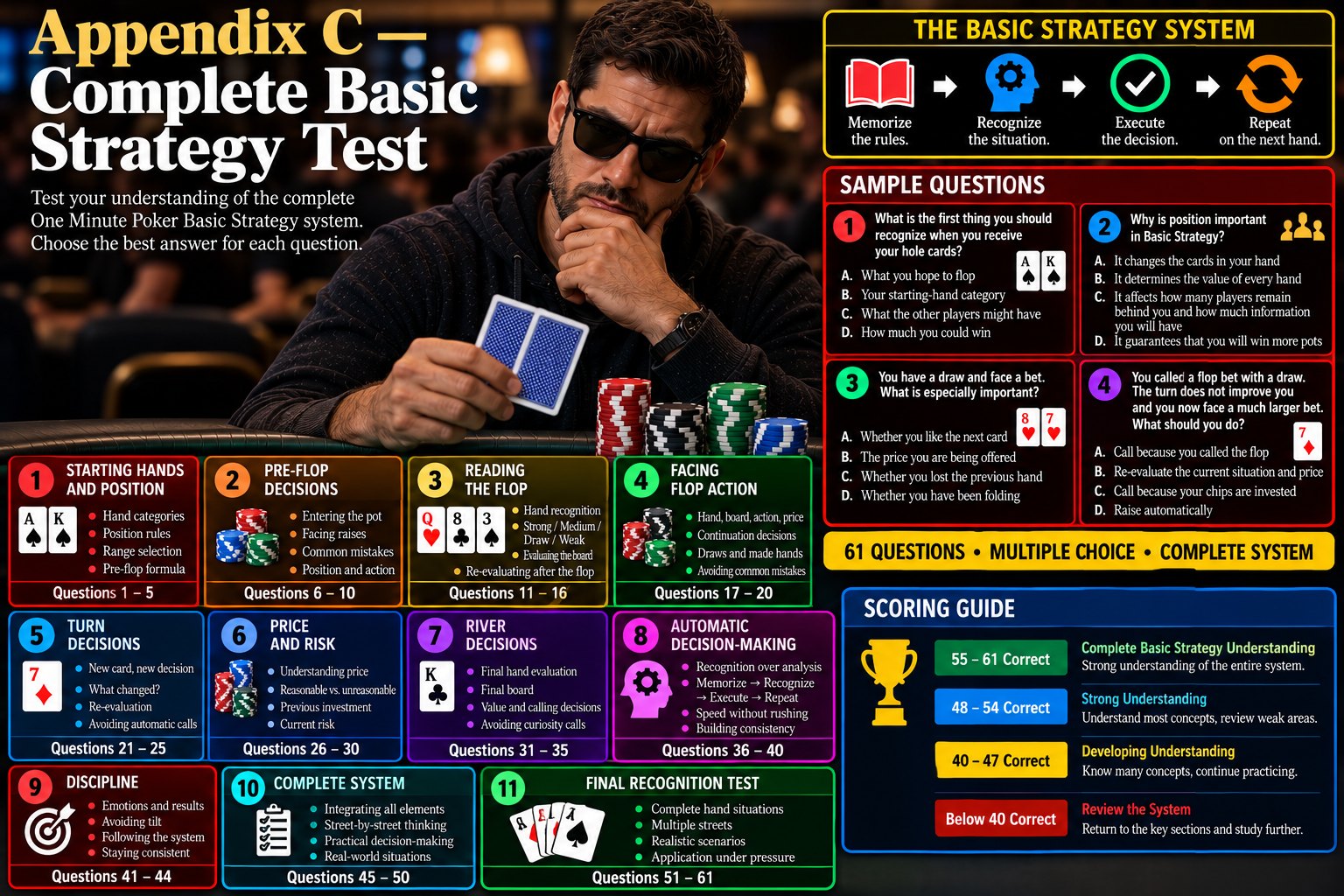
This test is designed to determine whether you understand and can apply the complete One Minute Poker Basic Strategy system. It covers starting hands, position, pre-flop decisions, flop recognition, turn decisions, river decisions, price, risk, discipline, memory, and automatic execution.
Choose the best answer for each question. The purpose is not to test whether you can memorize isolated sentences from the book. The purpose is to determine whether you understand the decision-making system and can recognize the correct action when the situation changes.
Part I — Starting Hands and Position
1. What is the first thing you should recognize when you receive your hole cards?
A. What you hope to flop
B. Your starting-hand category
C. What the other players might have
D. How much you could potentially win
2. Why is position important in Basic Strategy?
A. It changes the cards in your hand
B. It determines the value of every hand equally
C. It affects how many players remain behind you and how much information you will have
D. It guarantees that you will win more pots
3. Which statement best describes early-position play?
A. Play every hand that looks playable
B. Use a tighter starting-hand range
C. Always raise
D. Always limp
4. Why can more hands become playable in later position?
A. The cards become stronger
B. The blinds disappear
C. You have greater positional information and fewer players remaining behind you
D. Later position guarantees a winning hand
5. What is the basic pre-flop formula?
A. Hand strength + emotion = action
B. Position + starting hand + action = pre-flop decision
C. Pot size + previous result = decision
D. Opponent personality + hand = decision
Part II — Pre-Flop Decisions
6. If everyone folds to you before the flop, what are you deciding?
A. Whether to enter the pot
B. Whether you have a made hand
C. Whether the river will help you
D. Whether your opponent is bluffing
7. What changes when another player raises before you?
A. Your hole cards change
B. Your position changes
C. The situation changes and you must respond to the new action
D. You must automatically fold
8. Which is a common Basic Strategy mistake?
A. Recognizing your position
B. Following your starting-hand system
C. Playing a weak hand because you are bored
D. Re-evaluating on the turn
9. Why should you not play a hand simply because you have been folding for several hands?
A. Folding is always better than playing
B. Previous hands do not change the current starting hand
C. You should never play after folding
D. The dealer controls the next hand
10. If your starting hand does not qualify for your position and situation, what should you generally do?
A. Play it because you are curious
B. Play it because you already paid the blind
C. Fold it
D. Raise it automatically
Part III — Reading the Flop
11. What happens to your decision when the flop arrives?
A. Your pre-flop decision continues automatically
B. The hand becomes a new decision situation
C. You must always bet
D. You must always check
12. What should you recognize first on the flop?
A. What your starting hand has become
B. What you hope the turn will be
C. What your opponent is thinking
D. Whether you can win the entire pot
13. Which four basic categories are used for quick post-flop recognition?
A. Premium, bluff, trap, steal
B. Strong hand, medium hand, draw, weak hand
C. Raise, call, fold, check
D. Early, middle, late, blind
14. What is the most important distinction between a draw and a made hand?
A. A draw is always worthless
B. A draw has potential but is not yet a completed hand
C. A made hand can never lose
D. A draw should always be raised
15. You held a strong starting hand but completely missed the flop. What should you do?
A. Automatically continue because the starting hand was strong
B. Recognize what you actually have now
C. Automatically go all-in
D. Assume the opponent missed too
16. You flop a strong made hand. What should you recognize?
A. The hand has significant value and may support appropriate aggression
B. You must always slow-play it
C. You must always check
D. You can no longer lose
Part IV — Facing Flop Action
17. When facing a flop bet, what should you consider?
A. Only your original starting hand
B. Your current hand, the board, the action, and the price
C. Only how much you already invested
D. Only the personality of the bettor
18. Why is continuing simply because you entered the pot a mistake?
A. Every hand should be folded after the flop
B. The flop creates a new situation that must be evaluated
C. Pre-flop decisions never matter
D. The pot no longer exists
19. If you have a draw and face a bet, what is especially important?
A. Whether you like the next card
B. The price you are being offered
C. Whether you lost the previous hand
D. Whether you have been folding too much
20. Which statement best describes Basic Strategy post-flop?
A. Always be aggressive
B. Always be passive
C. Recognize your hand and situation, then choose the action that fits
D. Try to predict exactly what the opponent holds
Part V — Turn Decisions
21. Why must you re-evaluate on the turn?
A. The flop decision automatically expires
B. A new card has changed the situation
C. You must always bet the turn
D. The turn determines who wins automatically
22. What is the key question when the turn card arrives?
A. What did I want the turn to be?
B. What changed?
C. How can I recover my previous losses?
D. What would look aggressive?
23. Which situation can cause a previously reasonable decision to change on the turn?
A. A new card changes the board
B. You become bored
C. You remember the previous hand
D. You dislike your opponent
24. You called a flop bet with a draw. The turn does not improve you, and you now face a much larger bet. What should you do?
A. Automatically call because you called the flop
B. Re-evaluate the current situation and price
C. Call because your previous chips are already invested
D. Raise automatically
25. What is the mistake in automatically continuing on the turn because you continued on the flop?
A. There is no mistake
B. The turn is a new decision
C. Flop decisions are never important
D. You should always fold the turn
Part VI — Price and Risk
26. Why does price matter?
A. Because every continuation decision requires a commitment of chips
B. Because large pots are always better
C. Because a draw always wins at the right price
D. Because price determines your position
27. What should you ask when considering a call?
A. "How much have I already put in?"
B. "Is my hand good enough for the price I am being asked to pay?"
C. "Can I win the entire pot?"
D. "Do I want to see another card?"
28. Why should previous investment not control your current decision?
A. Previous chips are already committed and cannot be recovered by calling
B. Previous investment changes your cards
C. Previous investment guarantees a better price
D. Previous investment makes every call correct
29. Which statement best describes risk?
A. Risk is irrelevant when you have already invested chips
B. Risk concerns the additional chips you are being asked to commit now
C. Risk only matters on the river
D. Risk only matters when you have a draw
30. A draw costs very little to continue with on the flop but faces a very large bet on the turn. What changed?
A. Your position
B. The price and risk of continuing
C. Your starting cards
D. The rules of poker
Part VII — River Decisions
31. What makes the river different from the earlier streets?
A. There is no future card
B. You must always bet
C. You can never fold
D. Draws always win
32. What should you recognize on the river?
A. The hand you hoped to make
B. Your final hand and the final board
C. What you would have had if the river were different
D. Only the opponent's personality
33. You missed your draw on the river. What should you do?
A. Treat the draw as though it completed
B. Evaluate the hand you actually have
C. Automatically bluff
D. Automatically call
34. You have a strong final hand and face an action that allows you to gain additional value. What should you consider?
A. Appropriate value and the situation
B. Folding because strong hands are dangerous
C. Calling every time
D. Ignoring the board
35. Why is calling a river bet simply because you want to see the opponent's hand a mistake?
A. You are making the decision based on curiosity rather than the hand, situation, and price
B. River calls are never allowed
C. You cannot see an opponent's cards
D. The river does not matter
Part VIII — Automatic Decision-Making
36. What does "automatic" mean in One Minute Poker?
A. Playing without thinking
B. Making random decisions quickly
C. Recognizing familiar situations and responding without unnecessary analysis
D. Never changing your decision
37. What is the purpose of memorizing the starting-hand system?
A. To impress other players
B. To make recognition faster and reduce hesitation
C. To avoid learning post-flop poker
D. To guarantee a winning session
38. What is the correct progression for developing automatic Basic Strategy?
A. Analyze → Guess → React → Repeat
B. Memorize → Recognize → Execute → Repeat
C. Bluff → Raise → Call → Fold
D. Win → Lose → Change → Repeat
39. What is the difference between being automatic and being rushed?
A. There is no difference
B. Automatic means recognizing quickly; rushed means acting before recognizing the situation
C. Rushed decisions are always correct
D. Automatic decisions require no knowledge
40. What should you do when you make a mistake during practice?
A. Change the entire system immediately
B. Identify the mistake, correct it, practice it, and move on
C. Stop playing poker
D. Assume the result caused the mistake
Part IX — Discipline
41. You lose a large pot and immediately receive a marginal starting hand. What should determine your decision?
A. The desire to win the money back
B. The previous loss
C. The current hand, position, and action
D. Anger
42. You have won several large pots and receive a hand outside your normal range. What should you do?
A. Play it because you are winning
B. Follow the starting-hand system
C. Raise because you are confident
D. Play because the table owes you action
43. Why should you not change the system after one bad result?
A. Because poker has no variance
B. Because one result does not determine whether the decision was correct
C. Because losses are always good
D. Because you should never learn from mistakes
44. Which statement best describes discipline in Basic Strategy?
A. Follow the system even when emotion encourages you to do something else
B. Always play aggressively
C. Never fold
D. Never change your action
Part X — Complete System
45. You receive your starting hand. What should happen first?
A. Think about the river
B. Recognize the hand and position
C. Watch the opponent's reaction
D. Decide whether you are going to bluff
46. You recognize that your starting hand qualifies for your position, but another player raises before you. What should you do?
A. Automatically make the same decision you would have made if everyone folded
B. Recognize that the action has changed and respond to the new situation
C. Automatically fold every time
D. Automatically raise
47. You reach the flop with a playable starting hand and completely miss. What is the correct approach?
A. Stay attached to the starting hand
B. Recognize the hand you have now
C. Assume the opponent also missed
D. Automatically call
48. The turn creates a dangerous board and changes the strength of your hand. What should you do?
A. Ignore the change because of your flop decision
B. Re-evaluate the new situation
C. Continue automatically
D. Think only about the previous pot size
49. You reach the river with a medium-strength hand and face a significant bet. What should you consider?
A. Your final hand, the final board, the action, price, and risk
B. Only what you invested earlier
C. Only whether you are curious
D. Only whether you want to win the pot
50. What is the central objective of the One Minute Poker Basic Strategy system?
A. To predict every opponent perfectly
B. To make every poker decision mathematically complicated
C. To recognize situations quickly and make appropriate decisions consistently
D. To win every hand
Part XI — Final Recognition Test
For each situation below, select the response that best represents Basic Strategy.
51. You are in early position with a starting hand outside your normal range.
A. Play because you might flop something
B. Fold
C. Raise because nobody expects it
D. Call because you have been folding
52. You are in late position with a qualifying starting hand and everyone folds to you.
A. Recognize the hand, position, and action and make the appropriate opening decision
B. Fold automatically
C. Wait for the river
D. Call regardless of the hand
53. You have a strong starting hand, but the flop gives you a weak hand with no meaningful draw.
A. Automatically continue because the starting hand was strong
B. Recognize your current hand and make the appropriate flop decision
C. Automatically go all-in
D. Assume the opponent has a worse hand
54. You have a draw and face a small bet that offers a reasonable price.
A. Automatically fold every draw
B. Consider the draw, the price, and the current situation
C. Automatically raise
D. Call because every draw must be played
55. You have the same draw on the turn but now face a much larger bet.
A. Automatically call because you called the flop
B. Re-evaluate the current price and risk
C. Ignore the bet
D. Call because your previous chips are already invested
56. Your draw misses on the river.
A. Treat the draw as a completed hand
B. Recognize your final hand and make the appropriate river decision
C. Automatically call
D. Automatically bluff
57. You lose a hand after making what you believe was the correct decision.
A. Immediately change the system
B. Recognize that a correct decision can still produce a losing result
C. Decide the system does not work
D. Play recklessly to recover the loss
58. You win a large pot and then receive a marginal hand.
A. Play because you are ahead
B. Follow the same Basic Strategy process
C. Raise because you are confident
D. Play because you are due another win
59. You find yourself spending several minutes analyzing a simple decision that the system already makes clear.
A. Continue analyzing until you are completely certain
B. Recognize the situation, apply the system, and act
C. Change the system
D. Ask what the previous hand would have done
60. What should happen after you make a Basic Strategy decision?
A. Continue thinking about the decision throughout the next hand
B. Move on and recognize the next situation
C. Try to predict whether you would have won
D. Change the decision if the result was unfavorable
Final Question
61. Which statement best summarizes the entire One Minute Poker Basic Strategy system?
A. Find ways to outthink every opponent.
B. Play aggressively whenever possible.
C. Memorize the system, recognize the situation, execute the appropriate decision, and repeat.
D. Calculate every possible outcome before acting.
Answer Key
1. B
2. C
3. B
4. C
5. B
6. A
7. C
8. C
9. B
10. C
11. B
12. A
13. B
14. B
15. B
16. A
17. B
18. B
19. B
20. C
21. B
22. B
23. A
24. B
25. B
26. A
27. B
28. A
29. B
30. B
31. A
32. B
33. B
34. A
35. A
36. C
37. B
38. B
39. B
40. B
41. C
42. B
43. B
44. A
45. B
46. B
47. B
48. B
49. A
50. C
51. B
52. A
53. B
54. B
55. B
56. B
57. B
58. B
59. B
60. B
61. C
Scoring
55–61 Correct — Complete Basic Strategy Understanding
You have demonstrated a strong understanding of the complete One Minute Poker Basic Strategy system. You understand the relationship between starting hands, position, action, post-flop recognition, price, risk, discipline, and automatic decision-making. Your next objective is consistent execution.
48–54 Correct — Strong Understanding
You understand most of the system but have a few areas that require additional practice. Review the questions you missed and return to the corresponding sections of the book. Focus on recognition rather than memorizing isolated answers.
40–47 Correct — Developing Understanding
You understand many of the basic concepts but should continue practicing before considering the system automatic. Pay particular attention to position, post-flop recognition, turn re-evaluation, and price and risk.
Below 40 Correct — Review the System
Return to the major sections of the book and review the system before taking the test again. Concentrate on understanding the decision process rather than trying to memorize the answer key.
The Final Standard
Passing the test is not the final objective.
The real objective is to reach the point where you can sit at a poker table and recognize the situations without having to consciously reconstruct the entire system.
You should be able to recognize your starting hand.
You should recognize your position.
You should recognize the action.
You should recognize what the flop created.
You should recognize what changed on the turn.
You should recognize your final hand on the river.
You should recognize the price and risk.
Then you should make the appropriate decision.
Memorize → Recognize → Execute → Repeat.
That is the complete One Minute Poker Basic Strategy system.
About the Author
Jack Powers is the author of the One Minute Poker series, focused on practical poker decision-making, strategy, memory, and disciplined play.
The One Minute Poker System
One Minute Poker is built around a simple process:
Memorize → Recognize → Execute → Repeat
The objective is to turn fundamental poker decisions into automatic recognition and consistent execution.
Keep Practicing
Reading the system is only the beginning. The advantage comes from repetition. Review the basic rules, practice the drills, test your recognition, and apply the system at the table.
Learn it. Practice it. Make it automatic.