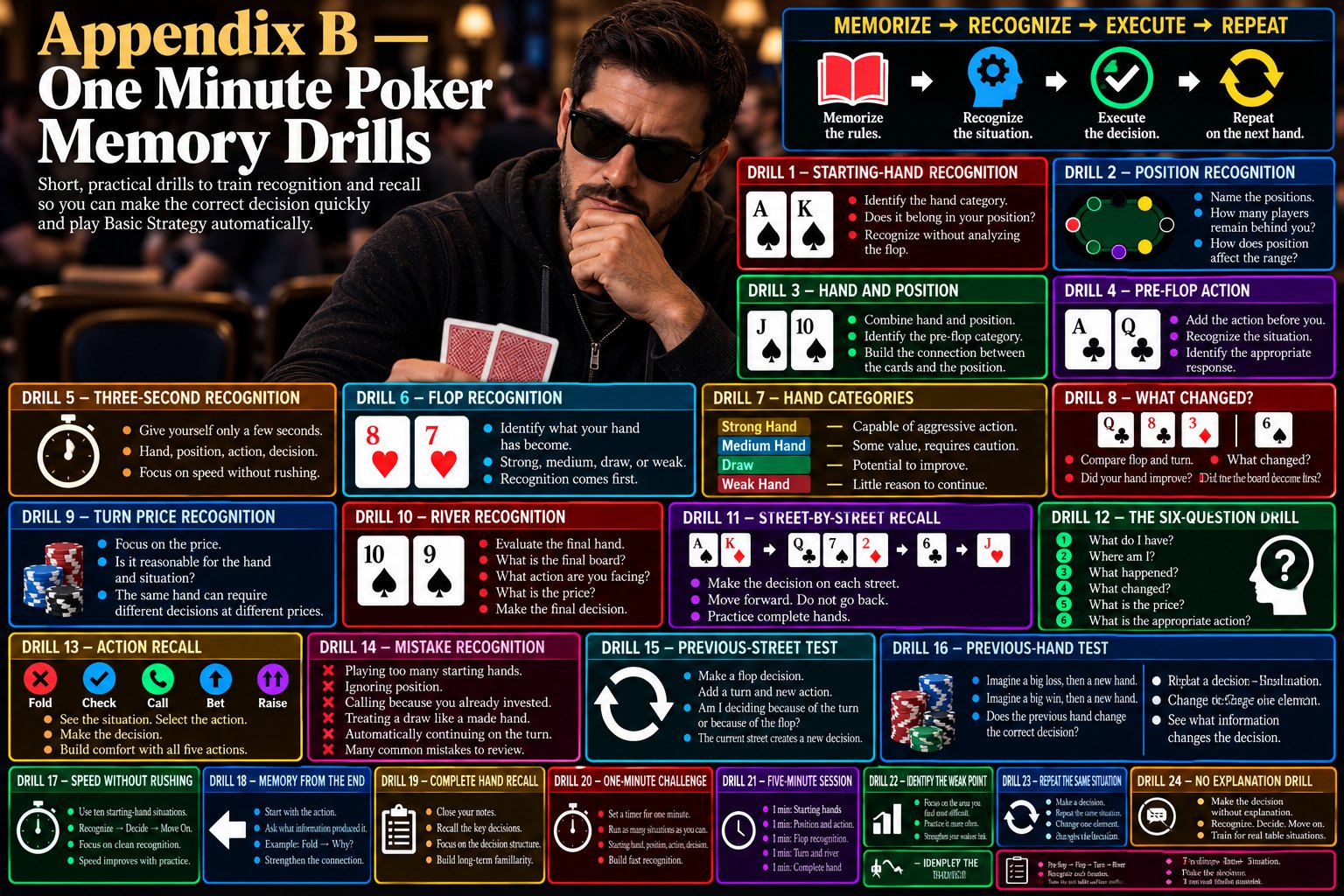
The purpose of memory training is not to memorize poker for the sake of memorization. The purpose is to make Basic Strategy available quickly when you need it. The more familiar the system becomes, the less time you spend searching for the answer and the more naturally you recognize the correct decision.
The One Minute Poker memory system follows the same pattern as the entire Basic Strategy system:
Memorize → Recognize → Execute → Repeat.
These drills are designed to be short. You do not need to spend an hour studying them. A few focused minutes of repetition can be enough to strengthen a particular part of the system. The objective is consistency.
Drill 1 — Starting-Hand Recognition
Look at a starting hand and identify its category immediately.
Do not begin analyzing the possible flop.
Do not imagine what might happen later.
Simply recognize the hand.
Ask yourself:
What is the hand?
What category does it belong to?
Does it belong in my position?
The goal is to reach the point where you can see the cards and recognize the appropriate starting-hand category without having to reconstruct the system.
Repeat the exercise with different hands until recognition becomes quick.
Drill 2 — Position Recognition
Practice identifying positions without looking at a starting-hand chart.
Name the positions around a nine-handed table.
Early Position → Middle Position → Late Position → Blinds
Then practice placing yourself into each position mentally.
Ask:
Where am I?
How many players remain behind me?
How does my position affect the starting-hand range?
The objective is to make position recognition automatic before you even begin evaluating the hand.
Drill 3 — Hand and Position
Now combine the first two drills.
Give yourself a starting hand and a position.
For example:
A♠ K♦ — Early Position
J♠ 10♠ — Late Position
7♣ 7♦ — Middle Position
Do not spend a long time analyzing the examples. Recognize the hand, recognize the position, and identify the appropriate pre-flop category.
The goal is to build the connection between the cards and the position.
Drill 4 — Pre-Flop Action
Add the action.
Give yourself a starting hand, a position, and an action before you.
For example:
A♠ K♦ — Middle Position — Everyone folds to you
J♠ J♦ — Early Position — Everyone folds to you
A♣ Q♣ — Late Position — Player raises before you
8♠ 8♦ — Middle Position — Player raises before you
Now ask:
What do I have?
Where am I?
What happened before me?
Then identify the appropriate response.
The purpose of this drill is to make the pre-flop decision process automatic.
Drill 5 — Three-Second Recognition
Take any starting hand and give yourself only a few seconds to identify the basic situation.
Look at the hand.
Recognize it.
Recognize the position.
Recognize the action.
Make the decision.
Do not worry about being perfect at first.
The objective is to train your brain to recognize familiar information quickly.
As your accuracy improves, the speed will naturally improve with it.
Drill 6 — Flop Recognition
Now move to the flop.
Give yourself a starting hand and a three-card flop.
Your first job is not to decide whether to bet or call.
Your first job is simply to recognize what your hand has become.
Ask:
Do I have a strong made hand?
Do I have a medium hand?
Do I have a draw?
Do I have a weak hand?
This is one of the most important memory drills in the system because post-flop decisions begin with recognition.
Drill 7 — Strong Hand, Medium Hand, Draw, Weak Hand
Practice identifying the four basic post-flop categories.
Use different combinations of hole cards and flops.
Your task is simply to identify the category.
Strong Hand
Medium Hand
Draw
Weak Hand
Do not turn the exercise into a long strategy discussion.
Recognition comes first.
Once recognition becomes automatic, the appropriate decision becomes easier to execute.
Drill 8 — What Changed?
Practice the turn by comparing the flop and turn.
Start with a flop.
Then add one turn card.
Ask:
What changed?
Did your hand improve?
Did a draw complete?
Did the board become more dangerous?
Did the relative strength of your hand change?
Did the price or action change?
The purpose of this drill is to train yourself not to carry the flop decision automatically onto the turn.
The turn is a new decision.
Drill 9 — Turn Price Recognition
Give yourself a hand, a board, and a turn bet.
Then focus specifically on the price.
Ask:
What am I being asked to risk?
Is the price reasonable for the hand and situation?
Do not try to calculate every possible outcome.
The purpose of the exercise is to develop practical recognition of reasonable and unreasonable prices.
Repeat the drill with different bet sizes.
The same hand can require a different decision when the price changes.
Drill 10 — River Recognition
Give yourself a complete hand through the river.
Now remove all thoughts about what you hoped would happen.
Look only at the final situation.
Ask:
What is my final hand?
What is the final board?
What action am I facing?
What is the price?
Then make the final decision.
This drill teaches you to evaluate the hand you actually have rather than the hand you wanted to make.
Drill 11 — Street-by-Street Recall
Take a complete hand and walk through it one street at a time.
Start with the pre-flop decision.
Then reveal the flop.
Make the flop decision.
Then reveal the turn.
Re-evaluate.
Then reveal the river.
Make the final decision.
Do not go backward after every street.
The purpose is to practice moving forward as the situation changes.
Drill 12 — The Six-Question Drill
This is one of the fastest drills in the entire system.
Give yourself any poker situation and ask:
1. What do I have?
2. Where am I?
3. What happened?
4. What changed?
5. What is the price?
6. What is the appropriate action?
You will not always need every question on every street.
The purpose is to train your mind to immediately search for the information that matters.
Drill 13 — Action Recall
Practice the five basic actions:
Fold
Check
Call
Bet
Raise
Look at a situation and identify which action fits.
The purpose is not to memorize the words.
The purpose is to become comfortable moving from recognition to action.
You recognize the situation.
You select the action.
You execute.
Drill 14 — Mistake Recognition
Take a common mistake and identify why it violates Basic Strategy.
For example:
Playing too many starting hands.
Ignoring position.
Calling because you already invested chips.
Treating a draw like a made hand.
Automatically continuing on the turn.
Calling the river simply because you want to see the opponent's hand.
For each mistake, state the correct principle.
This creates a mental connection between the mistake and the rule that prevents it.
Drill 15 — The Previous-Street Test
Give yourself a flop decision.
Make the decision.
Then add a turn card and new action.
Now ask:
Am I making this decision because of the turn, or because of what I decided on the flop?
This is an important distinction.
The previous decision does not control the current decision.
The current situation does.
Repeat the drill until you naturally re-evaluate instead of automatically continuing.
Drill 16 — The Previous-Hand Test
Imagine that you just lost a large pot.
Now deal yourself a completely new hand.
Ask:
Does the previous hand change the correct decision on this hand?
The answer is no.
Now imagine that you just won a large pot.
Deal another hand.
Ask the same question.
Again, the previous result does not change the correct Basic Strategy decision.
This drill trains emotional separation between hands.
Drill 17 — Speed Without Rushing
Take ten starting-hand situations.
Give yourself enough time to recognize each one, but do not deliberately slow yourself down.
For each situation:
Recognize → Decide → Move On.
If you get one wrong, identify the mistake and continue.
The goal is not maximum speed.
The goal is clean recognition without unnecessary hesitation.
Drill 18 — Memory From the End
Sometimes practice the system backward.
Start with:
Action
Then ask what information produced that action.
For example:
Fold → Why?
Price too high → Why?
What hand did I have?
What position was I in?
What action was I facing?
This helps strengthen the connection between the final decision and the information that produced it.
Drill 19 — Complete Hand Recall
After completing a practice hand, close your notes and try to recall the important decisions.
What was the starting hand?
What was the position?
What happened pre-flop?
What did the flop create?
What changed on the turn?
What was the river situation?
What was the final action?
You do not need to remember every detail.
Remember the decision structure.
This is what you want available automatically when you play.
Drill 20 — The One-Minute Challenge
Set aside one minute.
During that minute, run as many simple recognition situations as you can.
Starting hand.
Position.
Action.
Decision.
Next situation.
Starting hand.
Position.
Action.
Decision.
Continue.
Do not stop to write long explanations.
The purpose is to train fast recognition and execution.
When the minute ends, stop.
The exercise is complete.
Drill 21 — The Five-Minute Practice Session
For a longer session, divide five minutes into five one-minute sections.
Minute One: Starting-hand recognition.
Minute Two: Position and pre-flop action.
Minute Three: Flop recognition.
Minute Four: Turn and river recognition.
Minute Five: Complete hand walkthrough.
This gives you a compact practice session covering the entire system.
Drill 22 — Identify the Weak Point
Not everyone needs to practice the same part of Basic Strategy equally.
If starting hands are automatic but turn decisions are slow, spend more time on turn recognition.
If position is automatic but flop decisions are difficult, practice flop categories.
If your decisions are good but you frequently continue because you have already invested chips, practice price and risk.
The goal is not to practice everything equally.
The goal is to strengthen the part of the system that is not yet automatic.
Drill 23 — Repeat the Same Situation
When you make a mistake, do not immediately move to a completely different situation.
Repeat the same situation.
Make the decision again.
Then change one element.
Change the position.
Change the bet size.
Change the turn card.
Change the river card.
This allows you to see exactly what information changes the decision.
It also strengthens recognition.
Drill 24 — No Explanation Drill
Give yourself a poker situation and make the decision without explaining it out loud.
Recognize.
Decide.
Move on.
This may seem simple, but it is useful because the ultimate goal of Basic Strategy is not to produce long explanations at the table.
The goal is to make the correct decision.
The explanation is useful during study.
Recognition and execution are what matter during play.
Drill 25 — The Complete Automatic Drill
Now combine everything.
Start with a starting hand.
Recognize the position.
Recognize the pre-flop action.
Make the decision.
Reveal the flop.
Recognize your hand.
Recognize the board and action.
Make the decision.
Reveal the turn.
Recognize what changed.
Consider the price and risk.
Make the decision.
Reveal the river.
Recognize your final hand.
Recognize the final board and action.
Consider the price and risk.
Make the final decision.
Then end the hand.
Do not continue analyzing after the decision is complete.
Start another hand.
This is the complete One Minute Poker memory drill.
How to Use the Drills
You do not need to complete every drill every day.
Choose the drills that address the part of Basic Strategy you are currently trying to strengthen. Practice for a few minutes, then return to the game or come back later.
As the system becomes familiar, reduce the amount of conscious effort you put into each exercise.
At first, you may have to think through every step.
Later, you will recognize the situation immediately.
That is progress.
The Goal of Memory Training
The purpose of these drills is not to create a player who can recite an entire poker book from memory.
The purpose is to create a player who can recognize the important information quickly enough to make a clear decision.
You should eventually be able to look at a starting hand and recognize it.
Look at your position and understand its significance.
Look at the action and recognize the situation.
Look at the flop and recognize what your hand has become.
Look at the turn and recognize what changed.
Look at the river and recognize the final situation.
Then act.
That is what trained poker memory looks like.
The Final Memory Drill
If you remember only one drill from this appendix, remember this one:
What do I have?
Where am I?
What happened?
What changed?
What is the price?
What is the appropriate action?
Then stop.
You have made the decision.
Move on.
The next hand begins with the same process.
Memorize → Recognize → Execute → Repeat.
That is how Basic Strategy becomes automatic.