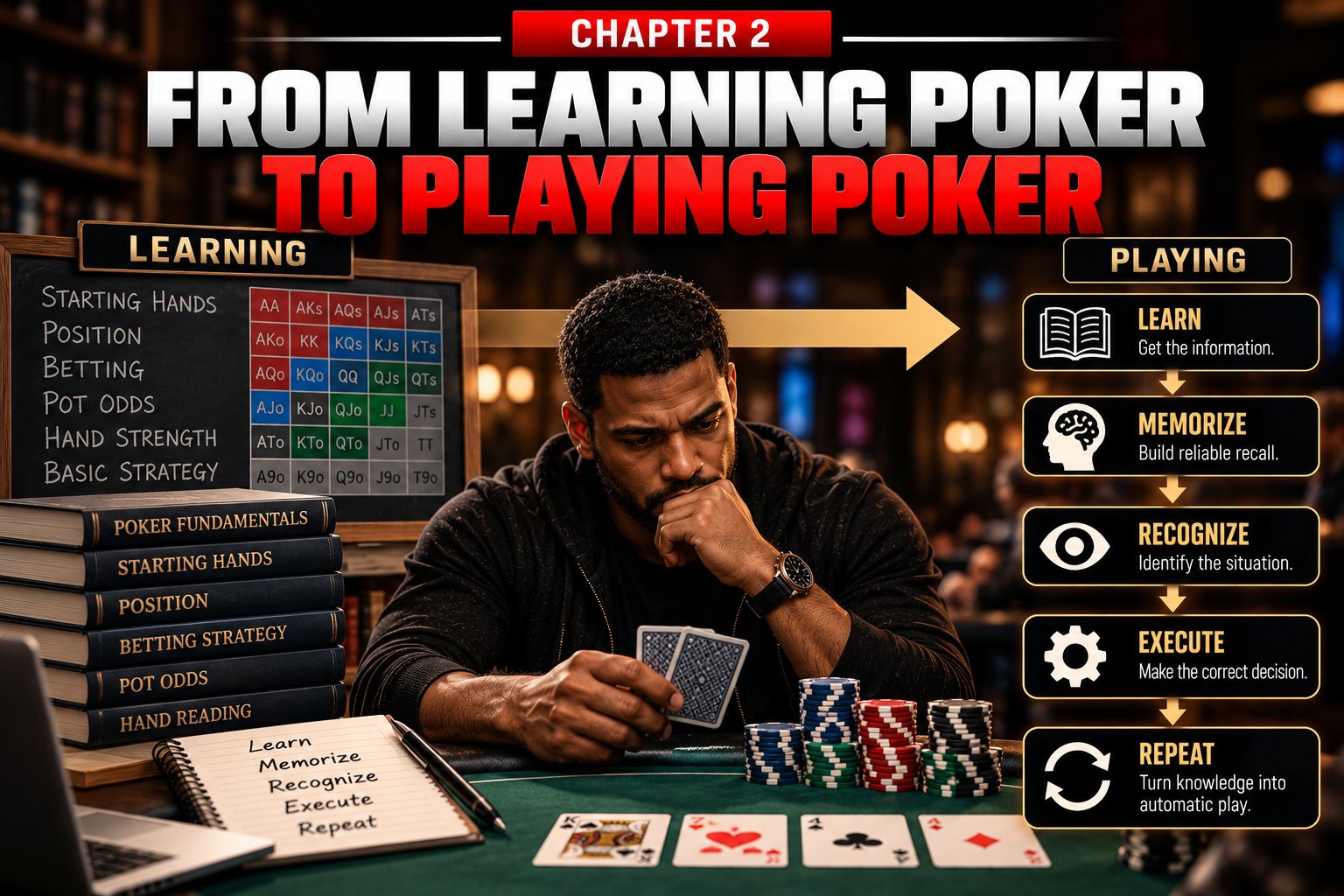
Learning poker and playing poker are two different things. You can read about starting hands, position, betting, pot odds, and hand strength and still struggle to make good decisions at the table. Information is only the beginning. The real goal is to turn that information into decisions you can recognize and execute.
When you are learning poker, you are consciously absorbing new information. You study a rule, learn a concept, look at examples, and try to understand why the concept works. At this stage, thinking through the process is necessary because the information is still new. But poker cannot remain in that stage forever. If you have to stop and consciously reconstruct every basic decision while playing, the game becomes unnecessarily difficult. The purpose of practice is to move information from conscious knowledge toward automatic recognition.
The process is simple: Learn → Memorize → Recognize → Execute → Repeat. Learning gives you the information. Memorizing gives you reliable recall. Recognition allows you to identify the situation when it appears. Execution turns recognition into action. Repetition strengthens the entire process.
A player may know that position matters without actually using position correctly. A player may know that certain starting hands should be folded without being able to recognize those hands quickly. A player may understand that calling too often is a mistake and still continue making unnecessary calls. This happens because knowing a rule and applying a rule are different skills.
Basic Strategy is designed to close that gap. Instead of simply giving you information, the system gives you information that can be practiced until it becomes usable at the table. The objective is not to make you think about poker constantly. The objective is to make the fundamental decisions easier to recognize.
Memorization is an important part of learning poker because some decisions should not require extensive analysis. Starting hands, position-based ranges, basic actions, and common situations can be learned well enough that they become familiar. The first time you study a starting-hand group, you may have to stop and think about where each hand belongs. After repeated practice, the same hands become easier to identify.
That change is important. You are moving from asking, “What am I supposed to do here?” to recognizing, “I know this situation.” Recognition is faster than reconstruction.
Once a situation becomes familiar, the next step is execution. You see the situation and apply the rule. If your starting hand does not belong in your normal range, you fold. If the hand belongs in your opening range for your position, you know that you can enter the pot. If you are facing a raise, you recognize the situation and apply the appropriate response.
The same process continues after the flop, turn, and river. The goal is not to eliminate judgment. The goal is to make the fundamental parts of that judgment familiar enough that they do not require excessive mental effort.
Reading a poker rule once does not make it part of your game. You need repetition. Practice the same decisions repeatedly. Review starting hands. Practice position. Test yourself on pre-flop actions. Recognize flop situations. Work through turn and river decisions. Repeat the process until the information becomes easier to recall.
Every repetition strengthens the connection between the situation and the decision. Eventually, you should spend less time remembering the rule and more time recognizing the situation. That is when learning begins to become playing.
The purpose of this system is not to make the player think more at the table. It is to help the player think less about decisions that should already be familiar. That does not mean playing on autopilot. It means removing unnecessary mental work.
A player who has memorized the basic strategy does not need to reconsider every fundamental rule every time a hand begins. The information is already available. The player recognizes the situation and uses the appropriate part of the system. This leaves more attention available for the situations that actually require thought.
The transition from learning poker to playing poker happens through practice. Study gives you the foundation. Memorization makes the information accessible. Repetition builds recognition. Recognition makes execution easier. Execution creates experience, and experience provides another opportunity to practice.
The process continues every time you play. The goal is not perfection on the first attempt. The goal is steady movement from conscious learning toward automatic execution.
You begin by learning the strategy. You continue by memorizing it. You practice until you recognize it. Then you execute it without unnecessary hesitation.
That is how knowledge becomes play.
And that is how One Minute Poker turns basic strategy from something you have studied into something you can actually use.