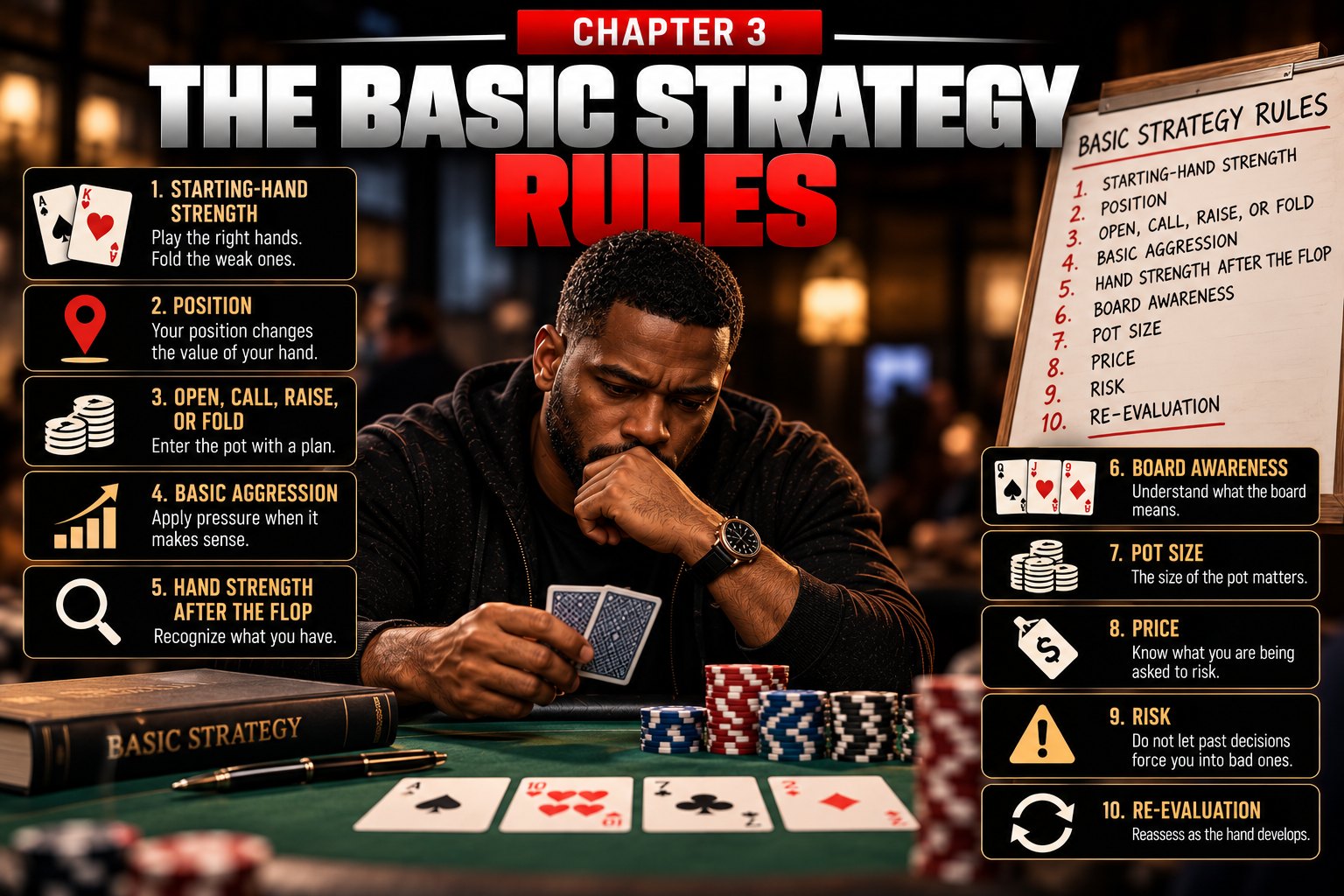
Basic Strategy begins with a small number of fundamental rules that guide the decisions made throughout a poker hand. These rules are not meant to cover every possible situation or turn every decision into a complicated analysis. Their purpose is to give you a reliable framework for deciding when to play, when to continue, when to apply pressure, and when to get out.
The first rule is to pay attention to starting-hand strength. Not every hand deserves to be played. Strong starting hands give you better opportunities to win, while weak hands often create difficult situations later. Basic Strategy begins by learning which hands belong in your normal ranges and which hands should normally be folded. The objective is not to memorize a random collection of hands. It is to develop instant recognition of hand strength.
The second rule is position. The value of a starting hand changes depending on where you are seated and what action has already occurred. A hand that can be played from a later position may not be appropriate from an earlier position. Position also affects how you approach post-flop decisions because acting later gives you more information about what other players have done. Basic Strategy therefore considers both the strength of your hand and the position from which you are playing it.
The third rule is to have a clear plan for opening, calling, raising, and folding. Entering a pot should be a decision, not a habit. When you choose to play a hand, you should know why the hand belongs in your range and what action is appropriate. Calling should not become the default simply because you are uncertain. Raising should have a purpose, and folding should be treated as a normal and necessary part of winning poker.
The fourth rule is to understand basic aggression. Strong poker does not mean waiting for premium hands and calling whenever someone else bets. When you have a hand or situation that benefits from betting or raising, Basic Strategy gives you reasons to apply pressure. At the same time, aggression should not become automatic. Betting simply because you believe you are supposed to be aggressive can create as many problems as playing too passively.
The fifth rule is to recognize hand strength after the flop. Your starting hand is only the beginning of the hand. The flop can improve you, leave you with a marginal hand, give you a drawing hand, or create a board that changes the value of what you hold. You must recognize whether you have a strong made hand, a medium-strength hand, a weak hand, or a draw and adjust your decision accordingly.
The sixth rule is board awareness. You are not playing your cards in isolation. The cards on the board determine what hands are possible and how dangerous the situation may be. A dry board and a coordinated board can require very different decisions. A paired board, a board containing several cards of the same suit, or a board with connected cards can change the risks you face. Basic Strategy requires you to recognize these basic board conditions without turning every hand into an advanced analysis.
The seventh rule is to pay attention to pot size. The size of the pot matters because it affects the amount you are risking and the decisions that follow. A small pot and a large pot do not necessarily call for the same approach. As the pot grows, the consequences of continuing with a weak or marginal hand become more important.
The eighth rule is to understand price. Whenever you are considering a call, you should know what you are being asked to risk compared with what you can potentially win. Basic Strategy does not require complicated mathematical calculations for every decision. It requires enough understanding to recognize when the price is reasonable, when it is marginal, and when you are paying too much to continue.
The ninth rule is to respect risk. Having chips already invested in a pot does not mean you are required to invest more. Every new decision is a new decision. If the situation has become unfavorable, folding can be the correct action even when you have already invested money earlier in the hand. Good Basic Strategy prevents previous decisions from forcing you into bad future decisions.
The tenth rule is re-evaluation. Poker changes as the hand develops. A hand that was worth playing before the flop may become a hand that should be folded on the flop. A strong flop hand may become weaker when the turn changes the board. A reasonable turn decision may require another evaluation on the river. You should not simply continue because you started the hand with a good hand or because you made a previous bet.
These rules work together. Starting-hand strength tells you whether the hand deserves consideration. Position changes how that hand should be played. The pre-flop action determines whether you enter, call, raise, or fold. The flop gives you new information. Hand strength and board conditions help determine what you should do next. Pot size, price, and risk help determine whether continuing is justified. Re-evaluation keeps you from becoming committed to a decision that is no longer correct.
The purpose of Basic Strategy is to make this process familiar. You should not have to rediscover these rules during every hand. You learn them, practice them, and gradually develop the ability to recognize the situations in which they apply.
The basic decision process can be reduced to a simple sequence:
Starting Hand → Position → Action → Hand Strength → Board → Pot → Price → Risk → Re-evaluate
This is not a rigid checklist that must be recited before every decision. It is the structure behind the system. With practice, the individual pieces begin to connect, allowing you to recognize the situation and respond without unnecessary hesitation.
Basic Strategy is therefore not one rule. It is a collection of connected rules that work together to produce better decisions. Learn the rules, understand how they connect, and practice them until recognition becomes automatic. The objective is simple: make fewer unnecessary mistakes by making better basic decisions consistently.
PART II — PRE-FLOP AUTOMATIC STRATEGY