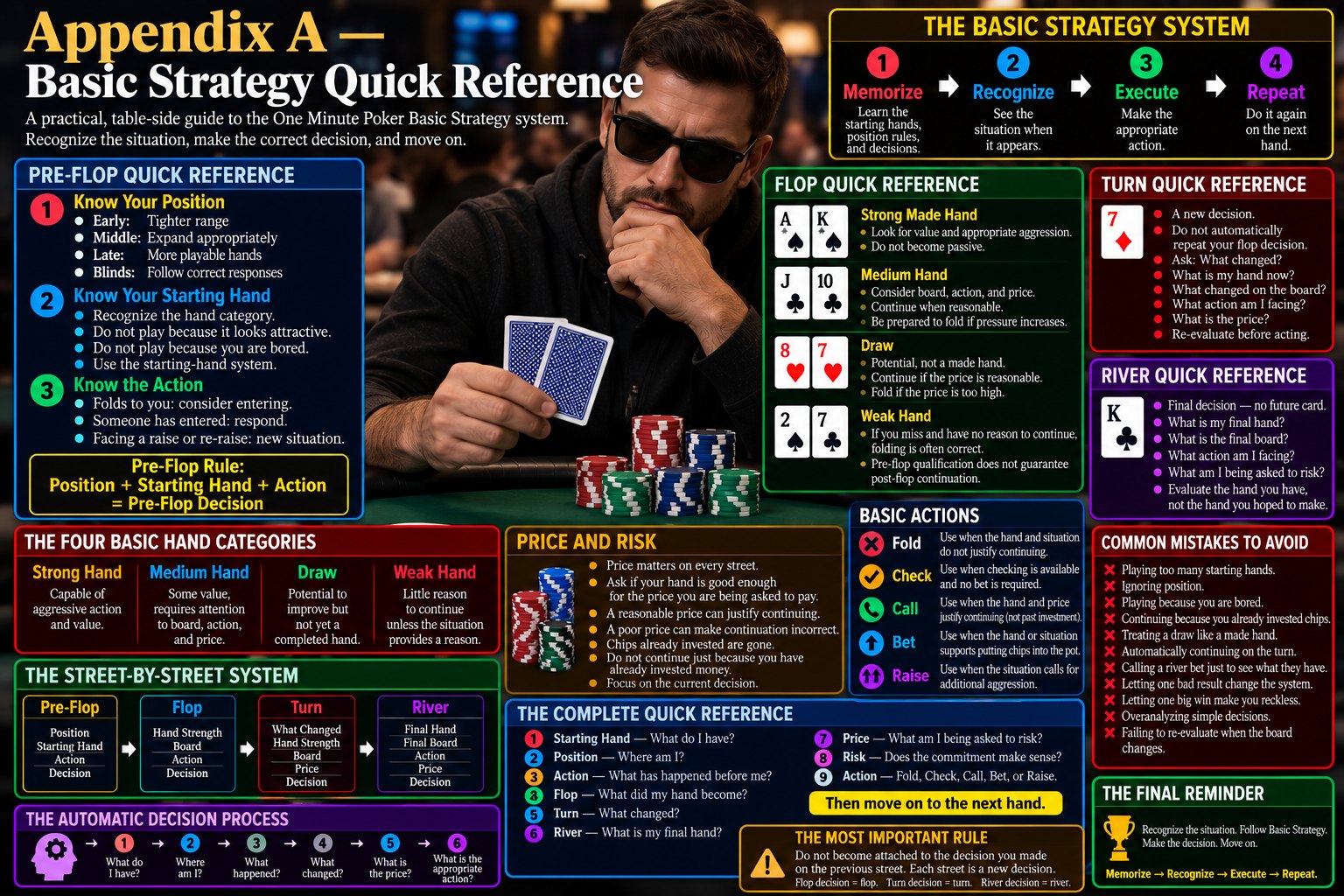
The One Minute Poker Basic Strategy system is designed to be simple enough to remember and practical enough to use while playing. This appendix condenses the major rules from the book into one quick-reference guide. The purpose is not to replace the full system, but to give you a compact reminder of what you have already learned.
The Basic Strategy System
Memorize → Recognize → Execute → Repeat. Memorize the starting hands, position rules, and basic decisions. Recognize the situation when it appears. Execute the appropriate action. Repeat the process on the next hand. The goal is to make good decisions without unnecessary analysis.
Pre-Flop Quick Reference
Know Your Position. Position matters because it determines how many players remain behind you and how much information you will have before making future decisions. Early position requires a tighter range. Middle position allows you to expand appropriately. Late position allows more playable hands because of the positional advantage. The blinds have their own appropriate responses.
Know Your Starting Hand. Before making a pre-flop decision, recognize the strength and category of your starting hand. Do not play a hand simply because it looks attractive, because you have been folding for several hands, or because you want action. Use the starting-hand system.
Know What Happened Before You. If everyone folds to you, you are deciding whether to enter the pot. If another player has entered, you are responding to existing action. If you face a raise or re-raise, recognize that you are in a different situation. Do not treat every pre-flop decision as though it were the same.
Pre-Flop Rule: Position + Starting Hand + Action = Pre-Flop Decision. Recognize those three things before acting, then execute the appropriate response.
Flop Quick Reference
When the flop arrives, the starting-hand system has done its job. The flop creates a new situation. Recognize what your starting hand has become, then recognize the board and the action.
Strong Made Hand: You have a strong hand. Look for appropriate aggressive action and value when the situation supports it. Do not become passive simply because you are afraid someone might improve.
Medium Hand: You have some value, but not a premium hand. Consider the board, action, and price. Continue when the situation supports continuation and be prepared to fold when pressure or price becomes too great.
Draw: A draw is potential, not a completed hand. Recognize the opportunity to improve, but do not treat the draw as though it has already arrived. A reasonable price may justify continuing; an unreasonable price may require a fold.
Weak Hand: If you miss the flop and have no meaningful reason to continue, folding is often correct. Pre-flop qualification does not guarantee post-flop continuation.
Turn Quick Reference
The turn is a new decision. Do not automatically repeat your flop decision. Ask: What changed? What is my hand now? What changed on the board? What action am I facing? What is the price? A hand can improve, a draw can complete, a dangerous board can appear, and a previously reasonable call can become unreasonable. Re-evaluate before acting.
River Quick Reference
The river is the final decision. There is no future card. A draw either completed or missed, your final hand is known, and the board is complete. Ask: What is my final hand? What is the final board? What action am I facing? What am I being asked to risk? A strong hand may justify a value bet. A medium hand may justify a call when the price is reasonable. A weak hand may need to fold. A missed draw must be evaluated as the hand you actually have, not the hand you hoped to make.
Price and Risk
Price matters because every decision requires a commitment of chips. Do not ask only, "Is my hand good?" Ask whether the hand is good enough for the price you are being asked to pay. A reasonable price can make continuation appropriate. A poor price can make continuation incorrect. Remember that chips already invested in the pot are gone. Do not continue simply because you have already invested money. The current decision concerns the chips you are being asked to commit now.
The Four Basic Hand Categories
Strong Hand: A hand capable of supporting aggressive action and value.
Medium Hand: A hand requiring more attention to board, action, and price.
Draw: A hand with potential to improve but not yet a completed hand.
Weak Hand: A hand with little reason to continue unless the situation provides a specific reason.
Recognizing these categories quickly is one of the keys to automatic Basic Strategy.
The Street-by-Street System
Pre-Flop: Position → Starting Hand → Action → Decision.
Flop: Hand Strength → Board → Action → Decision.
Turn: What Changed → Hand Strength → Board → Price → Decision.
River: Final Hand → Final Board → Action → Price → Decision.
You do not need to recalculate the entire hand on every street. You need to recognize the current situation.
The Automatic Decision Process
When the hand is moving quickly, use the shortest version of the system: What do I have? Where am I? What happened? What changed? What is the price? What is the appropriate action? Then act.
Basic Actions
Fold: Use when your hand and the situation do not justify continuing. Folding is not failure. Folding is a decision.
Check: Use when checking is available and the situation does not require a bet. Do not create unnecessary action simply because you have the opportunity.
Call: Use when your hand and the current price justify continuing without raising. A call should be based on the current situation, not on money already invested.
Bet: Use when your hand or situation supports putting additional money into the pot. Strong hands may provide value opportunities, and appropriate situations may provide opportunities for basic aggression.
Raise: Use when the situation calls for additional aggression. Do not raise simply because you want to appear aggressive. The action should fit the situation.
Common Mistakes to Avoid
Avoid playing too many starting hands, ignoring position, playing because you are bored, continuing because you already invested chips, treating a draw like a made hand, automatically continuing on the turn because you continued on the flop, calling a river bet simply because you want to see what the opponent has, allowing one bad result to change the system, allowing one big win to make you reckless, overanalyzing simple decisions, and failing to re-evaluate when the board changes.
The Most Important Rule
Do not become attached to the decision you made on the previous street. The flop decision was based on the flop. The turn decision is based on the turn. The river decision is based on the river. Each street creates a new decision.
The Memory Formula
Memorize the rules. Recognize the situation. Execute the decision. Repeat. The goal is not to memorize every possible poker hand. The goal is to memorize the system well enough that you can recognize the important situations quickly.
The One-Minute Standard
One Minute Poker does not mean that every decision must literally take sixty seconds. It means you should be able to reach a clear decision without becoming trapped in unnecessary analysis. Simple situations should remain simple. Recognize the situation. Apply the system. Make the decision. Move on.
The Complete Quick Reference
When you sit down to play, remember this sequence:
STARTING HAND: What do I have?
POSITION: Where am I?
ACTION: What has happened before me?
FLOP: What did my hand become?
TURN: What changed?
RIVER: What is my final hand?
PRICE: What am I being asked to risk?
RISK: Does the commitment make sense?
ACTION: Fold, Check, Call, Bet, or Raise.
Then move on to the next hand.
The Final Reminder
You do not need to control the cards. You do not need to control the other players. You need to control your decisions. Do not chase. Do not force action. Do not let previous investment determine the next decision. Do not let the previous hand determine the next hand. Do not turn a simple decision into a complicated one.
Recognize the situation. Follow Basic Strategy. Make the decision. Move on.
Memorize → Recognize → Execute → Repeat.
That is the One Minute Poker Basic Strategy Quick Reference.