Learning Basic Strategy and playing Basic Strategy are two different things. You can understand every rule in this book and still hesitate when the cards are in front of you. You can know the starting-hand system, understand position, recognize strong hands and draws, understand price and risk, and still find yourself thinking too long about decisions that should eventually become simple.
The goal of One Minute Poker is to close that gap.
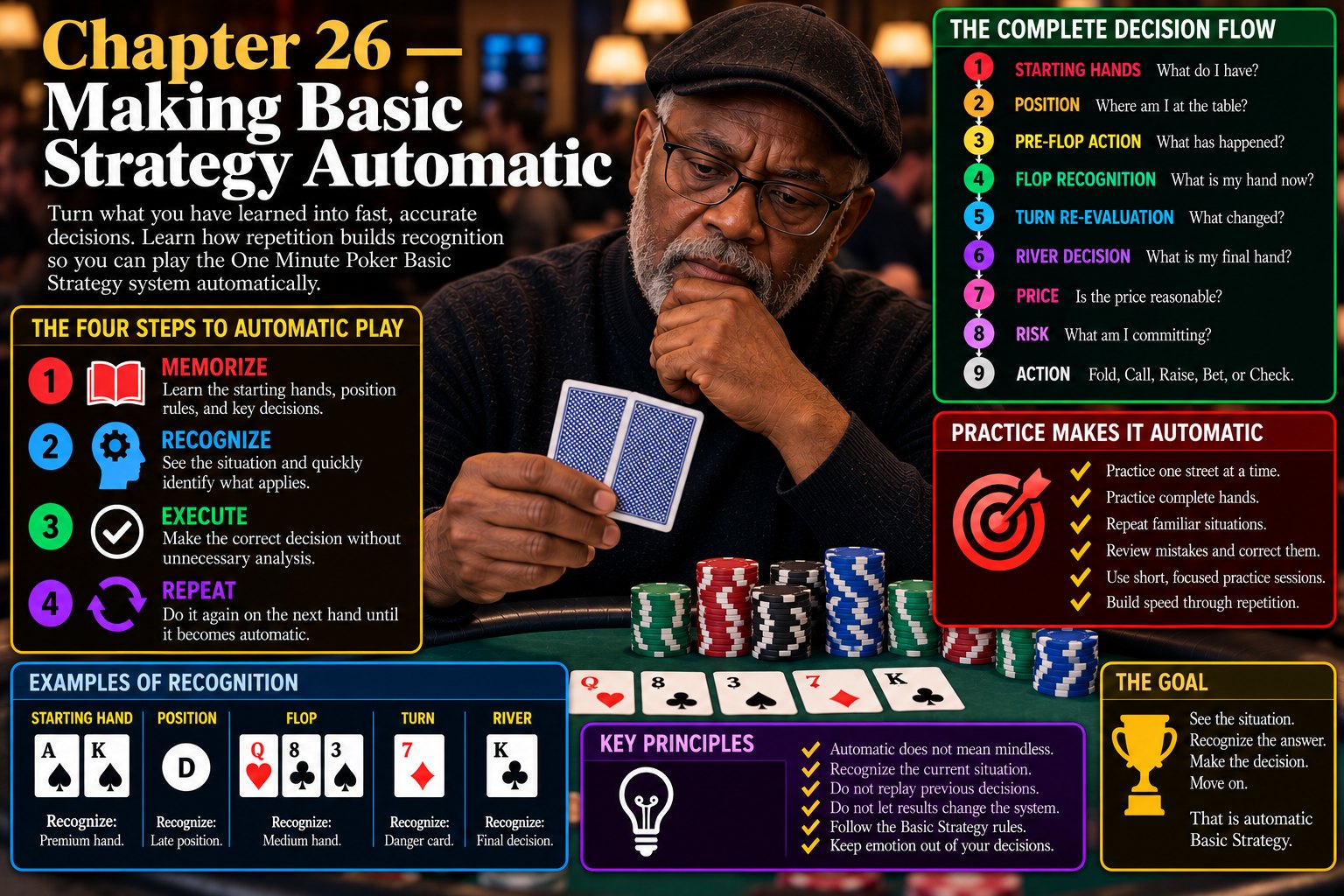
Basic Strategy is designed to become automatic through repetition. You learn the rules, memorize the important patterns, recognize those patterns at the table, and execute the appropriate action. With enough practice, the process becomes faster and requires less conscious effort.
That is what it means to make Basic Strategy automatic.
Automatic Does Not Mean Mindless
Automatic poker does not mean playing without thinking. It means thinking about the things that matter instead of trying to think about everything.
A beginning player may look at a hand and immediately begin asking dozens of questions. What does the opponent have? What if the next card is a heart? What if the opponent is bluffing? What if I raise? What if I call? What if I fold and would have won?
That kind of thinking can make even a simple decision feel complicated.
Basic Strategy gives you a structure that reduces the number of questions you need to ask. You recognize your starting hand. You recognize your position. You recognize the action. After the flop, you recognize what your hand has become. On the turn, you recognize what changed. On the river, you recognize your final situation. You consider price and risk when they matter, then make the decision.
The objective is not to stop thinking. The objective is to make the correct thinking familiar.
First You Learn, Then You Memorize
Automatic play begins with knowledge.
You cannot recognize a pattern you have never learned. That is why the early chapters established the starting-hand system, position, pre-flop decisions, post-flop recognition, turn play, river play, price, risk, and discipline.
At first, these ideas require conscious attention. You may have to stop and remember which hands belong in a particular position. You may need to think about whether a hand is strong, medium, a draw, or weak. You may need to remind yourself that a new street creates a new decision.
That is normal.
Do not expect a system to become automatic simply because you read it once.
The first stage is learning.
The second stage is remembering.
The third stage is recognizing.
The fourth stage is executing.
Eventually, those stages begin to happen almost together.
Memorization Creates Speed
Memorization is important because you cannot make a fast decision about information you have to reconstruct every time.
Imagine looking at a starting hand and having to rebuild the entire starting-hand chart in your head before deciding whether to play it. That would slow you down.
Instead, you want to see the hand and recognize it.
You see a premium hand and know what category it belongs to.
You see a hand that belongs in your position and recognize that it qualifies.
You see a hand outside the range and recognize that it should be folded.
That is why the memory work in One Minute Poker matters. The purpose of memorization is not to turn poker into a test. It is to remove unnecessary hesitation from the actual game.
Recognition Is the Key
Once the information is memorized, recognition becomes the central skill.
Recognition means seeing a situation and immediately identifying what it is.
You see your position.
You see your cards.
You recognize the starting-hand category.
You see the pre-flop action.
You recognize the appropriate response.
The flop arrives.
You recognize whether you have a strong hand, medium hand, draw, or weak hand.
The turn arrives.
You recognize what changed.
The river arrives.
You recognize your final situation.
This is much faster than trying to calculate everything from the beginning every time.
Practice Recognition, Not Just Memorization
A player can memorize a chart and still struggle at the table.
That happens because knowing information and recognizing information are different skills.
If you want Basic Strategy to become automatic, practice seeing situations and identifying them quickly.
Look at a starting hand and name its category.
Look at a position and identify the appropriate range.
Look at a flop and identify what your hand has become.
Look at a turn card and identify what changed.
Look at a river and identify the final hand.
The more often you perform these recognition exercises, the more familiar the situations become.
Eventually, you stop consciously searching for the answer.
You recognize it.
Practice One Street at a Time
You do not need to practice an entire poker hand every time.
In fact, isolating individual parts can make training more effective.
Practice starting hands by themselves.
Practice position by itself.
Practice pre-flop decisions.
Practice flop recognition.
Practice turn decisions.
Practice river decisions.
Then combine them.
This allows your brain to become familiar with each part before having to process the entire hand.
Once the individual pieces are comfortable, complete hand walkthroughs become much easier.
Then Combine the Streets
After practicing the individual decisions, begin practicing complete hands.
Start with the pre-flop decision.
Then reveal the flop.
Make the flop decision.
Then reveal the turn.
Make the turn decision.
Then reveal the river.
Make the final decision.
Do not go back and reconsider every previous decision while making the current one.
The purpose of the exercise is to practice moving forward.
The hand changes.
Your decision changes with it.
That is how automatic decision-making develops.
Do Not Memorize the Wrong Thing
There is an important difference between memorizing Basic Strategy and memorizing individual results.
You do not want to memorize that a particular hand always wins on a particular type of flop.
You do not want to memorize that one particular sequence always produces one particular action.
You want to memorize the principles that produce the action.
Recognize the starting hand.
Recognize the position.
Recognize the action.
Recognize what the board has created.
Recognize the price and risk.
Then choose the appropriate response.
This allows the system to work across many different hands rather than only the examples you have already seen.
Repetition Creates Familiarity
The first time you learn something, it may feel slow.
The tenth time, it may feel familiar.
The hundredth time, the recognition may become almost immediate.
That is the purpose of repetition.
You are building familiarity with the same types of decisions over and over again.
You do not need every poker hand to be unique. In fact, the repetition of familiar situations is exactly what makes automatic play possible.
You want to reach the point where seeing a situation produces recognition before you have consciously described every part of it.
That is not a shortcut.
That is trained skill.
Use Short Practice Sessions
Automatic skill does not require endless study sessions.
Short, focused practice can be more useful than sitting for hours while your attention gradually disappears.
Take a small group of starting hands and practice recognizing them.
Take several positions and practice identifying which hands qualify.
Take several flop situations and identify the hand category.
Take several turn situations and identify what changed.
Take several river situations and identify the appropriate final decision.
Then stop.
Return later and repeat the process.
The objective is consistent repetition rather than exhausting yourself with unnecessary study.
The One Minute Practice Method
The One Minute Poker approach can be used during practice exactly as it is used during play.
Give yourself a situation.
Recognize the important information.
Make the decision.
Move on.
Do not spend five minutes trying to find a perfect explanation for a decision that should eventually take seconds.
If you make a mistake, identify what you missed.
Then repeat the situation.
The goal is not to prove that you can analyze one hand for a long time. The goal is to train your recognition so that the next time you see a similar situation, the decision comes more naturally.
Review Mistakes Without Replaying Them Forever
Mistakes are useful when they teach you something.
Suppose you played a hand incorrectly because you forgot the starting-hand rule for your position. That tells you what to practice.
Suppose you continued with a draw after the price became unreasonable. That tells you to practice price and risk recognition.
Suppose you continued on the turn simply because you had called on the flop. That tells you to practice treating each street as a new decision.
Suppose you became attached to a strong pre-flop hand after the board changed. That tells you to practice re-evaluating the hand after each street.
Identify the mistake.
Correct it.
Practice it.
Then move on.
Do not turn one mistake into twenty minutes of mental replay.
Results Are Not the Training Goal
A practice hand can end in a win and still contain a bad decision.
A practice hand can end in a loss and still contain an excellent decision.
The result is not always an accurate measure of the decision.
If you have a strong hand and make the appropriate value bet, your opponent may fold. That does not make the bet wrong.
If you fold a draw because the price is unreasonable and the next card would have completed it, that does not make the fold wrong.
If you make the correct decision and lose, the decision can still be correct.
This is essential for automatic play because you do not want random results teaching you the wrong lessons.
Practice the process.
Judge the decision by the information available when you made it.
Do Not Change the System Because of One Hand
One of the easiest ways to destroy automatic play is to change your rules every time something unexpected happens.
You fold and discover that you would have won.
You decide you should have played the hand.
You call and lose.
You decide you should never call in that situation again.
You make a value bet and get raised.
You decide betting was a mistake.
This creates instability.
Basic Strategy needs consistency.
If you discover a genuine weakness in your understanding, correct it deliberately. Do not rewrite the system emotionally after one result.
The purpose of practice is to make your decisions more stable, not less stable.
Build the Habit of Recognition
Eventually, you want certain questions to become almost automatic.
Before the flop:
What is my position? What is my starting hand? What is the action?
On the flop:
What did my hand become? What is the board? What is the action?
On the turn:
What changed? What is my hand now? What is the price?
On the river:
What is my final hand? What is the action? What am I being asked to risk?
These questions should not become a rigid speech you recite every time you play. They are the structure underneath your recognition.
With practice, you may not consciously ask every question.
You will simply see the situation and recognize the answer.
Automatic Does Not Mean Rushed
There is an important difference between fast decision-making and rushed decision-making.
Rushed means acting before you have recognized the situation.
Automatic means recognizing the situation quickly because you have practiced it.
Do not rush simply because the system is called One Minute Poker.
Take the time necessary to recognize the important information.
Then act.
The objective is not to make the fastest possible decision.
The objective is to make a clear decision without unnecessary delay.
Keep the System Separate From Emotion
Automatic Basic Strategy also protects you from emotional decisions.
After losing a large pot, you may feel an urge to win the money back immediately.
After winning several pots, you may feel more confident and begin playing hands that do not qualify.
After folding repeatedly, you may become impatient.
These emotions are normal, but they do not change the rules.
The next hand still has to qualify.
The next position still matters.
The next flop still has to be recognized.
The next bet still has a price.
The next decision still has to be made according to the system.
Automatic play means returning to the same process regardless of what happened on the previous hand.
The System Becomes Smaller as You Learn It
When you first learn Basic Strategy, the system may seem large.
There are starting hands to memorize.
There are positions to understand.
There are pre-flop situations.
There are flop decisions.
There are turn decisions.
There are river decisions.
There are price and risk considerations.
There are discipline rules.
But as you practice, all of those individual pieces begin to connect.
What initially looked like many separate rules becomes a smaller number of familiar recognition patterns.
You stop thinking, "Which chapter applies here?"
You simply recognize the situation.
That is the point at which the system begins to feel automatic.
The Goal Is Clean Execution
The ultimate goal is not to know more poker words.
It is not to memorize more complicated explanations.
It is not to spend more time thinking.
The goal is clean execution.
See the hand.
Recognize the position.
Recognize the action.
Make the decision.
See the flop.
Recognize what changed.
Make the decision.
See the turn.
Re-evaluate.
Make the decision.
See the river.
Recognize the final situation.
Make the decision.
Then let the hand go.
That is clean execution.
Memorize → Recognize → Execute → Repeat
The entire training process can be reduced to four words:
Memorize. Recognize. Execute. Repeat.
Memorize the system until the important information is available without searching for it.
Recognize the situation when it appears.
Execute the appropriate decision without unnecessary analysis.
Repeat the process on the next hand.
Then repeat it again.
That repetition is what transforms Basic Strategy from something you know into something you can use naturally.
When Basic Strategy Becomes Automatic
You will know that Basic Strategy is becoming automatic when you notice that your decisions are taking less mental effort.
You see a starting hand and immediately know whether it belongs in your position.
You face a raise and immediately recognize the relevant situation.
You see the flop and quickly identify whether you have a strong hand, medium hand, draw, or weak hand.
You see the turn and immediately notice what changed.
You reach the river and recognize the final situation without having to reconstruct the entire hand.
You still think.
But your thinking is organized.
You are no longer searching for the system.
You are using it.
That is the real meaning of automatic Basic Strategy.
The Final Step Is Trust
Once you have learned the system and practiced it repeatedly, you have to trust the process.
Trust does not mean believing that every decision will win.
It means accepting that poker contains uncertainty while still following the decision process you trained.
You may make the correct decision and lose.
You may make the correct fold and later discover that you would have won.
You may make the correct value bet and receive no call.
None of those results require you to abandon the system.
Your responsibility is the decision.
The cards determine the result.
Basic Strategy Should Become Familiar
The final objective of this book is not for you to carry a large collection of rules around in your head forever.
The objective is for those rules to become familiar enough that you can recognize them quickly.
Eventually, Basic Strategy should feel less like something you are studying and more like something you are doing.
You see the situation.
You recognize what applies.
You make the decision.
You move on.
That is why the system begins with memorization but ends with automatic recognition.
Memorize → Recognize → Execute → Repeat.
The more consistently you practice that process, the more natural Basic Strategy becomes.
And when Basic Strategy becomes automatic, you have accomplished what the system was designed to accomplish: you can sit down at the table, recognize the situation in front of you, make the appropriate decision, and continue playing without unnecessary analysis.
That is One Minute Poker.