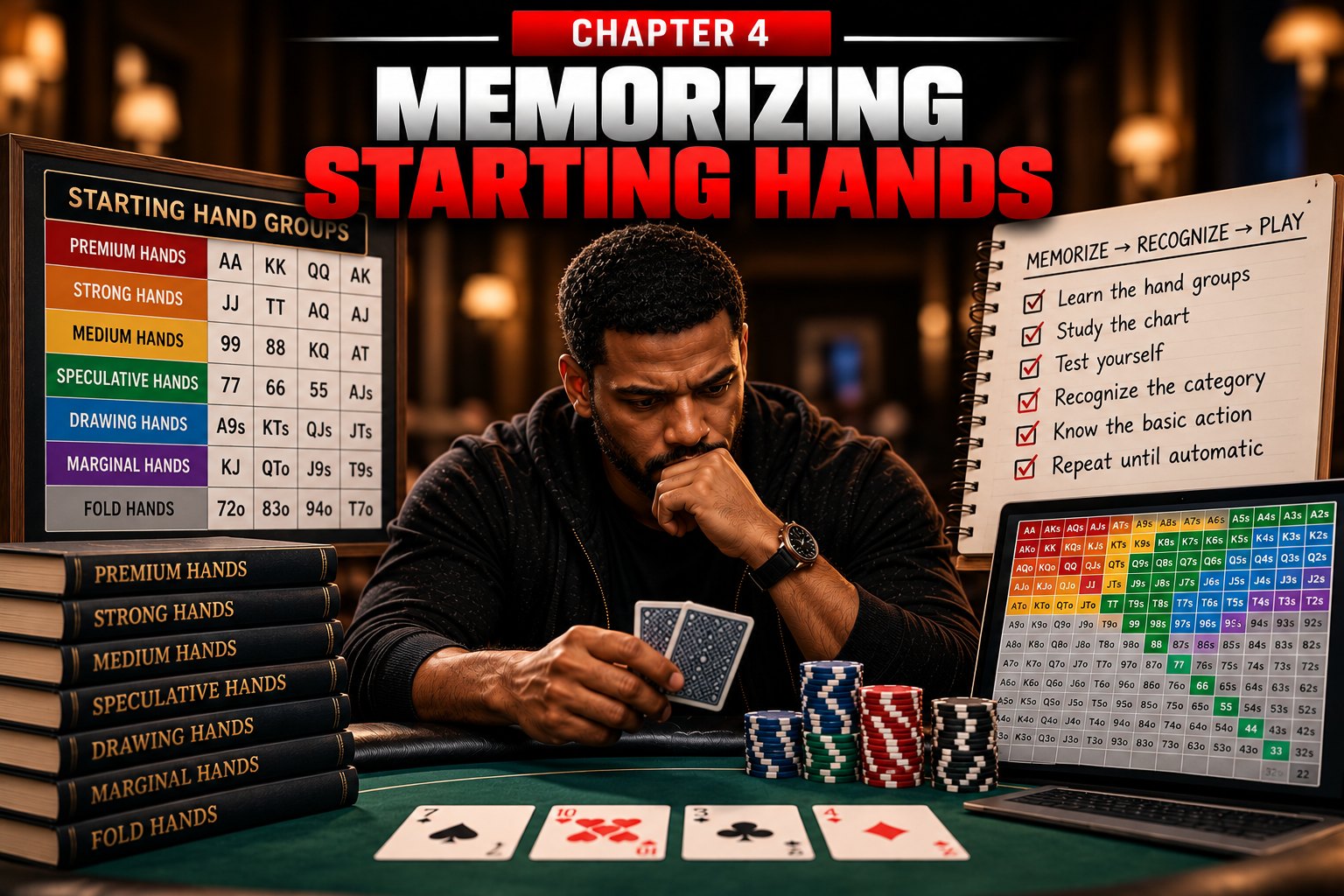
Starting hands are the first major decision in poker. Before you think about the flop, the turn, the river, the size of the pot, or what another player might do, you have to decide whether your two cards are worth playing. That decision happens before any community cards are dealt, which makes starting-hand recognition one of the most important parts of Basic Strategy.
The purpose of memorizing starting hands is not to create another complicated task at the table. It is to eliminate the need to figure out the value of your starting hand from scratch every time you receive two cards. You should eventually be able to look at your hand, recognize what category it belongs to, and know the basic action that normally follows.
This is the foundation of automatic pre-flop play. If you have to stop and study a chart every time you receive a hand, the strategy has not yet become part of your game. Charts are useful while learning, but the ultimate goal is to move the information from the chart into your memory.
The easiest way to do that is to organize starting hands into groups rather than trying to memorize every possible combination as an isolated fact. A hand group gives you a general understanding of where a hand belongs and how it should normally be treated. The groups used in Basic Strategy include premium hands, strong hands, medium hands, speculative hands, drawing hands, marginal hands, and hands that should normally be folded.
Premium hands are the strongest starting hands in the system. They are the hands that begin with a significant advantage and generally deserve the most aggressive treatment. Because these hands are easy to recognize, they should become some of the first hands you can identify automatically. When you see one, there should be very little uncertainty about which general category it belongs to.
Strong hands are also valuable starting hands, although they do not carry the same level of strength as the premium group. These hands will often be played, but their treatment can depend more heavily on position and the action that has already occurred. The important skill at this stage is recognizing that a strong hand is still a strong hand even when it is not one of the very best hands in the deck.
Medium hands require more discipline. They can be useful starting hands, but they are not hands that should automatically be treated like premium or strong holdings. Their value depends more heavily on the circumstances surrounding the hand. Memorizing the category helps prevent the common mistake of treating every playable hand as though it were a premium hand.
Speculative hands can have potential but often require the right circumstances to become profitable. They may improve substantially when they connect with the board, but they can also miss completely. The mistake is not recognizing that they have potential; the mistake is allowing that potential to become an automatic reason to play them.
Drawing hands are hands that can improve substantially when the right cards arrive. Their value comes from the possibilities they contain rather than simply from the strength of the hand at the moment. These hands require discipline because the possibility of improvement can make them look more attractive than they actually are.
Marginal hands are hands that sit near the edge of what should normally be played. They are precisely the kinds of hands that can cause problems when a player relies on emotion or instinct instead of a system. A marginal hand may look playable because it contains a face card, is connected, or has some other attractive feature. Basic Strategy requires you to recognize the category rather than become attached to the appearance of the cards.
Finally, there are hands that should normally be folded. Folding these hands is not a failure to participate. It is a basic winning decision. One of the most important things a player can learn is that being dealt two cards does not create an obligation to play them. Strong starting-hand discipline prevents many difficult situations before they ever begin.
These categories are useful because they give your memory structure. Instead of trying to remember an enormous collection of individual hands, you begin by recognizing the type of hand you are holding. Once the category becomes familiar, the appropriate basic action becomes easier to recall.
The process should be practiced away from the table as well as at the table. Look at two cards and identify the category. Do it again with another hand. Continue until you can recognize the category without having to stop and reason through every possibility. The goal is speed of recognition, not speed for its own sake.
Do not confuse memorization with guessing. If you are uncertain about a hand, return to the Basic Strategy material and review where that hand belongs. The purpose of practice is to replace uncertainty with reliable recall. Over time, the number of hands that require conscious thought should decrease.
Charts are valuable during the learning stage because they give you a visual reference. You can use them to study the structure of the starting-hand system and confirm where particular hands belong. But the chart should eventually become a training tool rather than a permanent crutch.
The progression is simple: chart → study → memorization → recognition → automatic response.
At first, you may need to look at the chart. Then you begin testing yourself without looking. Eventually, you should be able to see a starting hand and recognize its category immediately. The chart remains available when you need to review, but you no longer depend on it for every decision.
This is especially important because poker does not give you unlimited time to organize your thoughts. Even when you have plenty of time to act, unnecessary hesitation can create uncertainty. A player who already knows the basic starting-hand system can spend that time on the actual situation rather than trying to remember the fundamentals.
Memorizing starting hands also protects you from one of the most common pre-flop mistakes: playing a hand simply because it looks good. Some hands are attractive because they contain high cards. Others look interesting because they are connected or suited. But appearance is not a strategy. A hand belongs in the system because of its place within the system, not because you happen to like the way it looks.
The same discipline applies when you have been folding for a long time. Being dealt several poor hands in a row does not mean the next hand deserves to be played simply because you are tired of folding. The cards determine the starting-hand category, and the system determines the appropriate response.
The objective is to make the starting-hand decision increasingly automatic. You see the hand, recognize the category, and know the basic action. You are not trying to solve poker from the beginning of every hand. You are applying something you have already learned.
That is why starting-hand memorization comes before more complicated decisions. If you cannot consistently decide which hands belong in your basic strategy, every later decision becomes more difficult. If starting-hand recognition is automatic, the rest of the pre-flop process becomes much easier to manage.
The complete process can be reduced to three steps: See the hand → recognize the category → know the basic action.
With repetition, those three steps become faster and more natural. The purpose is not to turn you into someone who can recite a chart from memory. The purpose is to turn the chart into a working part of your poker decision-making.
When you sit down to play, you should not need to ask whether every hand is worth playing. You should recognize the hand, understand its basic category, and apply the strategy. That is the beginning of automatic poker.