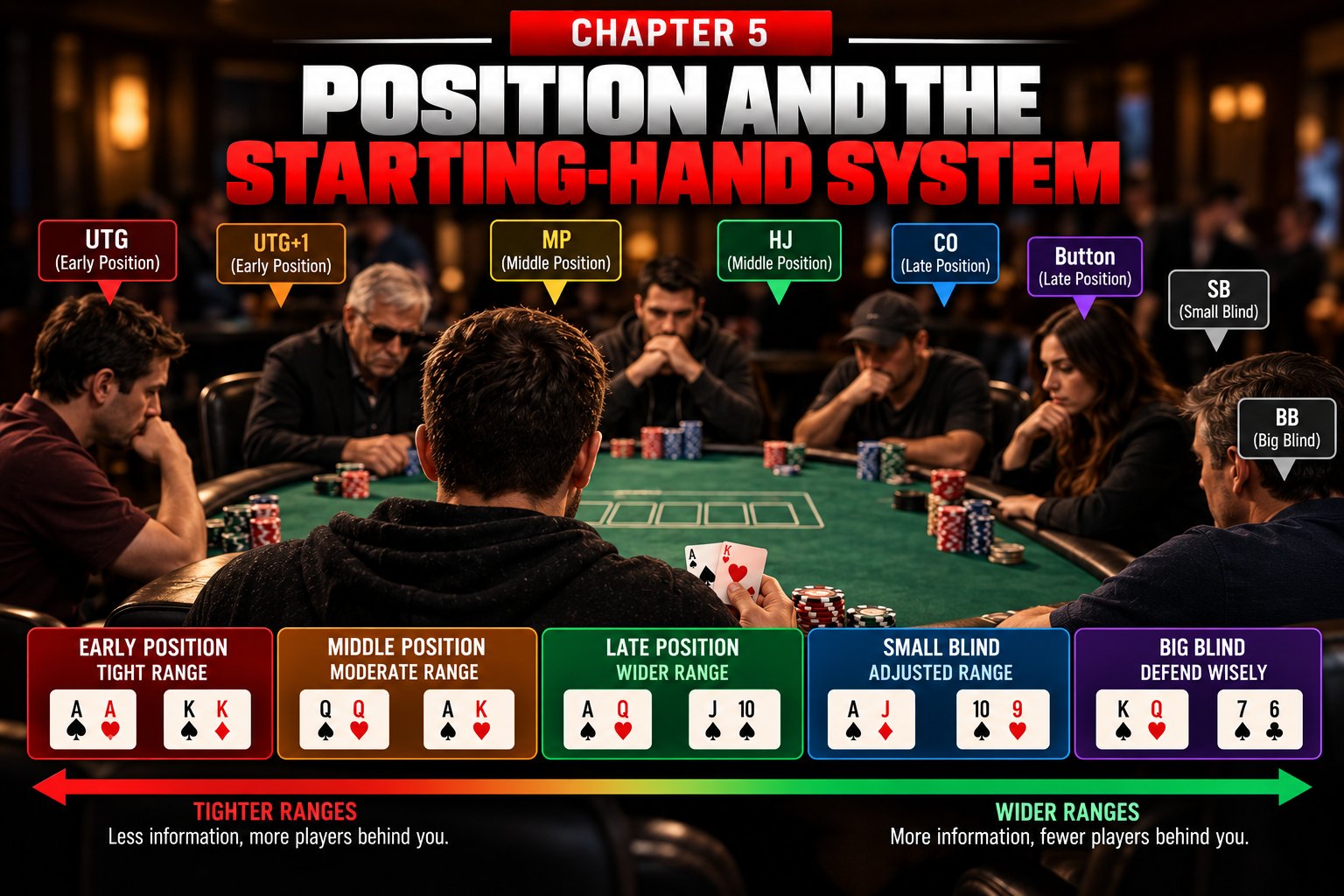
Position is one of the most important parts of the starting-hand system because the value of a hand depends not only on the cards you hold but also on where you are sitting at the table. The same starting hand can be a reasonable hand to play from one position and a hand that should normally be folded from another. Learning to recognize that difference is a basic part of automatic poker.
Position refers to where you act in relation to the other players. The earlier your position, the more players remain to act after you. The later your position, the more information you have before making your decision because more players have already acted. This changes the range of hands you should normally be willing to play.
In early position, you have the least information. Several players remain behind you, and any of them may enter the pot with a stronger hand. Because of this, your starting-hand range should generally be tighter. You want hands that can withstand the possibility of facing action from players who have not yet acted.
This does not mean that early position makes good hands bad. Premium hands remain premium hands. Strong hands remain strong hands. The important difference is that marginal and speculative hands become more difficult to play when several players remain behind you.
Early position therefore calls for discipline. A hand that looks attractive in isolation may not belong in your early-position range. The question is not simply, “Is this a good hand?” The better question is, “Is this a hand I should normally play from this position?”
Middle position gives you more information than early position because some players have already acted. At the same time, several players may still be behind you. Your range can therefore begin to expand, but it should still be more disciplined than your late-position range.
The important point is that position changes gradually. There is not one moment when every hand suddenly becomes playable. As you move closer to the button, more information becomes available and more hands can become reasonable candidates for entering the pot.
Late position provides the greatest advantage before the flop because most of the table has already acted. When players before you have folded, you know that those players do not currently have a hand with which they are entering the pot. You also have fewer players left who can act after you.
This allows your starting-hand range to become wider. Hands that would normally be folded from early position may become playable from late position. The cards have not changed. Your position has changed, and that changes the circumstances surrounding the hand.
This is one of the most important ideas to memorize: the same hand does not always have the same value in every position.
The blinds require special attention because they are different from the other positions. In the small blind and big blind, you have already placed chips into the pot before seeing how the action develops. You will also have different positional considerations after the flop.
The small blind is particularly difficult because you will generally be out of position after the flop. The fact that you have already posted part of the blind does not mean you should defend every hand. The starting hand still has to be evaluated according to the strategy.
The big blind is different because you have already invested the required blind and may have an opportunity to continue when facing an action that does not justify folding automatically. But the fact that you have posted the big blind does not make every hand worth defending. The starting-hand system still provides the basic framework for the decision.
The purpose of learning the blind positions is not to create a complicated mathematical calculation. It is to recognize that blind situations have their own rules and should not be treated exactly like ordinary early, middle, or late position.
Position also affects how many hands you should normally enter with. The basic pattern is straightforward: tighter ranges in earlier positions and wider ranges in later positions. This is not a command to play every hand that becomes slightly more attractive as you move around the table. It is a structure for deciding which hands belong in your normal range.
That structure makes memorization easier. Instead of trying to remember one enormous starting-hand chart, you can think of the system as a series of position-based ranges. First recognize the position. Then recognize the hand. Then determine whether that hand belongs in the range for that position.
This creates a simple decision sequence: Position → Starting Hand → Range → Action.
The first question is where you are sitting. The second is what two cards you hold. The third is whether those cards belong in your normal range from that position. The fourth is the appropriate basic action.
With practice, you should not have to consciously walk through all four steps every time. They are presented here so you understand the structure of the system. The ultimate goal is to make the sequence automatic.
For example, imagine that you are dealt the same starting hand twice. The first time, you are in early position. The second time, you are in late position. The cards are identical, but the decision does not have to be identical. In the first situation, several players remain behind you. In the second, most players have already folded. Your position has changed the situation.
This is why memorizing starting hands without memorizing position is incomplete. A player might know that a particular hand is playable but still make the wrong decision by ignoring where the hand is being played.
The reverse is also true. Knowing that position matters is not enough. You must be able to connect position with the starting-hand system. The purpose of practice is to build that connection.
One effective way to practice is to name a position before looking at a hand. Then look at a starting hand and decide whether it belongs in your normal range for that position. Repeat the exercise with different positions. Then reverse the process: look at a hand and test yourself on how its treatment changes as you move from early position to middle position to late position.
This type of repetition teaches the relationship rather than simply memorizing isolated facts.
The goal is not to memorize a chart so that you can stare at it during a poker session. The chart is a training tool. You use it to learn the structure of the system, test your memory, and correct mistakes. As your memory improves, you should need the chart less often.
Eventually, you should be able to sit down at a table and immediately identify your position. When you receive your starting hand, you should recognize the hand and understand how it fits into the range for that position. The decision should become increasingly familiar.
Position also helps prevent one of the most common pre-flop mistakes: playing a hand simply because the hand itself looks attractive. A player may see a connected hand, suited cards, or a high card and immediately want to play it. But the starting-hand system is not based on appearance alone. Position is part of the decision.
This discipline becomes especially important in early position. When many players remain behind you, playing too many marginal hands can put you into difficult situations. By keeping the early-position range tighter, you reduce the number of weak situations you create for yourself.
As you move toward late position, the system allows more flexibility because the information available to you has increased. More players have already made their decisions, and fewer players remain who can act after you. That creates opportunities that do not exist in the same way from early position.
The important thing is to recognize the difference without overthinking it. You do not need to calculate the exact advantage of every seat every time you play. You need to know the basic structure of the system and recognize where you are on the table.
Position is therefore not a separate concept from starting-hand strategy. It is part of starting-hand strategy. The two belong together.
The complete recognition process is simple: See your position → see your hand → recognize the range → make the basic decision.
Practice that sequence until it becomes familiar. When position and starting-hand recognition become automatic, a large part of your pre-flop decision-making has already been handled before the action becomes complicated.
The purpose of the system is not to make you analyze position on every hand. It is to teach you the relationship between position and starting hands well enough that the correct range becomes easier to recognize.
That is the foundation of position-based Basic Strategy: play tighter when you have less information, open your range as your position improves, and make your starting-hand decisions according to where you are sitting rather than simply how attractive your cards look.
Once that relationship becomes automatic, you are ready to move to the next question: what exactly should you do when you decide that a hand belongs in your range and it is time to enter the pot?