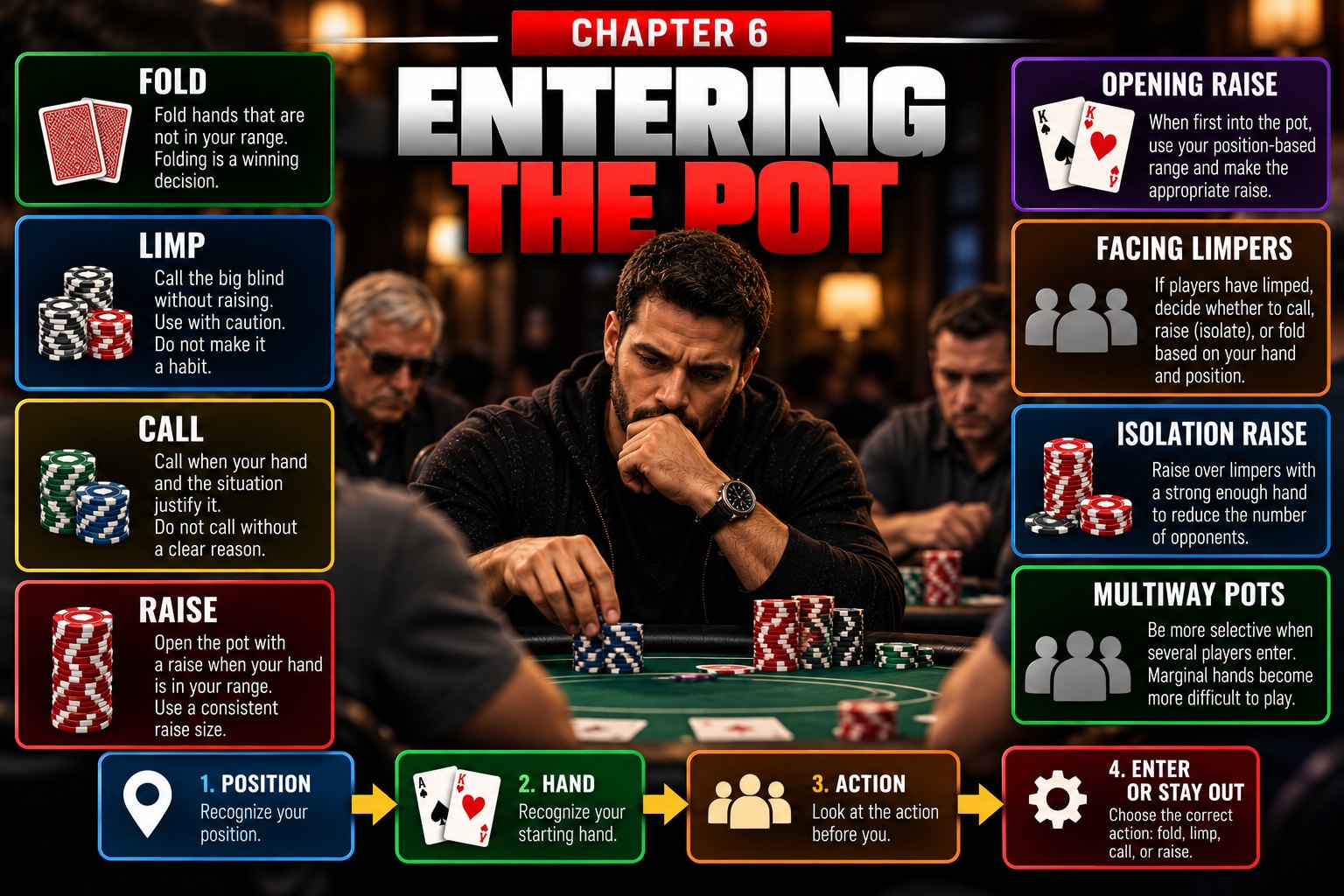
Once you know your starting hand and understand your position, the next decision is whether you are going to enter the pot. This is where the starting-hand system becomes an actual poker decision. You are no longer simply identifying what you hold. You are deciding what to do with it.
Entering the pot should be a deliberate decision based on your hand, your position, and the action that has already occurred. Some hands should be played aggressively. Some hands can be played under the right circumstances. Many hands should simply be folded. The goal of Basic Strategy is to make those decisions clear enough that you do not have to debate every hand from the beginning.
Folding is the first action to understand because folding is not a failure to play poker. It is one of the most important ways you protect yourself from bad situations. If your hand does not belong in your normal range for your position and the action in front of you gives you no reason to continue, folding is the correct decision. You do not need a special reason to fold a hand that should not be played. The reason is that the hand does not belong in your starting strategy.
This is where discipline becomes important. Players often enter pots because they are bored, because they have been folding for several hands, because the cards look attractive, or because they simply want to see a flop. None of those reasons changes the strength of the hand. If the hand does not belong in your range, staying out is the basic decision.
When you do decide to enter the pot, you need to understand the difference between limping, calling, and raising. These actions are not interchangeable. Each one creates a different situation for the rest of the hand.
Limping means entering the pot by calling the existing big blind without raising. Limping can sometimes be appropriate, but it should not become the default way you play hands. A common mistake is to limp simply because a player wants to see a flop cheaply. The problem is that a cheap entry does not automatically create a profitable situation. You may still be out of position, you may allow several players into the pot, and you may have to make difficult decisions after the flop with a hand that was only marginal to begin with.
Calling before the flop can also be correct in certain situations, but calling should have a purpose. A player should not call simply because raising feels uncomfortable or because folding feels too conservative. If the hand belongs in a calling situation, make the call according to the system. If it does not, folding is usually better than calling without a clear reason.
Raising is the primary way to enter many pots when you are the first player to voluntarily enter. This is an opening raise. Instead of simply matching the big blind, you put more pressure into the pot and make it more expensive for players behind you to continue. Your raise also communicates that your hand belongs to a range that is strong enough to enter the pot in that position.
Opening the pot requires two things to come together: your hand must belong in your range, and your position must support playing that range. A hand that is an automatic open from late position may not be an automatic open from early position. This is why Chapter 5 and this chapter work together. Position determines the range, and the range helps determine the action.
Basic Strategy does not require you to invent a new opening decision every time you receive a hand. You should already know which hands generally belong in your range. When you are first into the pot, the decision becomes much simpler: recognize your position, recognize your hand, determine whether it belongs in your opening range, and if it does, make the appropriate raise.
Raise sizing should also be consistent. The purpose of a basic raise size is to give you a dependable starting point rather than forcing you to choose a random amount every time. Your opening raise should be large enough to establish a meaningful pot and discourage players from entering too cheaply, while remaining consistent enough that your betting does not reveal unnecessary information about the strength of your hand.
The exact size can vary according to the game, table, and situation, but the important Basic Strategy principle is consistency. Do not make your raise enormous simply because you have a strong hand, and do not make it tiny because you are uncertain. Your basic opening size should be a standard part of your pre-flop routine.
The situation changes when players have already entered the pot. If one or more players have limped, you are no longer opening into an empty pot. You now have to decide whether to enter behind the limpers, raise, or fold.
Facing limpers requires discipline because limping can create a multiway pot very quickly. If several players have already entered cheaply, calling behind them may allow even more players to participate. That can reduce the value of hands that would be easier to play against fewer opponents.
When your hand is strong enough, raising over limpers can often be preferable to simply calling. This is commonly called isolating a limper or isolation raising. The purpose is to enter the pot with aggression and attempt to reduce the number of opponents who continue. You are not raising merely because raising is aggressive. You are raising because your hand is strong enough to enter and the existing limpers provide an opportunity to take control of the pot.
Isolation should still be based on the Basic Strategy system. You should not raise every time someone limps. A weak hand does not become strong simply because another player entered the pot. If your hand should normally be folded, you can still fold. If it belongs in a raising situation, you can raise. If the situation calls for a different action, follow that action.
The number of players already involved matters as well. A hand that is comfortable against one limper may become less attractive when several players have already entered. The more players involved, the greater the chance that someone has a strong hand or that the eventual pot will become difficult to control.
This is one reason multiway pots require discipline. When several players enter the pot, you should not automatically assume that your hand has the same value it would have against one opponent. Strong hands remain strong, but marginal hands become more difficult to play. Drawing hands may have potential, but they can also create expensive situations when several players are competing for the same pot.
Basic Strategy therefore emphasizes recognizing the number of players involved without turning the decision into an advanced analysis. You simply recognize that a multiway pot is different from a heads-up pot and adjust your willingness to enter accordingly.
The most important question remains the same: Should I enter this pot?
If the answer is no, fold.
If the answer is yes, determine the appropriate way to enter.
If you are first into the pot, use your opening range and make the appropriate raise.
If players have limped, determine whether your hand is strong enough to raise and isolate, whether calling is appropriate, or whether you should simply fold.
The goal is to make this process predictable. You should not be changing your decision because you are bored, excited, afraid, or hoping to hit something on the flop. The cards and the situation determine the action.
One of the biggest mistakes players make is confusing the desire to play with a reason to play. Wanting to see the flop is not a strategy. Wanting to win the pot is not a strategy. Being suited is not automatically a strategy. Having a connected hand is not automatically a strategy. Your starting-hand system exists so that you do not have to invent reasons to play hands that do not belong in your range.
The same discipline applies after you have already invested chips. If you limped into a pot and another player raises, the fact that you already put money into the pot does not mean you must continue. The decision is still based on the current situation. If your hand does not justify continuing, folding is still available.
This prevents a common form of pre-flop mistake: becoming committed to a hand simply because you have already invested something. Chips already placed into the pot cannot be recovered by continuing with a hand that should not be played. The correct decision is the decision that makes sense now.
Entering the pot should therefore follow a repeatable routine. First, recognize your position. Second, recognize your starting hand. Third, look at the action before you. Fourth, determine whether the hand belongs in your range for that situation. Fifth, choose the appropriate action: fold, call, limp, or raise. Finally, execute the decision without unnecessary hesitation.
You do not need to announce each step to yourself while playing. The purpose of learning the sequence is to make the sequence familiar. With enough repetition, you should be able to recognize the situation and move directly to the appropriate action.
A simple way to remember the process is:
Position → Hand → Action → Enter or Stay Out.
This routine protects you from one of the most common problems in poker: playing too many hands. You are not looking for reasons to enter. You are looking for hands and situations that qualify for entry.
When the hand qualifies, enter with a clear plan. When it does not, stay out.
That is the foundation of entering the pot with Basic Strategy. You do not need to play every hand, and you do not need to make every decision complicated. You need to recognize when your hand belongs in the game, choose the appropriate way to enter, and have the discipline to stay out when it does not.
The objective is simple: enter the right pots, enter them with the right action, and avoid creating unnecessary problems before the flop.