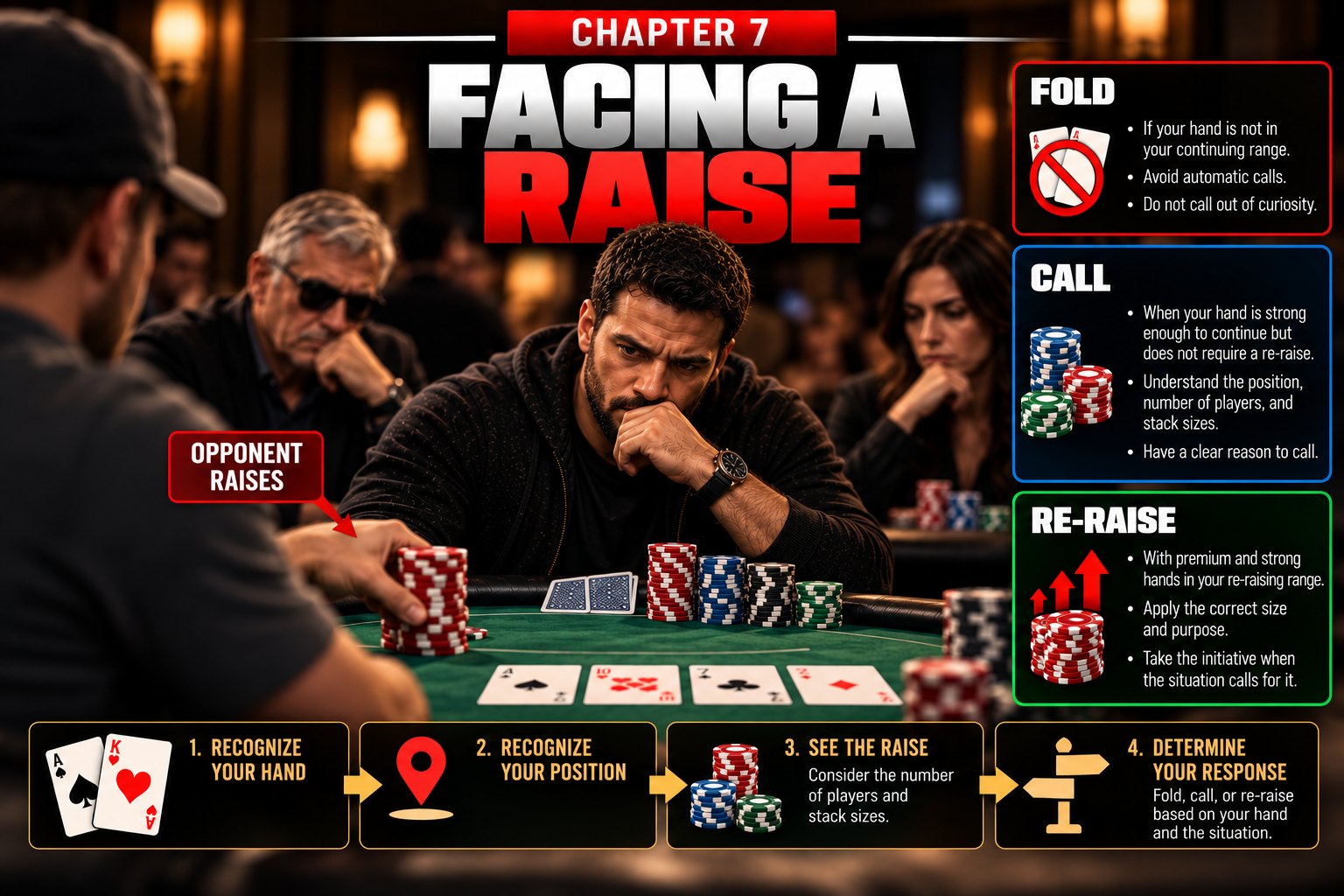
Facing a raise is one of the most common and important pre-flop situations in poker. Another player has already entered the pot with a raise, and now you have to decide whether your hand is strong enough to continue. The basic choices are straightforward: fold, call, or re-raise. The challenge is making the correct choice consistently rather than reacting emotionally or automatically.
The first question is whether your hand should continue at all. A raise does not mean that you have to defend your hand. If your starting hand is outside the range you should normally continue with from your position, folding is usually the simplest decision. This is especially important with marginal hands that may look playable but become difficult when you are facing an existing raise.
Folding when facing a raise is not giving up. It is following the starting-hand system. You already learned that position affects the value of a starting hand. The same principle applies here. Your hand must first qualify for the situation before you decide how to continue.
Calling is appropriate when your hand is strong enough to continue but does not necessarily require a re-raise. A call allows you to see the flop while keeping the pot smaller than it would be after a re-raise. But calling should never become the automatic response whenever you are uncertain.
Automatic calling is one of the easiest ways to create problems. A player may think, “I have a decent hand, so I'll call and see what happens.” That decision may feel safe, but it does not provide a strategy for what happens next. If the hand belongs in a folding range, call-and-see is simply delaying the fold. If the hand belongs in a re-raising range, calling may give up an opportunity to take the initiative.
The decision should therefore begin with the hand itself. Recognize your starting hand, recognize your position, and determine how that hand fits against a raise. Once you know the category, the appropriate response becomes much easier to recognize.
Premium hands are the simplest hands to handle. When you hold one of the strongest starting hands, a raise in front of you does not automatically turn that hand into a calling hand. Strong hands are often candidates for a re-raise because they are strong enough to continue building the pot and putting pressure back on the original raiser.
A re-raise, sometimes called a 3-bet, should have a clear purpose. You are not re-raising simply because you have been raised. You are re-raising because your hand belongs in a range that can profitably continue with additional aggression. This is another place where automatic strategy helps. You should not have to invent a reason to re-raise every time. Your starting-hand system should already tell you which premium and strong hands normally belong in that category.
Strong hands that are not premium hands require more judgment within the Basic Strategy system. Some will be comfortable continuing against a raise. Others may be better suited to calling or folding depending on position and the circumstances of the pot. The important thing is to recognize that “strong” does not mean “always re-raise.” The action still depends on the situation.
Speculative hands require even more discipline. A hand can have potential without being strong enough to continue against a raise. The possibility of making a straight, flush, two pair, or another strong hand later does not automatically justify paying to see the flop.
This is where many players make mistakes. They see a suited hand, connected cards, or another hand with potential and convince themselves that the call is inexpensive. But a raise changes the price of entering the pot, and the hand still has to justify continuing.
Position is especially important when facing a raise. If you are in a position where several players remain behind you, calling or re-raising can create additional problems because those players can still act. A hand that may be comfortable continuing in later position may not be as attractive from earlier position.
The number of players involved also matters. If one player raises and everyone else has folded, the situation is different from a raise followed by several callers. As more players enter the pot, the strength required to continue generally becomes more important. Marginal hands become harder to play when several players are competing for the same pot.
This does not mean you need to perform a complicated calculation every time the number of players changes. The basic recognition is enough: more players create a more crowded pot, and marginal hands become less attractive.
Stack size is another consideration. The number of chips you and the other players have behind affects how much can happen after the flop. A short stack may have a different practical decision than a deep stack because the remaining betting can be very different. You do not need to turn every stack-size situation into advanced mathematics, but you should recognize when the size of the remaining stacks changes the practical consequences of calling or re-raising.
The key is to avoid making a decision without considering what comes next. A call is not simply a decision to put chips into the pot. It is also a decision to continue playing the hand with the remaining stacks and future betting still ahead.
That is why Basic Strategy favors predetermined responses. You should know in advance which types of hands normally fold to a raise, which can call, and which can re-raise. You should also know how those ranges change with position and the number of players involved.
The process can be kept simple: Recognize your hand → recognize your position → see the raise → determine your response.
If the hand does not belong in your continuing range, fold. If the hand belongs in a calling range, call. If the hand belongs in a re-raising range, re-raise.
The purpose is not to make every response identical. The purpose is to make the response predictable based on the information you already know.
One of the most important disciplines when facing a raise is avoiding curiosity. You should not call simply because you want to see the flop. You should not continue simply because you think your opponent might be bluffing. You should not defend a hand simply because you have already invested chips in the pot. The decision is about the hand and the situation in front of you.
The same principle applies when you have already entered the pot and another player raises. If you limped or called before the raise, you are not required to continue simply because you have already invested chips. The new raise creates a new decision. Your hand must now be evaluated against the new situation.
This prevents the common mistake of becoming attached to a hand. A player may think, “I've already put money in, so I might as well call.” That is not a reason to continue. The chips already invested are gone from the decision. What matters is whether continuing now is justified.
Re-raising also needs discipline. Some players raise too little because they are afraid of building a large pot. Others re-raise too often because they believe aggression is always better. Basic Strategy avoids both extremes. Re-raise when the hand and situation call for it. Do not re-raise simply to appear aggressive.
The same principle applies to calling. Calling can be correct, but it should be a deliberate part of the system rather than a safe-looking default. If you find yourself calling because you do not know what else to do, you should recognize that as a warning sign.
The objective is to make the response to a raise as automatic as the recognition of your starting hand. You should not need to start analyzing the entire hand from scratch. You already know your hand, your position, and the basic range associated with the situation. The raise simply gives you another piece of information that determines which response applies.
As you practice, begin testing yourself with simple situations. Give yourself a starting hand and a position, then imagine that another player has raised. Decide whether the hand belongs in your folding, calling, or re-raising range. Then repeat the exercise with a different position or number of players.
The purpose of these drills is to build recognition. Eventually, you should be able to see the situation and immediately know which general category your hand belongs to.
Facing a raise does not require you to become an opponent reader. You do not need to guess whether the other player is nervous, aggressive, tight, loose, or bluffing. That kind of deeper interpretation belongs outside the basic predetermined system. Basic Strategy gives you a response based on your hand, your position, and the basic circumstances of the pot.
This distinction is important because it keeps the system simple. You are not trying to solve the opponent. You are trying to execute your own strategy correctly.
The basic process remains the same: hand, position, raise, response.
Strong enough to continue? Decide whether the correct action is call or re-raise. Not strong enough? Fold. Several players involved? Become more selective. Short or unusual stacks? Recognize that the remaining betting possibilities have changed. Most importantly, do not call automatically simply because you are unsure what else to do.
The goal is consistency. A player who responds to raises according to a predetermined system will avoid many of the common pre-flop mistakes created by curiosity, fear, impatience, or attachment to a starting hand.
When you face a raise, you do not need to panic, guess, or reinvent your strategy. Recognize the situation, apply the range you have already learned, and make the appropriate decision.
Fold when the hand does not belong. Call when the hand belongs in the calling range. Re-raise when the hand belongs in the re-raising range.
That is how facing a raise becomes another automatic part of One Minute Poker.