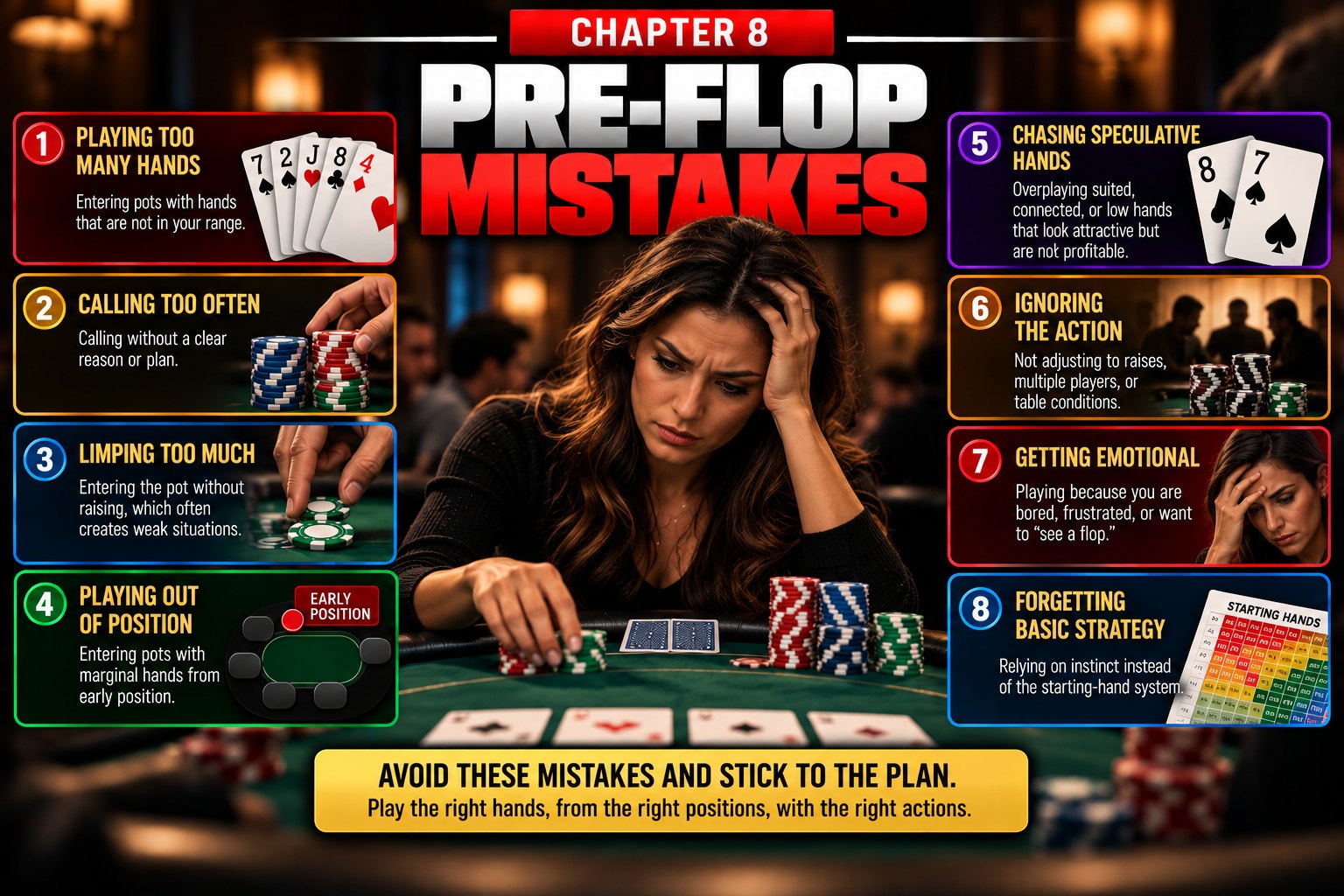
Most pre-flop mistakes are not complicated. They come from repeatedly doing things that the Basic Strategy system is designed to prevent. Playing too many hands, calling too often, limping too much, ignoring position, and becoming attached to attractive-looking cards can turn an otherwise simple pre-flop decision into a difficult hand. The purpose of this chapter is to recognize those mistakes before they become habits.
The first and most common mistake is playing too many hands. Poker gives you two cards, but that does not mean you are supposed to play them. The starting-hand system exists partly to tell you which hands belong in your normal range and which hands should normally be folded. When you begin entering pots with hands outside that range, you are giving yourself more difficult decisions before the flop and more difficult situations after it.
Playing too many hands often begins with a simple thought: “This hand isn't that bad.” But “not that bad” is not the same as being a hand you should play. A hand can have some attractive features and still belong in the folding range. The solution is not to find a reason to play it. The solution is to recognize where it belongs in the system and follow that decision.
Another common mistake is calling too often. Calling can be a correct poker action, but it should not become the default response whenever you are uncertain. Players sometimes call because they want to see the flop, because they do not want to fold a hand that looks playable, or because raising feels too aggressive. None of those reasons automatically makes the call correct.
A call should have a place in your strategy. If the hand belongs in a calling range for the situation, call. If it belongs in a raising range, raise. If it belongs in the folding range, fold. The important point is to avoid using calling as a way to postpone a decision you already know you should make.
Limping too much creates a similar problem. Limping allows you to enter the pot cheaply, but cheap does not automatically mean good. When you limp, you may allow several players to enter behind you, create a multiway pot, and reach the flop with a hand that was never particularly strong to begin with.
Limping can have a place in certain situations, but it should not become your normal response simply because you want to see a flop. If your hand is strong enough to enter and the situation calls for a raise, raising is usually more consistent with the system. If your hand is not strong enough to enter, folding is better than limping just to participate.
The opposite mistake is raising too little. Some players recognize that they should be entering pots aggressively but become uncomfortable putting enough chips into the pot. They make tiny raises that do little to establish the pot or discourage other players from entering.
Basic Strategy calls for consistent opening decisions. Your standard raise should be large enough to serve its purpose without becoming unnecessarily complicated. You should not choose your raise size based on fear or uncertainty. A consistent basic raise gives your pre-flop strategy structure and makes the decision easier to execute.
There is also such a thing as raising too much. Aggression is useful, but aggression without discipline is not Basic Strategy. Making unnecessarily large raises can put more chips at risk than the situation requires and can create larger pots with hands that may not be strong enough to support them.
The goal is not to raise as much as possible. The goal is to use the appropriate action for the hand and situation. A strong starting hand does not require you to abandon consistency. Your basic raise should remain part of the system rather than becoming an emotional reaction to receiving a good hand.
Another major mistake is ignoring position. A starting hand does not have exactly the same value from every seat at the table. Earlier positions require greater discipline because more players remain to act. Later positions provide more information and can allow a wider range.
Ignoring position often happens when a player looks only at the cards. The player sees a hand that appears playable and forgets to ask where the hand is being played. But position is part of the starting-hand decision. A hand that belongs in a late-position range may not belong in an early-position range.
The correction is simple: recognize your position before deciding what to do with your starting hand. Do not evaluate the cards in isolation. The starting-hand system and the position system work together.
A related mistake is playing hands because they “look good.” This is one of the easiest traps to fall into. High cards look good. Suited cards look good. Connected cards look good. A hand containing a face card can feel stronger than it actually is. But poker decisions should be based on the system, not the appearance of the cards.
A hand can look attractive and still be a fold. A hand can look ordinary and still belong in your range. What matters is where the hand belongs in the starting-hand system and how position and action affect the decision.
This becomes particularly dangerous with speculative hands. Suited connectors, small pairs, and other hands can have potential, but potential is not the same thing as immediate strength. Players often imagine the straight, flush, set, or two pair they might make and forget how often those improvements fail to appear.
The purpose of Basic Strategy is not to eliminate speculative hands from poker. It is to prevent the possibility of improvement from becoming an automatic reason to continue. A speculative hand should only be played when it belongs in the strategy for the situation. If it does not, the fact that it could make a strong hand later is not enough.
Another mistake is defending hands that should simply be folded. This often happens when a player has already invested chips or believes that folding would somehow mean losing the money already put into the pot. But chips already invested do not create an obligation to continue.
Every new decision should be based on the situation that exists now. If a hand should be folded when facing a raise, the correct action remains folding even if you previously limped or called. Continuing simply because you have already invested chips can turn a small mistake into a much larger one.
The same principle applies when you are facing a raise and believe that your hand is “probably good enough.” Probably is not a strategy. If the hand belongs in the folding range, fold. If it belongs in the calling range, call. If it belongs in the re-raising range, re-raise. The system gives you a predetermined structure so that you do not have to defend every hand you happen to like.
One of the most difficult mistakes to eliminate is becoming emotionally attached to a starting hand. You may receive a hand you have been waiting for. You may have folded for several rounds and finally receive something playable. You may simply like a particular hand. None of those things changes what happens on the table.
Emotional attachment can make players reluctant to fold when the situation changes. They begin thinking about how strong the hand was before the action instead of recognizing what the current situation requires. A good starting hand is not a guarantee that you should continue forever. The hand still has to fit the situation.
The best way to prevent emotional attachment is to make the starting-hand decision as objective as possible. Recognize the hand. Recognize the position. Recognize the action. Apply the system. Once the decision has been made, do not create a new reason to continue simply because you like the cards.
These mistakes are closely connected. Playing too many hands leads to difficult situations. Difficult situations encourage excessive calling. Excessive calling can lead to multiway pots and larger pots with marginal hands. Ignoring position makes all of those problems worse. Playing hands because they look good encourages speculative decisions. Becoming attached to a hand makes folding more difficult when the situation changes.
Basic Strategy breaks that chain by giving you a predetermined process.
See the hand. Recognize the position. Look at the action. Identify the correct range. Make the decision.
That process should be simple enough to repeat every time you play.
The important thing is not to expect yourself to eliminate every mistake immediately. Instead, learn to recognize the patterns. If you notice that you are playing hands outside your range, correct it. If you are calling because you are unsure what else to do, recognize the problem. If you are limping simply to see a flop, return to the starting-hand and entering-the-pot rules. If you are ignoring position, make position the first thing you identify.
The goal is consistency. You do not need to find a brilliant pre-flop play every time. You need to avoid the common mistakes that cause you to enter pots you should not enter or continue with hands that should already have been folded.
A strong Basic Strategy player understands that folding is a decision, calling is a decision, raising is a decision, and staying out of the pot is a decision. None of these actions should be controlled by boredom, curiosity, excitement, frustration, or attachment to the cards.
The more automatic your basic decisions become, the easier it is to recognize when you are about to make one of these mistakes. You see a marginal hand in early position and recognize that it should normally be folded. You see a speculative hand facing a raise and recognize that the possibility of improving does not automatically justify a call. You notice that you are considering a call simply because you have already invested chips and recognize that the previous investment should not control the current decision.
That is what Basic Strategy is designed to accomplish. It gives you a system that can be learned well enough that the common mistakes become easier to identify and avoid.
Pre-flop discipline is not about playing fewer hands simply for the sake of playing fewer hands. It is about entering the right pots, from the right positions, with the right hands, and using the appropriate action. When the hand does not qualify, stay out. When it does qualify, follow the system.
The fewer unnecessary pre-flop mistakes you make, the fewer difficult situations you create for yourself after the flop. Good poker begins before the community cards appear, and one of the easiest ways to improve your game is to stop creating problems before the hand has even developed.
PART III — AUTOMATIC POST-FLOP STRATEGY