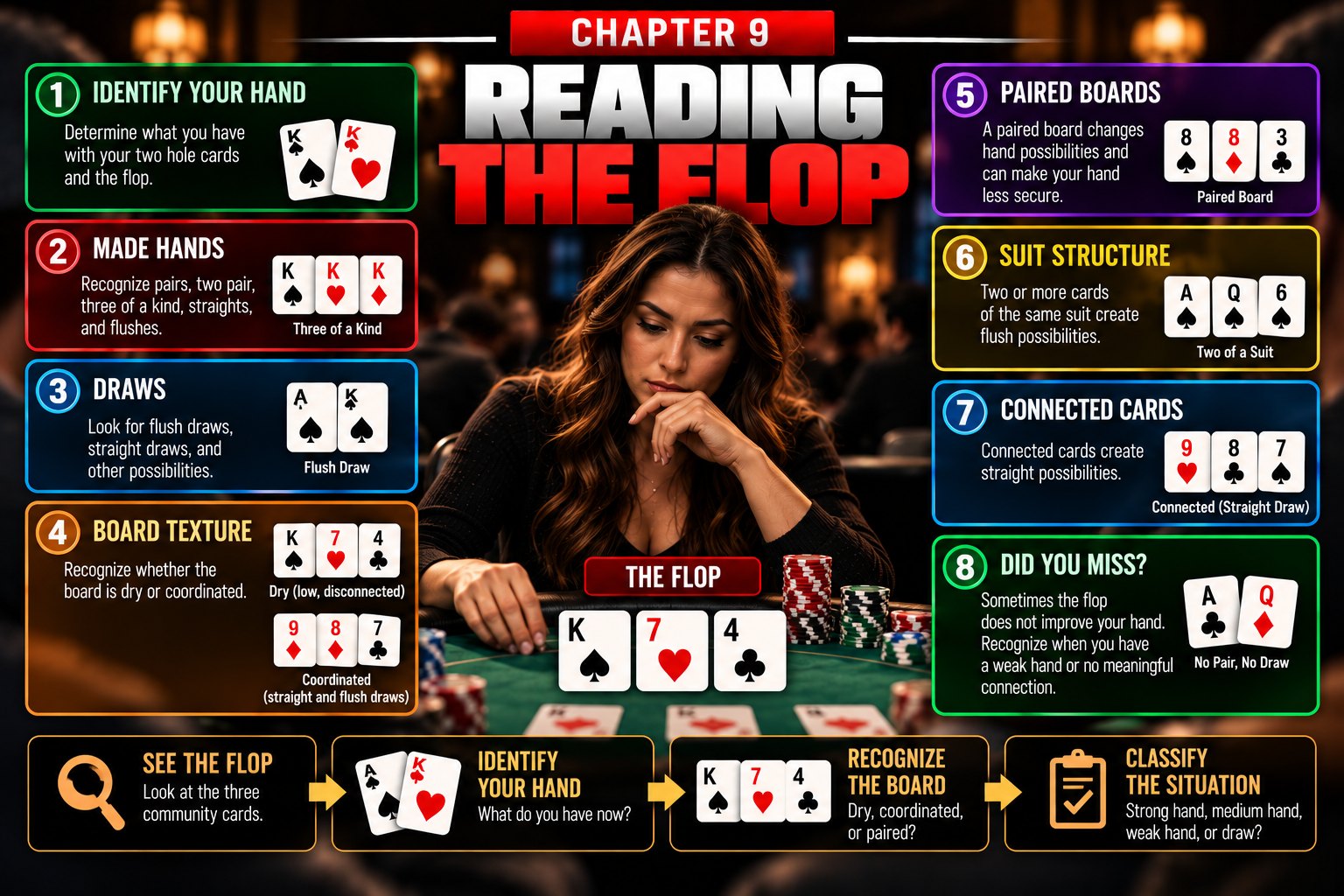
The flop is where the two cards you started with meet the first three community cards. Everything changes here. Before the flop, you were deciding whether your starting hand was worth entering the pot with. After the flop, you have new information and must determine what your hand has become, what the board is showing, and how strong your position is.
Reading the flop does not mean trying to figure out exactly what another player holds. That is outside the purpose of Basic Strategy. The objective here is much simpler: recognize what the board has done to your hand and understand the basic strength of the situation quickly.
The first thing to recognize is whether you have a made hand. A made hand is a hand that already has a completed poker combination. You may have a pair, two pair, three of a kind, a straight, a flush, or another completed hand. Recognizing what you have is the first post-flop decision skill because everything that follows depends on your actual hand strength.
A pair is often the first made hand a player recognizes. But not all pairs have the same value. You may have paired one of your hole cards, paired the board, or have a pocket pair that remains higher or lower than the cards on the board. The fact that you have a pair does not automatically mean you have a strong hand. You need to recognize where that pair fits in the situation.
Two pair is stronger because you have two separate pairs. Three of a kind is stronger still. A straight or flush can be an even stronger made hand, depending on the exact cards involved. The important point is to recognize the hand you actually have rather than treating all made hands as though they were equal.
The flop can also pair the board. When two or more players are using a paired board, the possibilities of the hand change. A player holding one pair may find that the board creates additional possibilities for stronger hands. A paired board can therefore make an otherwise simple hand more complicated.
You also need to recognize draws. A drawing hand is not a completed hand, but it has the potential to improve. A player may have a flush draw, straight draw, or another type of drawing opportunity. Draws are important because they can change the value of your hand and influence your later decisions.
The key is to separate what you have now from what you might have later. A draw is not a made hand. A possible straight is not a straight. A possible flush is not a flush. Basic Strategy requires you to recognize the difference so that you do not overvalue a hand simply because it has potential.
The flop also creates board texture. Some flops are relatively dry, meaning they do not offer many immediate drawing possibilities. Others are coordinated, meaning the cards work together in ways that create more straight and flush possibilities. Recognizing whether the board is dry or coordinated helps you understand how dangerous or dynamic the situation may be.
A dry board may contain disconnected cards with fewer obvious drawing possibilities. A coordinated board may contain connected cards, multiple cards of the same suit, or other features that create more ways for hands to improve. The purpose of recognizing this is not to calculate every possible combination. It is to understand whether the board is relatively simple or whether it contains more possible threats.
Paired boards deserve special attention because the pairing changes the structure of the hand. A board such as 8-8-3 is different from a board such as 8-7-3. The paired board creates different hand possibilities and changes how certain hands should be viewed.
Your job at this stage is recognition. You do not need to spend several minutes analyzing every possible hand that could exist. You need to see the board and understand its basic character.
The same applies when the flop gives you three cards of different suits compared with a flop containing two cards of the same suit. A coordinated suit structure creates additional drawing possibilities. Connected cards can create straight possibilities. A paired board creates another group of possibilities. These are basic patterns you should learn to recognize immediately.
Reading the flop also means recognizing when the flop misses you. You may enter the pot with a strong starting hand and see a flop that does not improve it. You may have two overcards, a small pair, a weak pair, or simply no meaningful connection to the board. Missing the flop is a normal part of poker.
The mistake is believing that the strength of your starting hand automatically survives the flop. It does not. The flop has changed the situation, and you must recognize what you have now.
At the same time, do not make the opposite mistake of assuming that missing the flop means you must automatically give up. The next decision depends on the situation, and later chapters will deal with what to do after recognizing your hand and the board. Chapter 9 is about seeing the situation correctly before making that next decision.
The most important habit is therefore fast recognition. When the flop appears, identify your hand before anything else. Then look at the board itself. Ask what the board has changed, what draws are possible, whether the board is paired, and whether the texture is dry or coordinated.
This process should become increasingly automatic. You should not have to stare at the board trying to remember the names of every possible poker hand. With practice, the basic combinations become immediate.
You should also recognize the difference between your hole cards and the board. Your two private cards matter, but so do the community cards available to everyone. Your final hand is made from the best five-card combination available to you. The flop is the first point at which you can begin accurately identifying that combination.
This is why the flop is such an important transition point. Before the flop, starting-hand strength and position dominate your decision. After the flop, those factors still matter, but you now have actual information about the hand you have made and the board on which you are playing it.
The board can improve you, partially improve you, or miss you completely. It can create a strong made hand, a medium-strength hand, a weak hand, or a draw. It can also become dangerous even when it does not appear dangerous at first glance.
Your starting hand therefore becomes only part of the picture.
For example, a player may begin with a strong pocket pair and see a flop containing three low cards. The pocket pair may still be a strong hand. Another player may begin with a suited hand and connect with two cards of the same suit on the flop, creating a flush draw. Another player may begin with connected cards and see a flop that creates an open straight possibility. Each player started with two cards, but the flop created three very different situations.
You need to recognize those situations without turning them into complicated calculations.
The basic categories are enough to begin: strong made hand, medium-strength hand, weak hand, or draw. Then recognize the board: dry, coordinated, or paired. That gives you a basic picture of what has happened.
One of the most important skills is recognizing your basic hand strength without becoming emotionally attached to it. A player who makes a pair may immediately feel that the hand is strong. A player who starts with a premium pocket pair may continue believing the hand is unbeatable even when the board changes significantly. A player with a flush draw may already imagine the finished flush.
Basic Strategy requires you to stay with what is actually on the table.
A pair is a pair. A draw is a draw. A straight is a straight. A dangerous board is a dangerous board. Recognition comes before action.
This is also where the discipline learned in the first part of the book becomes important. The goal is not to analyze everything at once. It is to identify the information that matters and use it in the proper sequence.
Start with your hand. Then recognize the board. Then recognize the basic possibilities. Once you have done that, you are ready to make the next decision.
The entire process can be reduced to a simple pattern:
See the flop → identify your hand → recognize the board → classify the situation.
You should be able to perform those steps quickly because they are based on information that is directly visible. There is no need to guess. The cards are right in front of you.
That is why flop reading is a recognition skill. You are not trying to predict the future. You are recognizing the present.
As you practice, begin showing yourself different flops and naming what you see. Identify pairs, two pair, three of a kind, straights, flushes, and draws. Then identify whether the board is dry, coordinated, or paired. Repeat the exercise until you can recognize the basic situation immediately.
The purpose of this practice is not to make you an analyst. It is to make the board familiar.
Once the flop becomes familiar, your decisions become easier because you are no longer spending unnecessary time figuring out what you are looking at. You recognize the hand. You recognize the board. You recognize the situation.
That is the foundation of Basic Flop Strategy.
Read the flop accurately. Recognize what you have. Recognize what the board is doing. Then move to the next decision.
Fast recognition comes first. Action comes second.