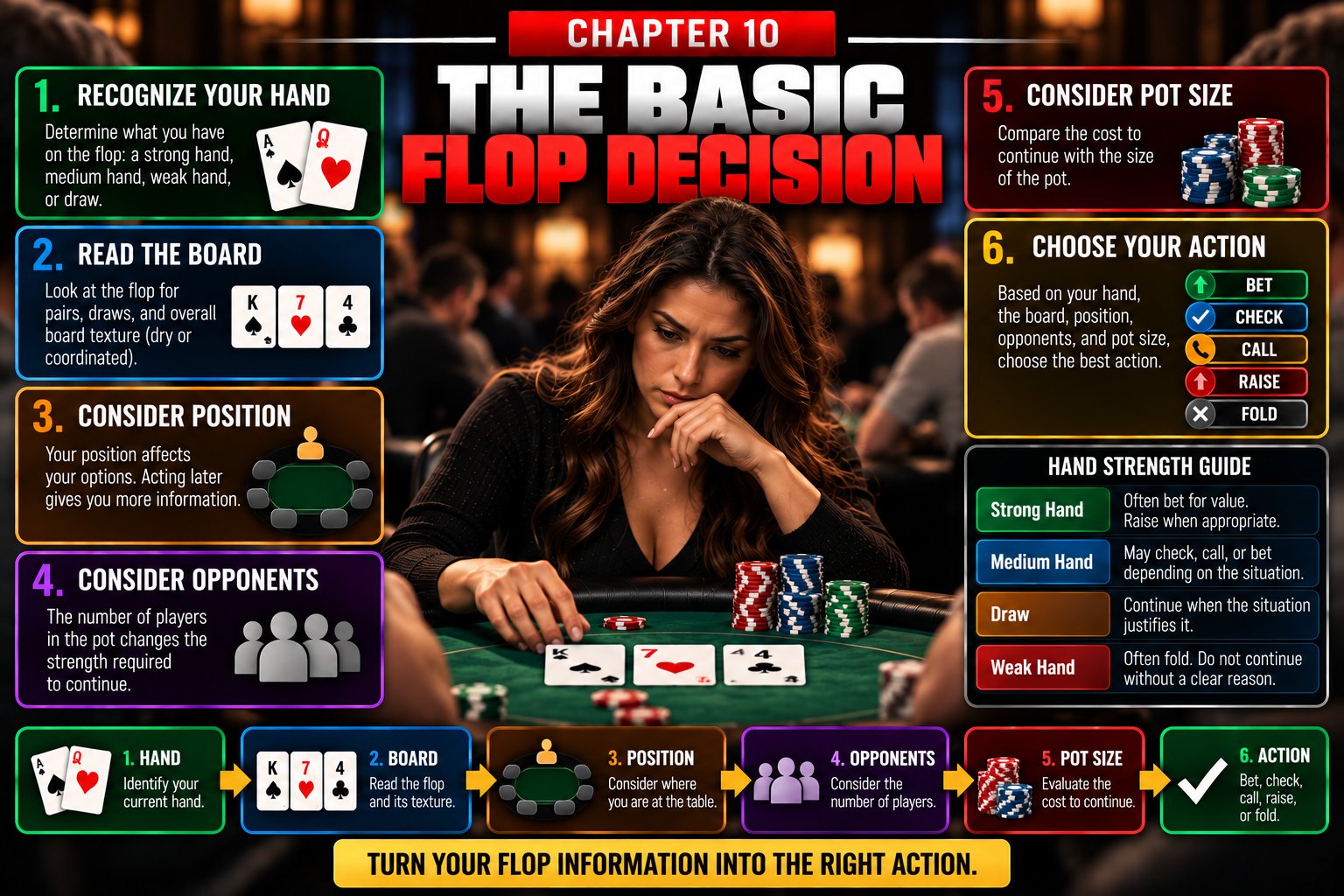
Reading the flop tells you what you have. The next step is deciding what to do with it. This is where the information you recognized in the previous chapter becomes an actual poker decision. You may have a strong made hand, a medium-strength hand, a weak hand, or a draw. Now you must decide whether to bet, check, call, raise, or fold.
The purpose of Basic Flop Strategy is not to make every flop decision complicated. It is to give you a repeatable way to respond to the situations you see. You already learned how to recognize your starting hand, your position, and the basic strength of your hand after the flop. Now those pieces come together.
The first question is whether you should continue with the hand at all. If your hand is weak and the situation gives you no reason to continue, folding may be the correct decision. If your hand has enough strength or potential to continue, you then determine the appropriate action. This prevents you from automatically continuing simply because you entered the pot before the flop.
A common mistake is believing that once you have entered a pot, you are committed to playing the hand through the flop. You are not. The flop creates new information, and every new street creates a new decision. A hand that was worth playing before the flop may not be worth continuing with after the flop.
When you have a strong hand, betting is often the basic way to build the pot and get value. Strong hands should not automatically be hidden simply because you are afraid another player might fold. Your objective is to play the hand according to its strength and the situation. If the hand is strong enough to bet, betting can be the straightforward decision.
Checking can also be correct with a strong hand. Checking does not automatically mean weakness. There are situations in which the board, position, number of opponents, or previous action make checking a reasonable way to continue. The important point is that checking should be a deliberate part of the system rather than something you do because you are afraid to bet.
With a medium-strength hand, the decision becomes more dependent on the circumstances. A medium hand may be strong enough to continue but not strong enough to build a large pot automatically. You may check, call, or sometimes bet depending on the situation. The goal is to recognize that medium strength requires more caution than a very strong made hand.
One of the biggest mistakes with medium-strength hands is overvaluing them. Making a pair does not mean you have a hand that must continue regardless of what happens. A pair may be useful, but the board and the action still matter. Basic Strategy requires you to recognize the strength of the hand you actually have rather than becoming attached to the fact that you connected with the flop.
With a weak hand, the decision is often simpler. If you have little connection to the board and no meaningful reason to continue, folding can prevent you from putting additional chips into a situation that is unlikely to improve. You do not need to manufacture a reason to stay in the hand.
A weak hand can sometimes be used for a bet in the right circumstances, but Basic Strategy should not turn every weak hand into a bluff. Betting without a reason is another form of automatic play, and it is not the kind of automatic play this system is designed to create. Automatic does not mean blindly repeating one action. It means recognizing the category of situation and applying the appropriate response.
Drawing hands require their own recognition. A draw has potential, but it is not yet a completed hand. You may have a flush draw or straight draw and therefore have a reason to continue, but you still need to decide whether betting, calling, raising, or folding is appropriate.
The important distinction is between having a draw and having a made hand. A draw can improve, but improvement is not guaranteed. This means you should not treat every draw as though it were already strong. The strength of the draw, the board, the pot, your position, and the action all help determine whether continuing is reasonable.
Position remains important after the flop. Acting later gives you more information about what other players have done. Acting earlier means you have less information and may have several players still able to respond after you. The same hand can therefore require a different approach depending on where you are sitting.
This does not mean you need to perform a complicated calculation every time your position changes. You simply recognize that position affects the decision. A strong hand may be easier to play from any position, while a medium or marginal hand can become more difficult when you must act first.
The number of opponents also matters. A hand that is comfortable against one opponent may not be as comfortable against several opponents. When more players are involved, there are more opportunities for someone to have connected strongly with the board.
This is particularly important with medium and weak hands. A marginal pair may be reasonable against one opponent but much less attractive when several players remain in the pot. A draw may still have potential, but you must recognize that more players create more possible strong hands and more possible competing draws.
The size of the pot matters as well. A small pot and a large pot create different situations because the amount you are risking and the amount you can win are different. Basic Strategy does not require you to perform complicated mathematical calculations on every flop. It requires you to recognize whether the size of the pot makes continuing with your hand reasonable.
This is where the basic idea of price begins to appear, but the purpose here is still practical. You should know what you are being asked to risk and what you are trying to win. If the amount required to continue is small relative to the situation, continuing may make sense. If you are being asked to put a large amount into a pot with a weak hand, folding may be the simpler decision.
The important thing is to avoid treating every flop decision as though it has only one correct action regardless of the circumstances. Basic Strategy gives you a framework, but poker still requires you to recognize the situation in front of you.
A useful decision sequence is Hand Strength → Board → Position → Opponents → Pot → Action. First recognize what you have. Then recognize what the board is doing. Consider your position and how many opponents remain. Recognize the size of the pot. Then choose the appropriate action.
That action may be a bet. If you have a strong hand or a situation where betting makes sense, betting allows you to put money into the pot with a purpose. It may be a check when there is no need to bet or when checking provides the better basic response. It may be a call when your hand is strong enough to continue but a raise is not required. It may be a raise when your hand and situation justify additional aggression. Or it may be a fold when continuing is not justified.
The key is that none of these actions should become automatic by themselves. You do not want to become the player who always bets because you have a pair, always checks because you are afraid, always calls because you want to see another card, or always raises because you believe aggression is automatically good.
The goal is automatic recognition followed by appropriate action.
This distinction is important. Automatic poker does not mean pressing the same button every time. It means that you recognize familiar situations quickly enough that you do not have to rebuild your entire decision-making process from the beginning.
Suppose you flop a strong made hand. You recognize it immediately. You look at the board and determine whether it is relatively safe or coordinated. You recognize your position and the number of opponents. You look at the pot. Then you choose the appropriate action.
Now suppose you flop a weak hand with no meaningful draw. The process is much shorter. You recognize that the hand is weak, recognize the board and action, and determine whether there is a legitimate reason to continue. If there is not, you fold.
The same process applies to a medium hand. You recognize that it is not strong enough to treat automatically like a premium hand, but it is not necessarily weak enough to discard immediately. You consider the basic circumstances and select the appropriate action.
This approach keeps you from making one of the most common post-flop mistakes: treating every hand as though it deserves the same level of commitment. Strong hands, medium hands, weak hands, and draws are different categories. The board, position, opponents, and pot determine how those categories should be handled.
You also need to avoid curiosity decisions. Calling simply because you want to see the next card is not a strategy. Calling because you want to find out what another player has is not a strategy. Continuing because you already invested chips is not a strategy. Every decision should have a reason within the system.
The same principle applies to betting. Do not bet simply because you believe you are supposed to be aggressive. A bet should have a purpose. You may be betting a strong hand for value, betting a draw, protecting a hand, or taking an appropriate basic aggressive action. The reason for the bet should be clear enough that you are not simply pressing the betting button because checking feels weak.
The flop decision should also be made without trying to solve the entire hand at once. You do not know what the turn will bring. You do not need to predict every future card before making the current decision. Recognize the information available now and make the best basic decision with that information.
This is one of the central ideas of One Minute Poker. You are not trying to perform a complete analysis of every hand. You are trying to recognize the current situation and execute the appropriate response.
With practice, the process becomes faster. You see the flop, recognize your hand, recognize the board, consider the basic circumstances, and choose your action. You do not need to spend unnecessary time debating information you have already learned.
The basic flop decision can therefore be reduced to a simple routine: Recognize your hand. Recognize the board. Consider position and opponents. Consider the pot. Choose the action.
That is the transition from reading the flop to playing the flop.
The objective is not to make every flop decision perfect. The objective is to make your basic decisions consistent. When you have a strong hand, know how to treat it. When you have a medium hand, recognize its limitations. When you have a weak hand, know when to let it go. When you have a draw, recognize that it is a draw rather than a made hand.
Then consider the situation around that hand and act accordingly.
Basic Flop Strategy is therefore about turning recognition into action. You have learned what the flop means. Now you learn what to do about it.
See the hand. Read the board. Recognize the situation. Choose the action.
With enough repetition, that process becomes automatic, and the basic flop decision becomes another part of One Minute Poker that you no longer have to overthink.