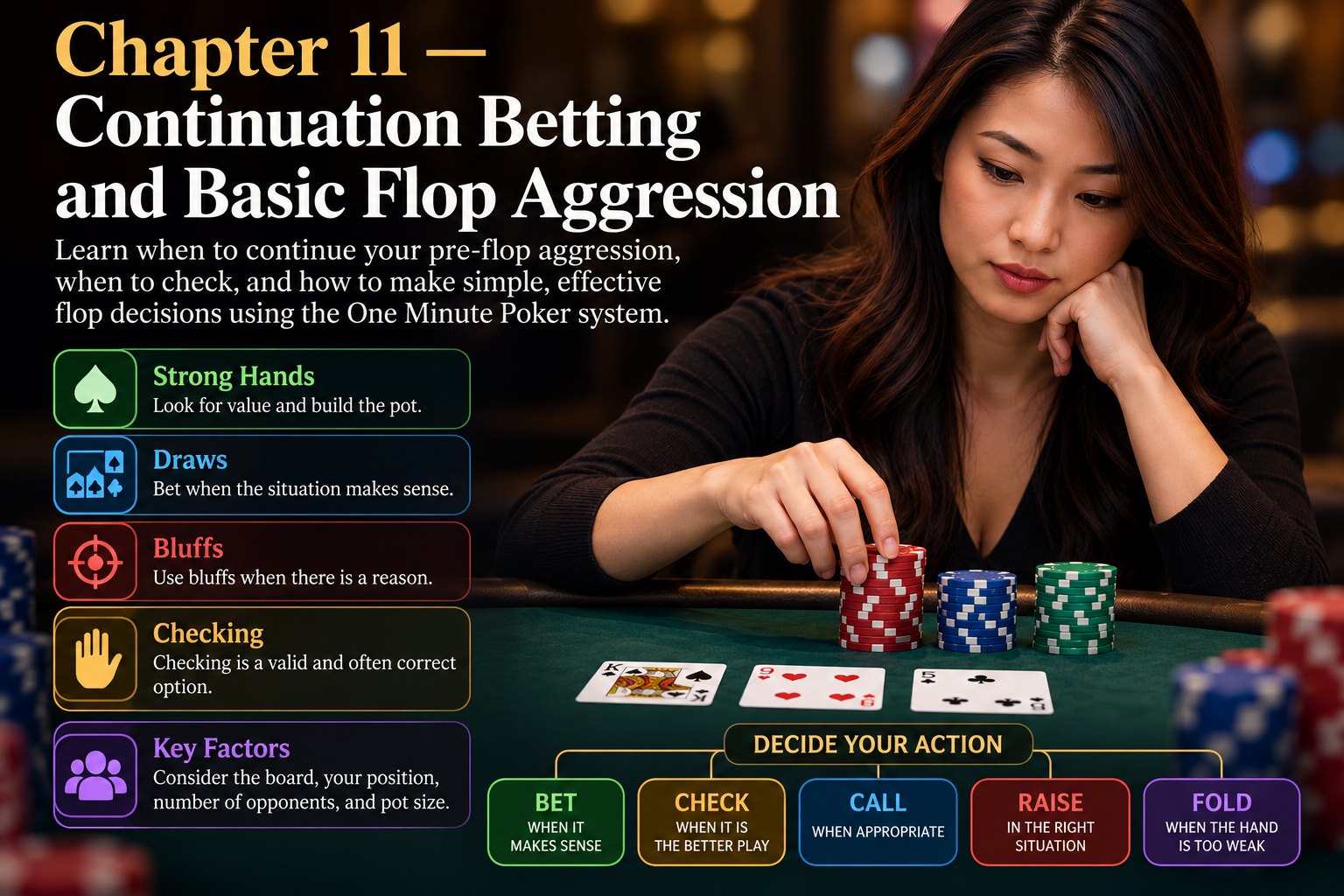
A continuation bet is a flop bet made by the player who was the aggressor before the flop. You raised before the flop, the flop arrived, and you now have the opportunity to continue your aggression. This is a basic and important part of poker, but it should not become an automatic action.
The reason continuation bets exist is simple. When you raised before the flop, you represented a range of hands strong enough to enter the pot aggressively. The flop gives you new information. Sometimes that information supports another bet. Sometimes it does not. Your job is to recognize the difference.
A continuation bet makes sense when the flop and your hand give you a reason to continue applying pressure. It may be a value bet with a strong hand, a bet with a draw, or a basic bluff when the situation provides a reasonable opportunity. But the fact that you raised before the flop does not mean you must bet every flop.
This is one of the most important distinctions in Basic Strategy: automatic recognition does not mean automatic aggression.
You should first recognize what the flop did to your hand. Did you make a strong hand? Did you make a medium-strength hand? Did you miss the flop? Did you pick up a draw? Once you know the answer, you can decide whether continuing with a bet makes sense.
With a strong hand, betting is often the simplest decision. You have a hand that can win the pot, and betting gives weaker hands an opportunity to continue while building the pot when you are ahead.
This is value betting. You are betting because your hand is strong enough that worse hands may call. You are not betting simply because you raised before the flop.
A strong pair, two pair, three of a kind, straight, flush, or other strong made hand may provide a good reason to bet. The stronger your hand, the more important it can be to recognize opportunities to get value rather than simply checking every time.
That does not mean every strong hand must automatically be bet. Checking remains one of your basic options. The board, your position, the number of opponents, and the action can all affect the decision. The important thing is to make the decision deliberately rather than following a rule that says, “I have a strong hand, so I must bet.”
Draws are another situation in which betting may make sense. A flush draw or straight draw is not yet a completed hand, but it has the potential to improve. Betting a draw can give you more than one way to win the pot.
You may complete the draw on a later street, or your bet may cause an opponent to fold immediately. This makes a draw capable of supporting aggression in the right situation.
But a draw is still a draw. Do not treat a possible straight or flush as though you already have one. The draw has potential, but the improvement has not happened yet. Recognizing that difference keeps you from overvaluing drawing hands.
Basic bluffing also has a place in flop strategy. A bluff is a bet made when you do not currently have the best hand but believe the bet may cause an opponent to fold.
The important word is may. A bluff should have a reason. Basic Strategy does not require you to bluff every time you miss the flop. It does not require you to turn every continuation bet into an automatic bluff.
If you raised before the flop and completely missed the board, you still have to recognize the situation. Sometimes a continuation bet makes sense. Sometimes checking is better. Sometimes the hand is simply not worth continuing.
A missed flop does not automatically mean you should give up, but it also does not automatically mean you should fire a continuation bet.
Checking is therefore an important part of basic flop aggression. Checking is not automatically weakness. It is one of the available actions, and there are many situations in which checking is the better decision.
You may check because your hand is weak, because the board is unfavorable, because several opponents remain, because your medium-strength hand does not need to build a large pot, or because you simply have no good reason to bet.
The important principle is aggression should have a purpose. Betting a strong hand for value has a purpose. Betting an appropriate draw has a purpose. Bluffing when there is a reasonable opportunity to make a better hand fold has a purpose. Betting simply because you raised before the flop does not automatically have a purpose.
One of the most common mistakes is automatic continuation betting. The player raises before the flop, the flop arrives, and the player immediately bets without properly recognizing the board or the hand.
That is not the kind of automatic play One Minute Poker is designed to create. The goal is to make recognition automatic. You should quickly recognize what your hand became on the flop and then choose the appropriate action. The system should make the decision faster, not make you blind to the situation.
Another mistake is automatic aggression. A player learns that aggressive poker is valuable and then begins betting and raising simply because aggression feels like the correct approach.
Aggression is valuable when it is appropriate. It is not valuable simply because it is aggression.
A strong hand may deserve aggression. A draw may provide an opportunity for aggression. A bluff may sometimes be appropriate. But a weak hand on an unfavorable board does not automatically become a betting hand because you were the pre-flop raiser.
The number of opponents also matters. A continuation bet against one opponent is different from a continuation bet into several opponents. The more players involved, the greater the possibility that someone connected strongly enough with the flop to continue.
You do not need to profile those players or guess exactly what they hold. You simply recognize the basic situation. More opponents means more possible hands that can continue.
The board matters as well. A dry flop may provide a different betting opportunity from a coordinated flop. Connected cards and multiple cards of the same suit create more possible draws. A paired board changes the possible hand combinations. These are the basic board-recognition skills you learned in Chapter 9. Now those skills become part of the betting decision.
Your position also matters. Acting later gives you more information about what other players have done. Acting earlier means more players remain who can respond to your bet. A continuation bet should therefore be considered within the position and not treated as an isolated action.
The pot size is another basic consideration. You should know what is already in the pot and what you are risking when you bet. A continuation bet does not need to be enormous to accomplish its purpose. Consistent and reasonable sizing keeps the strategy simple and prevents you from risking too much simply because you want to appear aggressive.
The same principle applies to value betting. You want to get paid by worse hands without unnecessarily putting excessive amounts into the pot. The purpose of the bet is to make the most of your hand, not simply to make the pot as large as possible.
A useful basic framework is:
Strong hand: Look for value.
Draw: Recognize the potential and determine whether betting makes sense.
Weak hand: Do not automatically bluff.
Medium hand: Recognize that checking may be better than automatically building the pot.
Unfavorable situation: Checking or folding may be better than forcing aggression.
These are recognition guidelines rather than absolute commands. They help you avoid the two major mistakes this chapter is designed to prevent: automatic continuation betting and automatic aggression.
A continuation bet should be viewed as an extension of your pre-flop strategy, not as an obligation. You raised because your starting hand belonged in your range. The flop arrived. Now you have new information. Use it.
The player who understands this does not feel compelled to bet every time the flop appears. Instead, the player looks at the hand and board and asks a simple question: Does continuing my aggression make sense here?
If the answer is yes, bet. If the answer is no, checking is available. If the hand is too weak to continue and there is no good reason to bluff, folding may be the correct decision.
That is the difference between purposeful aggression and automatic aggression.
The objective is not to become the most aggressive player at the table. The objective is to become a player whose aggression is controlled by the Basic Strategy system.
You should recognize a strong hand quickly, recognize a draw quickly, recognize a missed flop quickly, and recognize a dangerous board quickly. Then you choose the action that fits what you have recognized.
This keeps One Minute Poker simple. You are not trying to determine exactly what another player holds. You are not profiling opponents. You are not using the Four Conditions. You are not applying advanced exploitation. You are simply recognizing your hand, recognizing the board, recognizing the basic circumstances, and choosing the appropriate action.
Continuation betting is therefore a tool, not a rule that must be used every time.
Basic flop aggression works the same way.
Bet when the situation gives you a reason to bet. Check when checking is the better decision. Do not confuse aggression with automatic betting.
The objective is to make good flop decisions quickly, consistently, and without unnecessary analysis.
Recognize the hand. Recognize the board. Recognize the situation. Then decide whether aggression makes sense.