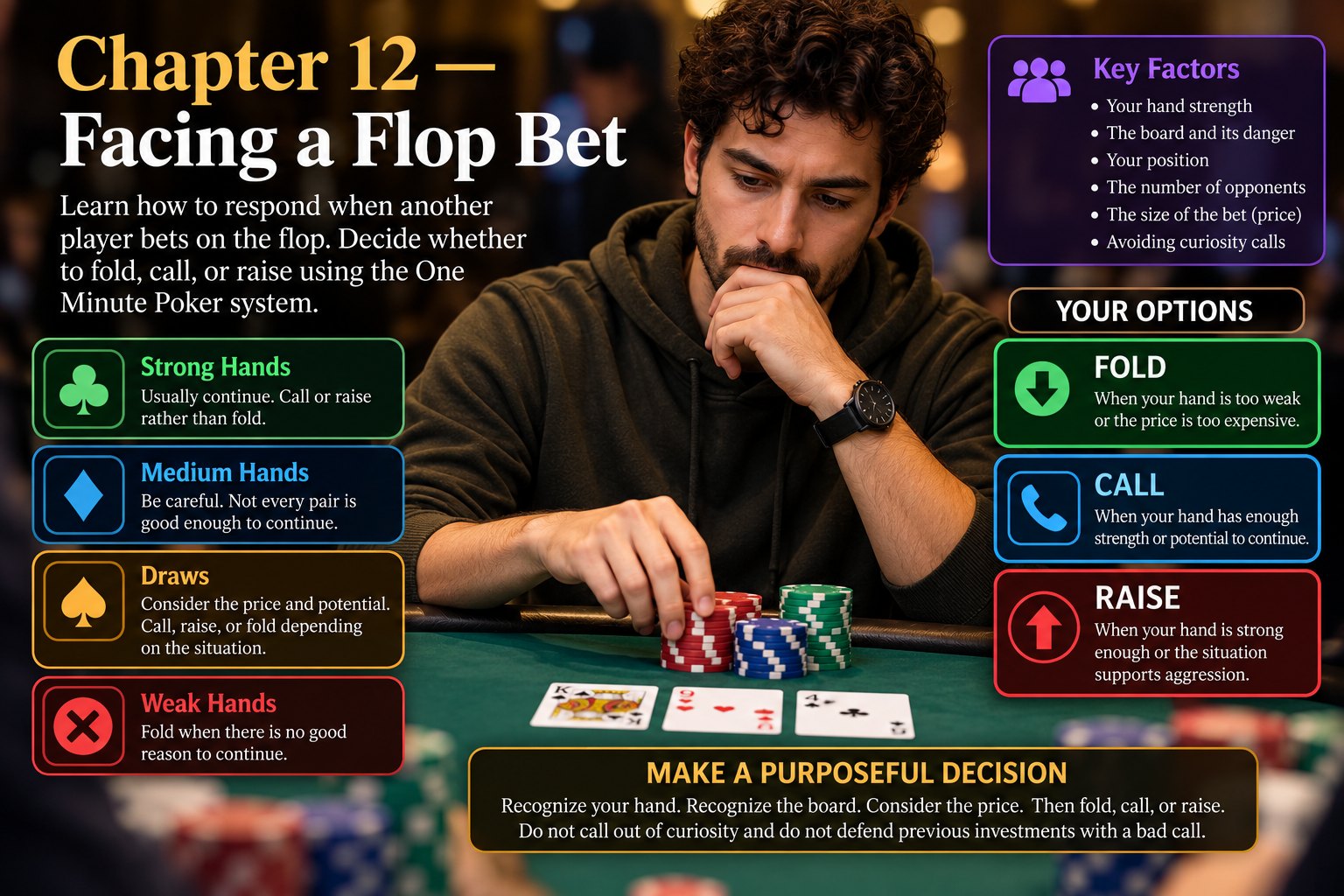
You have learned how to read the flop and make your own basic flop decisions. Now the situation changes. Instead of deciding whether to bet first, another player has bet and the decision is in front of you. You must decide whether to fold, call, or raise. This is one of the most important defensive decisions in Basic Strategy because a player can make just as many mistakes by continuing too often as by folding too often. The goal is not to defend every hand. The goal is to recognize your hand, recognize the board, recognize the basic situation, and respond appropriately.
The first question is simple: Should I continue? If your hand is too weak, folding is often the correct answer. If your hand is strong enough to continue, you then decide whether calling or raising is the better action. If you have a draw, you determine whether the draw provides enough reason to continue. The decision should be based on the hand and situation rather than curiosity or the desire to see another card.
A strong hand usually gives you the easiest defensive decision. If you have a strong made hand and another player bets, folding is generally not the response you are looking for. Your choices will normally be between calling and raising. Calling can allow the other player to continue betting while keeping the pot under control. Raising can build the pot when your hand is strong enough to want additional money in the middle. The important point is that a strong hand should not automatically be played passively simply because someone else has bet.
If the board is dangerous, however, you still need to recognize what is happening. A strong hand on a changing board may require more attention than a strong hand on a relatively safe board. You do not need to predict every possible hand your opponent could have. You simply need to recognize that the board can affect the strength of your hand.
A medium-strength hand requires more caution. A pair may be good enough to continue, but that does not mean you must call every bet. The size of the bet, the board, your position, the number of opponents, and the strength of your hand all matter. Medium hands are where many unnecessary calls occur. A player sees a pair and thinks, “I have something, so I have to continue.” That is not Basic Strategy. Having a hand is not the same as having a hand that is worth continuing with.
You should recognize the actual strength of your hand and compare it with the situation in front of you. Sometimes calling is reasonable. Sometimes raising is appropriate. Sometimes folding is the better decision.
Draws require the same discipline. A flush draw or straight draw gives you potential, but you do not have the completed hand yet. When someone bets, you must decide whether continuing with the draw makes sense. A call may be reasonable when the price is acceptable and the draw has enough potential. A raise may sometimes be appropriate when the draw can support aggression. Folding can also be correct when the price is too expensive or the situation does not justify continuing. The important point is not to chase every draw simply because you might improve. A draw is a possibility, not a guarantee.
This is where basic price considerations become useful. You do not need complicated mathematics every time someone bets. You need to recognize what you are being asked to risk and what you could realistically win. If the bet is small relative to the pot, continuing may be easier to justify. If the bet is large, you are being asked to risk more. The larger the price, the stronger the reason you need to continue. Basic Strategy is designed to keep these decisions practical. You should be able to recognize an obviously reasonable price, an obviously expensive price, and situations where the cost of continuing is simply too high for the hand you have.
A weak hand is usually the easiest situation to handle defensively. If you have little connection to the board, no meaningful draw, and no other basic reason to continue, folding is often the correct response. This is where discipline becomes important. You do not need to prove that your opponent has a better hand. You do not need to know exactly what they have. You simply need to recognize that your own hand is not strong enough to justify continuing.
Folding is not failure. Folding is one of the fundamental actions of good poker. The purpose of Basic Strategy is to make folding easier when the situation calls for it.
One of the biggest problems is the curiosity call. A curiosity call happens when you call because you want to see what happens next or because you want to find out what the other player has. That is not a strategic reason to call. Calling should have a purpose. You may have a strong enough hand to continue. You may have a draw with enough potential at the current price. You may have a medium-strength hand that can reasonably continue. But “I want to see another card” is not enough.
The same principle applies to calling because you have already invested chips. The money you put into the pot before the current decision is already gone. The decision now concerns whether putting additional chips into the pot makes sense. Do not defend your previous investment with a bad call.
Your position also matters when facing a flop bet. Acting later can give you more information about what other players do after you. Acting earlier means there may still be players who can respond after your decision. Position does not automatically determine whether you call or fold, but it helps determine how comfortable a marginal hand is in the situation. A hand that is easier to play in position may be more difficult when you must act first.
The board is another important part of the decision. A relatively dry board may create fewer immediate dangers than a coordinated board with several possible draws. A paired board can change the possible hand combinations. A third card of a suit can complete a flush. A connected card can complete a straight. You do not need to analyze every possible combination. You need to recognize whether the board is becoming more dangerous and whether your hand remains strong enough to continue.
The number of opponents also matters. Facing a bet from one opponent is different from facing a bet when several players are involved. More players create more possibilities for someone to have connected strongly with the board. Again, the purpose is not to read individual players. It is to recognize the basic structure of the situation.
When facing a flop bet, the basic choices are fold, call, or raise. Fold when your hand is not strong enough to justify continuing, when the price is too expensive, or when the board and situation make continuing unattractive. Call when your hand has enough strength or potential to continue but does not require a raise. Raise when your hand is strong enough to want more money in the pot or when the situation provides a legitimate reason for aggressive action.
These are simple categories, but they become powerful when they are practiced repeatedly. The goal is not to spend several minutes debating every flop bet. The goal is to recognize familiar situations and respond quickly. Strong hand? Recognize it. Medium hand? Recognize its limitations. Draw? Recognize its potential and its price. Weak hand? Recognize when it should be released.
This is what makes defensive play automatic. You should not become attached to the fact that you made a pair. You should not become attached to the fact that you started with a good hand. You should not become attached to the money already invested in the pot. Each new action creates a new decision.
A player who understands this can fold a hand that looked promising before the flop without feeling that the fold is somehow a mistake. The flop changed the situation. The bet changed it again. Your decision should respond to the current situation.
Facing a flop bet therefore requires the same basic discipline used throughout One Minute Poker: recognize before you act. Recognize your hand, recognize the board, recognize your position, recognize the number of opponents, and recognize the price. Then choose the appropriate response.
Do not call simply because you are curious. Do not raise simply because you are afraid of being pushed around. Do not fold simply because someone bet. Do not continue simply because you already put chips into the pot. Your action should come from the situation you are actually facing.
This creates the automatic defensive response that Basic Strategy is designed to produce. You see a flop bet and do not panic. You do not immediately call. You do not automatically fold. You recognize the category of your hand and respond according to the system.
The objective is not to win every hand in which you face a flop bet. The objective is to stop making unnecessary defensive mistakes. When the hand is too weak, fold. When the hand is strong enough to continue, decide between calling and raising. When you have a draw, consider its potential and the price. When you have a medium-strength hand, avoid automatically assuming it is good enough. When the board becomes dangerous, recognize that the strength of your hand may have changed. When the price becomes too expensive, be willing to fold. And when you find yourself thinking, “I just want to see what happens,” recognize that as a warning sign rather than a reason to call.
Facing a flop bet is not about defending your pride. It is about making the correct decision with the hand you have now.
See the bet. Recognize your hand. Recognize the board. Consider the price. Then fold, call, or raise.
PART IV — TURN AND RIVER BASICS