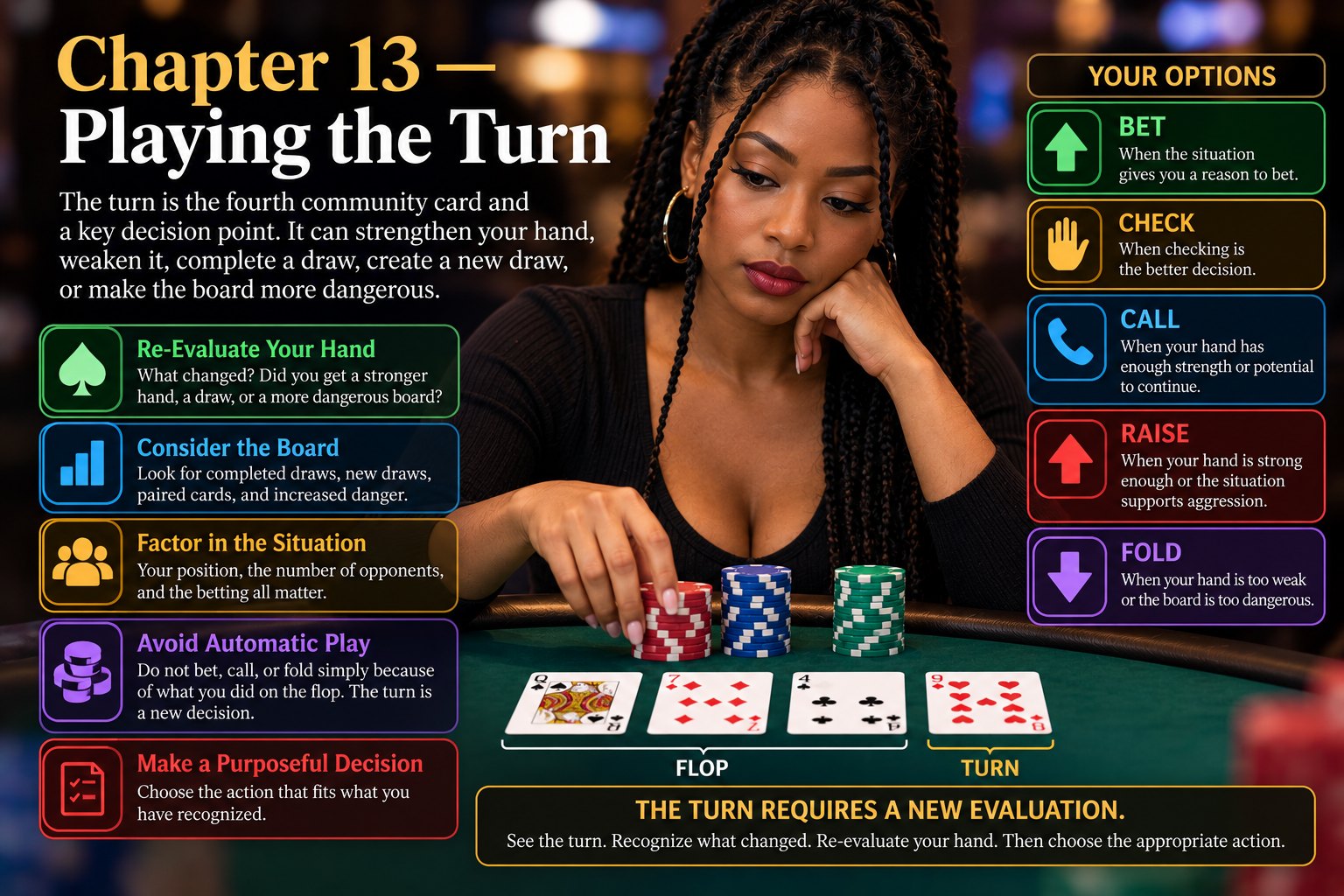
The turn is the fourth community card and the second major decision point after the flop. It changes the hand because there is now only one card left to come. The turn can strengthen your hand, weaken it, complete a draw, create a new draw, change the board, or leave the situation essentially unchanged. The important principle is simple: the turn requires a new evaluation.
Do not automatically continue the decision you made on the flop. The flop decision was based on the information available at that time. The turn gives you new information, so you must recognize what changed before deciding what to do next.
This is especially important when you bet the flop. A common mistake is to think, “I bet the flop, so I should bet the turn.” That is automatic continuation, not good Basic Strategy. The turn card may have changed the strength of your hand or the structure of the board. Your action should respond to the current situation.
The first step is to re-evaluate your hand. Ask what you have now. Did you make a stronger hand? Did you remain with the same hand? Did the turn create a draw? Did it complete a draw? Did the board become more dangerous? The answer determines what kind of turn decision you are facing.
A new card can change everything. If you held one pair on the flop and the turn gives you two pair, your hand has improved. If the turn gives you three of a kind, your hand has improved substantially. If the turn completes a straight or flush, you now have a made hand that must be evaluated according to the new board.
The opposite can also happen. A turn card can make your hand less comfortable without actually changing the cards you hold. A third card of the same suit can create a possible flush. A connected card can complete a straight. A paired board can create new possibilities. The card may not change your hand, but it can change the situation.
The turn can also create new draws. A card that gives you four cards toward a straight or flush creates additional potential. You should recognize that potential without treating it as a completed hand. A draw gives you possibilities, not certainty.
Completed draws require particular attention. When the turn completes an obvious straight or flush, the strength of your previous hand must be reconsidered. A pair that was strong on the flop may no longer be strong enough to continue aggressively on the turn. A hand that was comfortably ahead may now need to slow down.
This does not mean you should become afraid every time the board changes. It means you should recognize the change. The purpose of Basic Strategy is not to predict every possible hand another player could have. It is to recognize your own hand and the board well enough to make a sound decision.
The basic turn actions remain the same: bet, check, call, raise, or fold. Your task is to determine which action fits the situation.
When you have a strong hand, betting is often an important option. A strong hand may be able to extract value from weaker hands while continuing to build the pot. If the turn improves your hand substantially, you should recognize the opportunity to put more money into the pot when appropriate.
Calling can also be correct with a strong hand. You do not always need to raise simply because your hand is strong. The goal is not maximum aggression on every street. The goal is to choose the action that best fits the current situation.
When you have a medium-strength hand, the turn often requires more caution. A hand that was strong enough to continue on the flop may become less attractive when the turn changes the board or when the betting becomes stronger.
This is where re-evaluation becomes important. Do not remain attached to your flop decision. You are not required to continue simply because you called or bet on the previous street. The turn is a new decision.
A drawing hand also requires re-evaluation. If you picked up a new draw, recognize the additional potential. If you still have the same draw you had on the flop, recognize that there is now only one card left to complete it. The turn is therefore different from the flop because the remaining opportunity to improve is smaller.
The turn can also be the point where a drawing hand should be released. If the price of continuing becomes too high or the situation no longer justifies the risk, folding can be the correct decision. You do not chase a draw simply because you have already invested chips.
Betting the turn can have several basic purposes. You may be betting a strong hand for value. You may be betting a draw. You may be continuing a bluff when the situation gives you a reasonable opportunity. Or you may be betting because the turn improved your hand and you want to build the pot.
The important point is that the bet should have a reason. Do not bet the turn simply because you bet the flop.
Checking is equally important. Checking can be appropriate when your hand is not strong enough to build the pot, when the turn creates danger, when you want to control the size of the pot, or when there is simply no good reason to bet.
Checking does not mean that you have surrendered the hand. It means you are choosing not to put additional money into the pot at that moment.
Calling can be appropriate when another player bets and your hand has enough strength or potential to continue. But calling should not become automatic. You should recognize what the turn did to your hand and whether continuing still makes sense.
A player who calls the flop and then automatically calls the turn is making the same mistake as the player who automatically continuation bets. The turn is a new decision.
Raising is appropriate when your hand is strong enough to want additional money in the pot or when the situation provides a legitimate reason for aggression. A raise should not be used simply because you do not want to call.
A fold is appropriate when your hand is no longer strong enough to continue, when the board has become too dangerous for the strength of your hand, or when the action requires more than your hand can reasonably support. Folding on the turn is often a sign of good discipline, not a sign that the earlier decision was wrong.
The turn also changes the importance of board awareness. On the flop, several possible draws may still be developing. By the turn, some of those draws may have been completed. Other draws may have appeared. The board may have become paired, coordinated, or otherwise more dangerous.
You should therefore recognize the current board rather than remembering only what it looked like on the flop.
Position remains important as well. Acting later gives you more information about what other players have done. Acting earlier leaves more players who can respond after you. A marginal hand can be easier to play in position than out of position, so position should remain part of your basic recognition process.
The number of opponents also matters. A turn bet against one opponent is different from a turn bet into several opponents. More players create more opportunities for someone to have connected with the changing board. Again, this does not require player profiling. It is simply recognition of the basic situation.
The turn is also where many players make the mistake of protecting a previous decision. They think, “I called the flop, so I have to call the turn,” or “I bet the flop, so I have to bet again.” Neither is true.
Every street gives you a new decision.
The chips already invested in the pot do not create an obligation to invest more. Your previous action does not determine your current action. The turn card and the current betting determine the decision you make now.
This is one of the most important habits in Basic Strategy: do not confuse consistency with automatic continuation.
Good poker is consistent in its principles, not necessarily in repeating the same action. You may bet the flop and check the turn. You may check the flop and bet the turn. You may call the flop and fold the turn. You may bet the flop, bet the turn, and then slow down on the river. Each action can be correct because the situation changes.
Basic turn aggression should therefore be controlled aggression. When the turn improves your hand, recognize the opportunity to bet. When the turn creates danger, recognize the need to slow down. When the turn creates a draw, recognize the potential. When the turn leaves you with a weak hand, recognize when continuing is no longer justified.
You do not need to turn the turn decision into a complicated mathematical exercise. You need to recognize the basic relationship between your hand, the board, the action, and the price. More detailed discussion of price and risk belongs in the next chapter. Here the emphasis is on recognizing what changed and responding correctly.
The turn should therefore become another automatic recognition point in One Minute Poker. You see the new card, quickly determine what it did to your hand and the board, and then choose the action that fits.
Re-evaluate before you act.
A strong hand may call for a bet or raise. A medium hand may call for caution. A draw may provide a reason to continue or may no longer justify the cost. A dangerous board may require you to slow down. A weak hand may simply need to be folded.
The important thing is not to carry your flop decision blindly into the turn.
The turn is a new street, a new board, and a new decision.
See the turn. Recognize what changed. Re-evaluate your hand. Then choose the appropriate action.