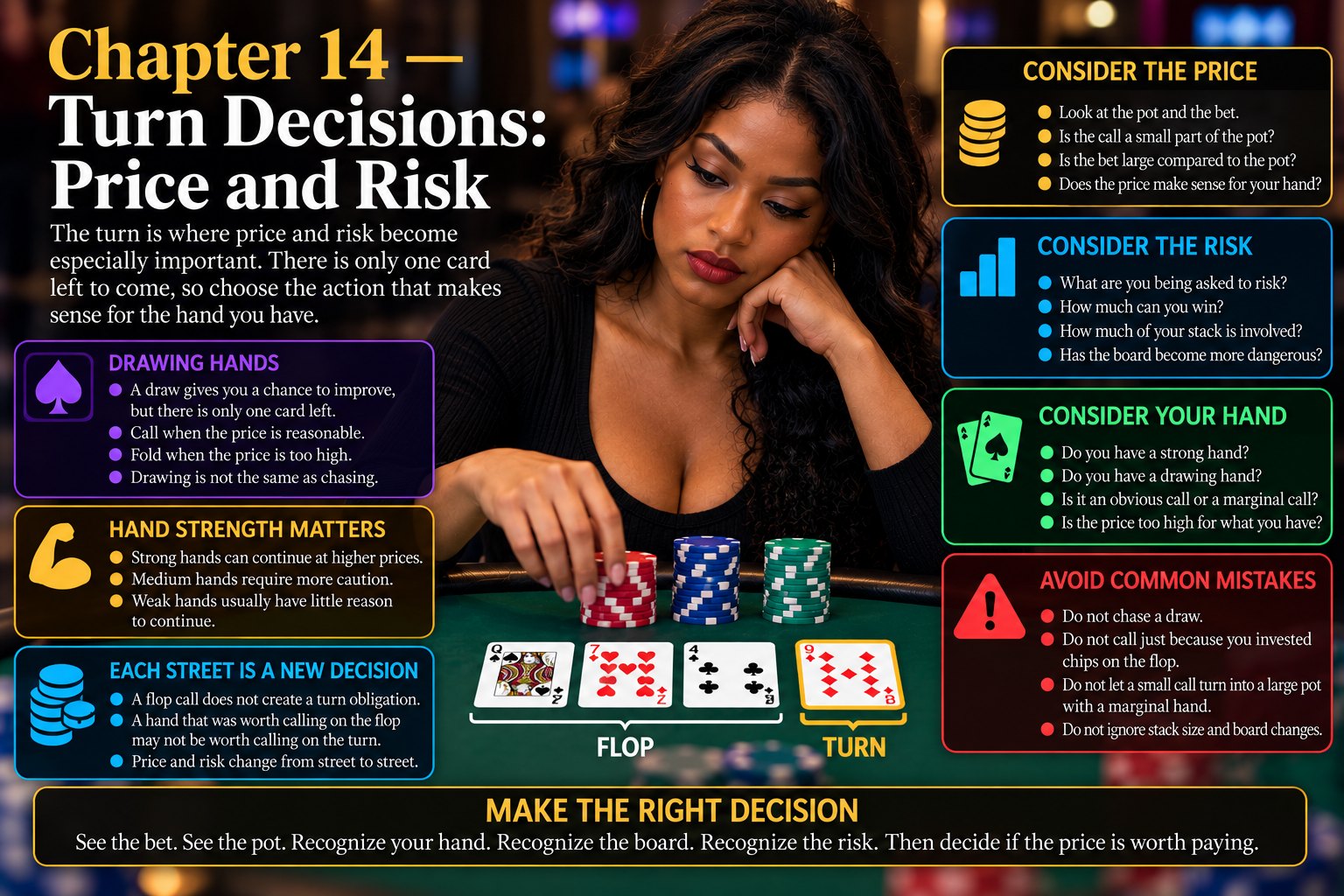
The turn is where price and risk become especially important because there is only one card left to come. On the flop, a player may have several opportunities to improve. On the turn, that opportunity is reduced to the river. A decision that was reasonable on the flop can therefore become too expensive on the turn. Basic Strategy does not require complicated mathematics. It requires you to recognize what you are being asked to risk, what you are trying to win, and whether the price makes sense for the hand you have.
Price means what you must pay to continue compared with what is already in the pot and what you can potentially win. If the pot is large and the bet is small, the price may be reasonable. If the pot is small and the bet is large, the price may be expensive. The same hand can therefore produce different decisions depending on the amount you are being asked to call.
This is the practical idea behind pot odds. You do not need to turn every decision into a mathematical calculation. You need to understand the relationship between the size of the call and the size of the pot. If there is $100 in the pot and you are asked to call $20, you are risking $20 to continue for a pot that would become $120 if you call. If you are asked to call $100 into that same $100 pot, the price is very different. The point is not to memorize complicated equations. The point is to recognize when the cost of continuing is reasonable and when it is too high.
Your hand strength must always be considered with the price. A strong made hand can justify continuing at a price that would be unreasonable for a weak hand. A medium-strength hand may be able to continue against a small bet but not against a large one. A drawing hand may be worth continuing with when the price is favorable but not when the bet becomes too expensive. A weak hand with no meaningful draw may have little reason to continue regardless of the pot size.
Drawing hands are especially important on the turn because there is only one card left. A draw gives you a chance to improve, but it does not guarantee improvement. If you have a flush draw or straight draw and face a turn bet, do not automatically call simply because you have a draw. Look at the price. Consider what you must risk and what you can realistically win. If the price is reasonable, continuing may make sense. If the price is too high, folding may be the better decision.
This is the difference between drawing and chasing. Drawing means recognizing that your hand has potential and deciding whether the cost of pursuing that potential is reasonable. Chasing means continuing simply because you hope the next card will save you. The turn is a particularly dangerous place to chase because there is only one opportunity left to improve.
The distinction between obvious calls and marginal calls is also important. An obvious call is one where the price is reasonable and your hand or draw provides a clear reason to continue. A marginal call is one where the price is questionable and the strength of your hand does not provide much justification for taking the risk. Basic Strategy does not require you to force yourself into marginal situations. When the price is clearly unfavorable, folding is often the simplest decision.
Do not allow previous investment to control the current decision. The chips you already put into the pot are already in the pot. If you called a bet on the flop, that does not mean you must call another bet on the turn. If you bet the flop, that does not mean you must continue betting simply because you started the action. The turn creates a new decision with a new price and a new level of risk.
Suppose you have already invested $20 and now face a $40 turn bet. The question is not whether you should protect the $20 you already invested. That money is no longer yours to protect. The question is whether risking another $40 makes sense with the hand, board, pot, and situation in front of you. This simple distinction prevents many expensive calls.
Stack size also affects risk. You should know how much you have left and how much you may have to risk if the hand continues. A large turn call can become much more significant when it represents a large portion of your remaining stack. You do not need complicated stack calculations for every hand, but you should recognize when continuing is beginning to create a major commitment.
The pot can also become too large for the strength of your hand. A player may make a small call on the flop, another call on the turn, and then discover that a large amount of money is now committed to a hand that was only marginal from the beginning. Avoid allowing several small decisions to turn into one large mistake. If the hand is not strong enough to justify continued investment, folding before the pot becomes even more expensive can be the correct decision.
The opposite is also true. If the turn improves your hand significantly, the larger pot may create an opportunity rather than a problem. A strong hand may justify betting or raising because weaker hands can continue. Price and risk are therefore not considered in isolation. They must be considered together with the strength of your hand and the situation.
Board changes can also affect the risk. A turn card may complete a straight or flush, create a new draw, pair the board, or otherwise make the board more dangerous. When that happens, the price of continuing must be considered along with the possibility that your hand has become less valuable. You do not need to identify every possible hand another player could have. You need to recognize that the board has changed and that the risk may have changed with it.
Position can also influence the decision. Acting later can provide more information about what other players do before you act. Acting earlier leaves more players who can respond after you. A marginal decision can therefore be more difficult when you are out of position. Position does not replace the basic price-and-risk decision, but it is part of the situation you are evaluating.
The key is to avoid turning price into a complicated calculation that prevents you from acting. One Minute Poker is designed around recognition. You should be able to look at the pot, look at the bet, recognize your hand, recognize the board, and quickly determine whether the price is reasonable.
A useful basic process is: What am I being asked to risk? What am I trying to win? How strong is my hand or draw? Has the board changed? How much of my stack is involved? You can answer those questions without performing a long mathematical analysis.
When the price is reasonable and your hand provides enough justification, continue. When the price is marginal, be cautious. When the price is clearly too expensive for the hand you have, fold. This does not mean folding every time you face a large bet. It means recognizing that a larger price requires a stronger reason to continue.
The most important lesson is that price and risk change from street to street. A flop decision does not automatically determine a turn decision. A hand that was worth calling with on the flop may not be worth calling with on the turn. A draw that was reasonable to pursue earlier may become too expensive when only one card remains. A medium-strength hand may survive a small bet but not a large one.
You are not trying to calculate the exact mathematical value of every turn decision. You are trying to avoid obvious mistakes: paying too much to chase a draw, calling large bets with weak hands, continuing because you already invested chips, and allowing the pot to grow beyond what your hand can reasonably support.
The turn should therefore produce a simple recognition process: see the bet, see the pot, recognize your hand, recognize the board, recognize the risk, and decide whether the price is worth paying.
If it is, continue.
If it is not, fold.
That is the practical meaning of price and risk in Basic Strategy. The goal is not to make every decision mathematically complicated. The goal is to know when continuing makes sense and when you are simply paying too much to stay in the hand.
Know what you are risking. Know what you are trying to win. Know the strength of your hand. Then decide whether the price is reasonable.