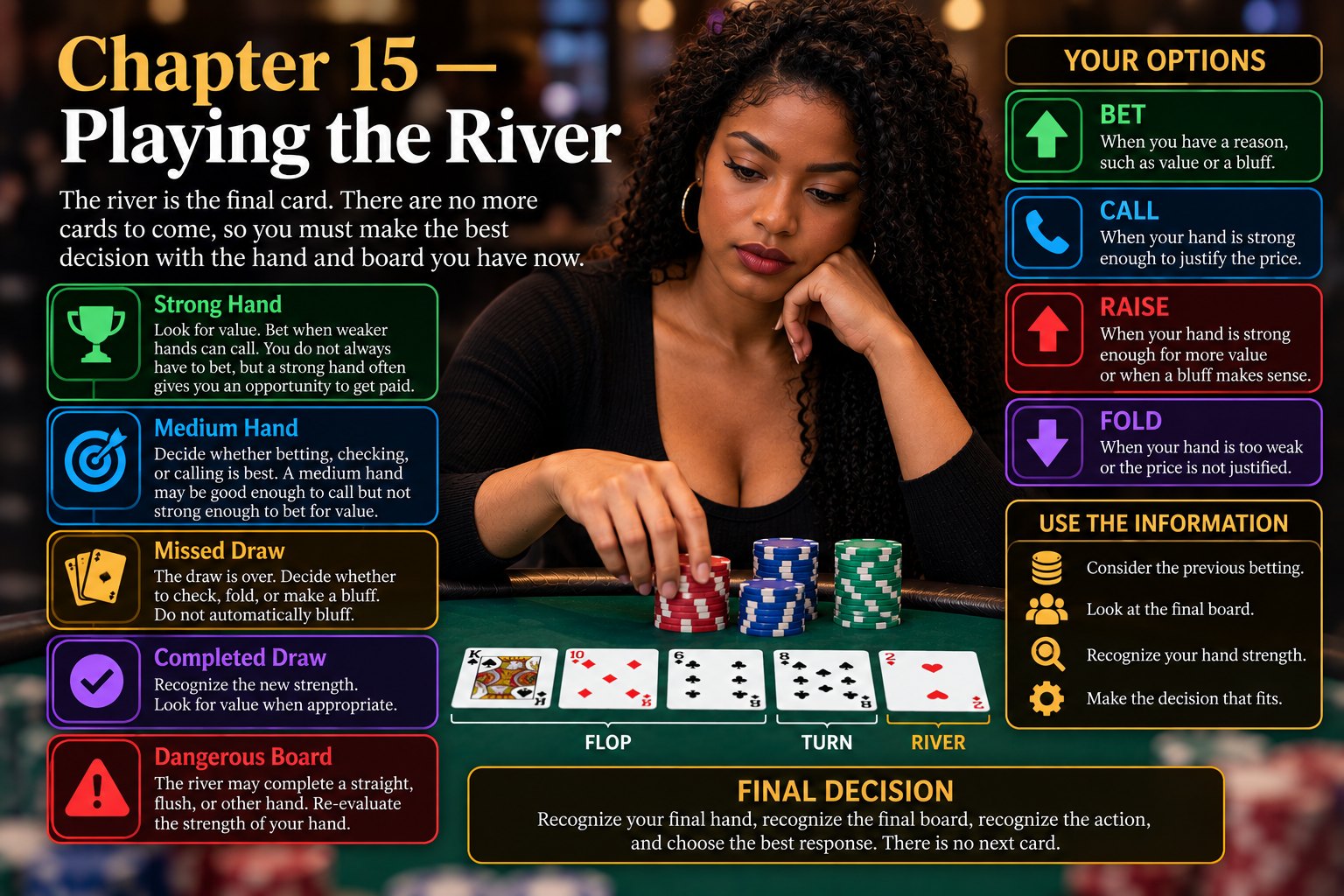
The river is the final community card and the last decision point in the hand. There are no more cards to come, so your hand is now complete. The river can improve your hand, complete a draw, miss a draw, create a dangerous board, or leave your hand essentially unchanged. The important difference from the flop and turn is that there is no future card to consider. You must make your decision with the hand and board you have now.
The first step is to recognize your final hand. Did you make a strong hand? Did a draw complete? Did your draw miss? Did the river create a straight or flush possibility? Did the board pair? Did the river change the strength of your hand? These are the basic facts that should be recognized before you decide whether to bet, check, call, raise, or fold.
A strong hand may provide an opportunity for value betting. A value bet is a bet made because weaker hands may call. The purpose is to get additional money into the pot when your hand is strong enough to be called by worse hands. You do not need to determine exactly what another player holds. You simply need to recognize whether your hand is strong enough to make betting for value reasonable.
Checking is also a legitimate river decision. You may have a hand that is strong enough to win at showdown but not strong enough to expect many worse hands to call. A medium-strength hand may therefore be better served by checking than by making a thin or unnecessary value bet. A weak hand may also be checked when there is no good reason to put more money into the pot.
A missed draw requires clear recognition. If you were drawing to a straight or flush and the river did not complete it, the draw is over. There is no additional card coming. You must now decide whether your remaining hand has enough strength to continue or whether checking, folding, or making a bluff is appropriate.
A missed draw does not automatically mean you should bluff. Bluffing has a purpose: trying to make a better hand fold. If there is no reasonable reason to believe a bet can accomplish that, checking or folding may be better. The goal is not to turn every missed draw into an automatic bluff.
A completed draw creates the opposite situation. If the river completes your straight or flush, your hand has improved and you should recognize the new strength of your hand. A completed draw may give you an opportunity to bet for value, especially when weaker hands can still call.
The river can also create a dangerous board. A card can complete a straight, complete a flush, pair the board, or create another possible hand that changes the situation. A hand that was strong on the turn may not be as strong on the river. You should not automatically continue with the same confidence simply because your hand was strong one street earlier.
The important response is recognition. Look at the completed board and determine what your hand is now. You do not need to analyze every possible combination of cards. You need to recognize whether the river improved your hand, improved the possible hands that can beat you, or both.
When another player bets, the basic choices are folding, calling, or raising. A strong hand may justify a call or raise. A medium-strength hand may be able to call a reasonable bet but may not be strong enough to raise. A weak hand may simply need to fold. The price of the call, the completed board, your hand strength, and the betting that occurred earlier in the hand all contribute to the decision.
A river call should have a reason. You call because you believe your hand is strong enough to win often enough to justify the price. You do not call because you are curious about what the other player has, because you have already invested money, or because you do not want to be bluffed.
This is where bluff catching becomes important. A bluff catcher is a hand that may not be strong enough to beat many value hands but may still beat a bluff. If an opponent bets and your hand has some showdown value, you must decide whether calling makes sense. You do not need to prove that the opponent is bluffing. You need to determine whether your hand is strong enough to justify the call.
Avoid unnecessary hero calls. Catching a bluff can feel rewarding, but Basic Strategy is not about making dramatic calls. If the price is too high or your hand is too weak to justify continuing, folding can be the better decision even when you know that bluffing is possible.
The same discipline applies to raising. A strong hand may be raised for additional value when worse hands can call. A bluff raise may sometimes be appropriate, but Basic Strategy does not require complicated river aggression. If there is no clear reason to raise, calling or folding may be better.
The previous betting can provide useful basic information. Consider what happened on the flop and turn. Did the pot grow substantially? Did the board change? Did the river complete a draw? Did the betting remain controlled or become aggressive? You do not need to reconstruct every possible holding. You simply recognize the important information that has developed throughout the hand.
The river is therefore a final evaluation. Recognize your hand, recognize the board, recognize the action, and choose the response that fits. If you have a strong hand and worse hands can call, look for value. If your hand has showdown value but is not strong enough to bet comfortably, checking may be better. If your draw missed, recognize that it missed. If your draw completed, recognize the new strength of your hand. If the board became dangerous, recognize that your previous hand strength may have changed.
The most important river principle is that there is no next card. On the flop and turn, you can sometimes continue because your hand may improve. On the river, that possibility is gone. Your hand is complete. A weak hand does not become stronger by waiting. A missed draw does not have another opportunity. A strong hand should be evaluated for value now.
This also makes folding an important part of river play. If you face a bet with a weak hand and have no reasonable basis for believing you can win by calling, folding is often the correct decision. You do not need to protect the money already invested in the pot. That money is already there. The only question is whether putting additional money into the pot makes sense now.
The river should not become a street of unnecessary heroics. You do not need to make the biggest call at the table. You do not need to bluff simply because you missed. You do not need to bet simply because you reached the final street. You need to make the decision that fits the hand and board in front of you.
The basic river process is simple: recognize your final hand, recognize the final board, recognize whether a draw completed or missed, recognize whether your hand is strong enough to bet for value, and recognize whether an opponent's bet is worth calling. Then choose the appropriate action.
The goal is not to solve every possible river situation. The goal is to recognize the major categories quickly and respond appropriately. Strong hand: look for value. Medium hand: determine whether betting or calling is justified. Missed draw: recognize that the draw is finished. Completed draw: recognize the new strength of the hand. Dangerous board: re-evaluate. Opponent bets: decide whether your hand is strong enough to call or raise. No reasonable reason to continue: fold.
The river is the final decision. There is nothing left to wait for and nothing left to improve. Make the best decision available with the information you have.
Recognize the final hand. Recognize the final board. Recognize the action. Then make the river decision.