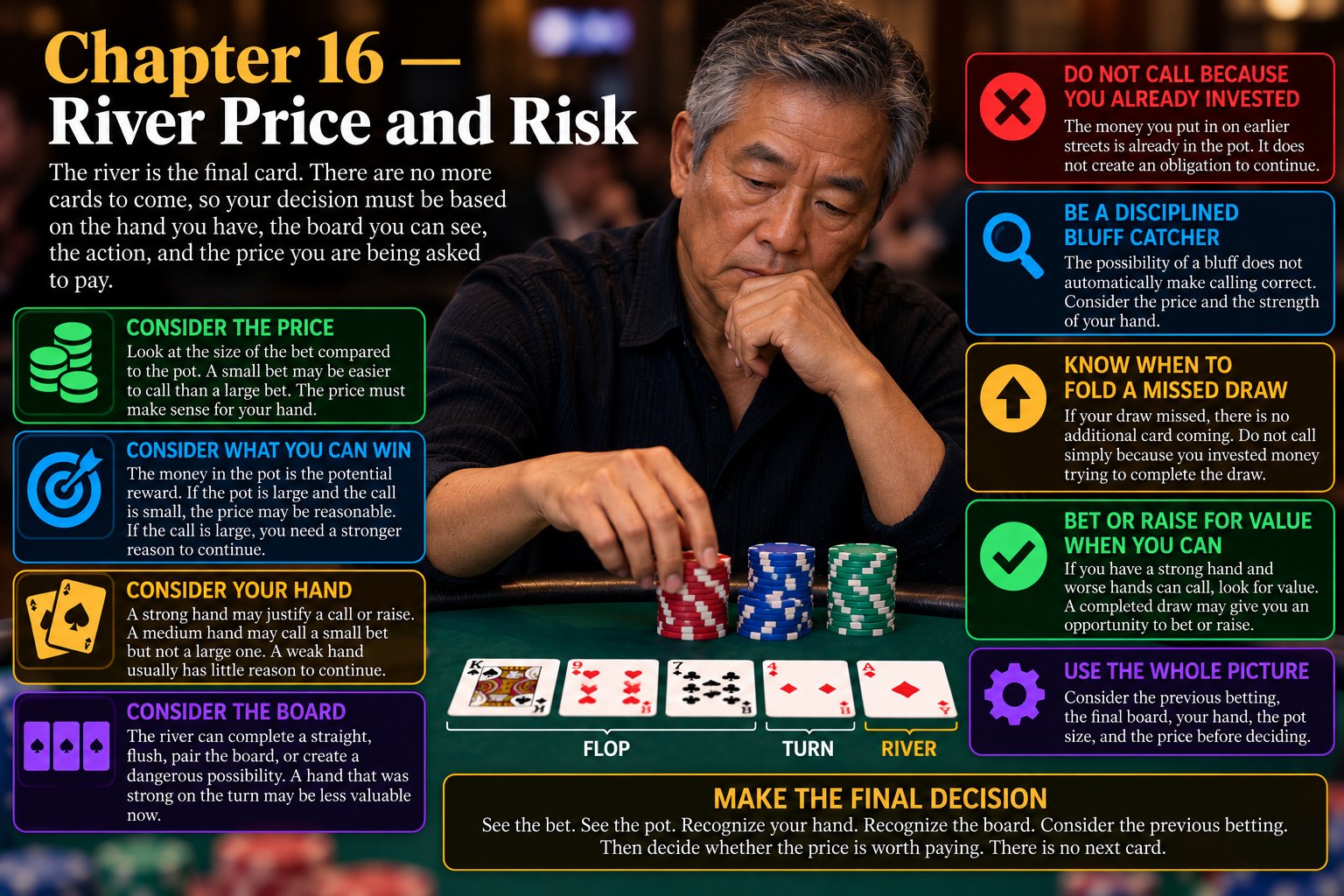
The river creates a different price-and-risk decision because there is no future card left to improve your hand. The hand is complete, the board is complete, and the only question is whether continuing to put money into the pot makes sense. Chapter 14 dealt with turn decisions, where a player could still improve on the river. On the river, that possibility is gone. Your decision must be based on the hand you have, the board you can see, the action in front of you, and the price you are being asked to pay.
The first question is simple: What am I being asked to call? Look at the size of the bet compared with the pot. A small bet may be easier to call than a large bet. A large bet requires a stronger reason to continue. You should not think about the size of the bet by itself. Think about the bet in relation to the pot and the strength of your hand.
The second question is: What can I realistically win? The money already in the pot is the potential reward for continuing. If the pot is large and the call is small, the price may be reasonable. If the call is large compared with the pot, you are risking much more to win relatively less. The basic idea is the same as on the turn: understand the relationship between what you must risk and what you can win without turning the decision into a mathematical exercise.
The third question is: How strong is my hand? A strong hand may justify a call or raise even when the bet is large. A medium-strength hand may be able to call a smaller bet but not a large one. A weak hand may have little reason to continue regardless of how much money is already in the pot. Price and hand strength must be considered together.
The board is equally important. A river card can complete a straight, complete a flush, pair the board, or create another dangerous possibility. If the river makes the board more dangerous, you should recognize that before deciding whether to call. A hand that was strong on the turn may be less valuable on the river because the final card changed what hands are possible.
The previous betting also provides useful information. You should remember the basic action that brought the hand to the river. Did the pot become large? Was there heavy betting on earlier streets? Did a player continue betting? Did the river complete a draw? You do not need to reconstruct every possible hand an opponent could hold. You simply need to recognize the important information created by the betting and the board.
The river is where many players make the mistake of calling because they have already invested money. That is not a reason to call. The money you invested on the flop and turn is already in the pot. It does not become more valuable simply because you have reached the river. The current decision is about the additional money you are being asked to risk.
If you invested $50 earlier in the hand and now face a $40 river bet, the question is not whether you should protect the $50. The question is whether calling another $40 is reasonable given the size of the pot, your hand, the board, and the action. Previous investment does not create an obligation to continue.
A river call can become too expensive when the amount you must risk is not justified by the strength of your hand and the realistic possibility of winning. This is particularly important with medium-strength hands. A pair may be good enough to call a small bet but not a large one. A weak bluff catcher may be capable of beating a bluff, but that does not mean it can justify calling every bet.
This is where bluff catching must remain disciplined. If an opponent bets the river, there may be hands they could be bluffing with. But the possibility of a bluff does not automatically make calling correct. You must consider the price and the strength of your hand. If the bet is large, you need a stronger reason to call.
Do not make a river call simply because you think, “They might be bluffing.” They might be. But the question is whether the possibility of a bluff is strong enough to justify the price you are being charged.
This also helps prevent unnecessary hero calls. A hero call can feel exciting because you catch an opponent bluffing, but Basic Strategy is not about making dramatic decisions. If your hand is too weak for the price, folding can be correct even when a bluff is possible.
The same principle applies when you miss a draw. If your straight or flush draw missed on the river, there is no additional card coming. You must decide whether your remaining hand can win without improving. If an opponent bets and your hand is not strong enough to justify a call, fold. Do not call simply because you invested money trying to complete the draw.
If you complete your draw, the situation is different. You now have a made hand and should evaluate its strength. If worse hands can call, you may have an opportunity to bet for value. If another player bets, your completed hand may justify calling or raising depending on the situation.
The river can therefore produce very different price-and-risk decisions from the same type of hand. A completed flush may be strong enough to continue against a large bet. A missed flush draw may have no reason to continue. A medium pair may call a small bet but fold to a large one. The price must always be considered together with the final hand.
Bankroll protection is another practical part of river risk. You do not need to make a call simply because the pot is large. In fact, a large pot can make a bad call more expensive. Protecting your bankroll means being willing to release hands when the price is too high for what you have.
This does not mean playing scared. It means recognizing that chips saved by avoiding bad calls are just as important as chips won by making good calls. A disciplined fold can prevent a marginal hand from becoming an unnecessarily expensive mistake.
Not every river decision requires mathematical calculation. You should understand the basic idea of price and risk, but you should not stop the game to perform a complicated analysis every time someone bets. Basic Strategy is about recognition and execution. You should be able to look at the pot, look at the bet, recognize your hand, recognize the board, and make a practical decision.
There will be obvious calls, obvious folds, and decisions that are closer. When the price is reasonable and your hand provides enough reason to continue, call. When the price is clearly too high for the strength of your hand, fold. When you have a strong hand and believe worse hands can continue, consider raising for value.
The river is also a place where discipline replaces curiosity. You may desperately want to know what your opponent has. You may believe they could be bluffing. You may have invested a significant amount of money already. None of those things automatically justify a call. Your decision should be based on the current price, the current board, and the strength of your completed hand.
The practical river process is therefore straightforward: see the bet, see the pot, recognize your hand, recognize the board, remember the important previous betting, and decide whether the price is worth paying.
If the call is reasonable and your hand can realistically win often enough, continue.
If the price is too high for your hand, fold.
If you have a strong hand and worse hands can pay you, look for value.
If your draw missed and you have no reasonable way to continue, let the hand go.
The goal is not to calculate every river decision perfectly. The goal is to stop making the expensive mistakes that come from ignoring price and risk.
The river is the final decision. There is no future card to consider and no future opportunity to improve. You are deciding whether the money you put in now is justified by what you can realistically win.
Know what you are being asked to call. Know what you can realistically win. Know the strength of your hand. Recognize the danger of the board. Consider the previous betting. Then decide whether continuing is worth the price.
PART V — BUILDING AUTOMATIC PLAY