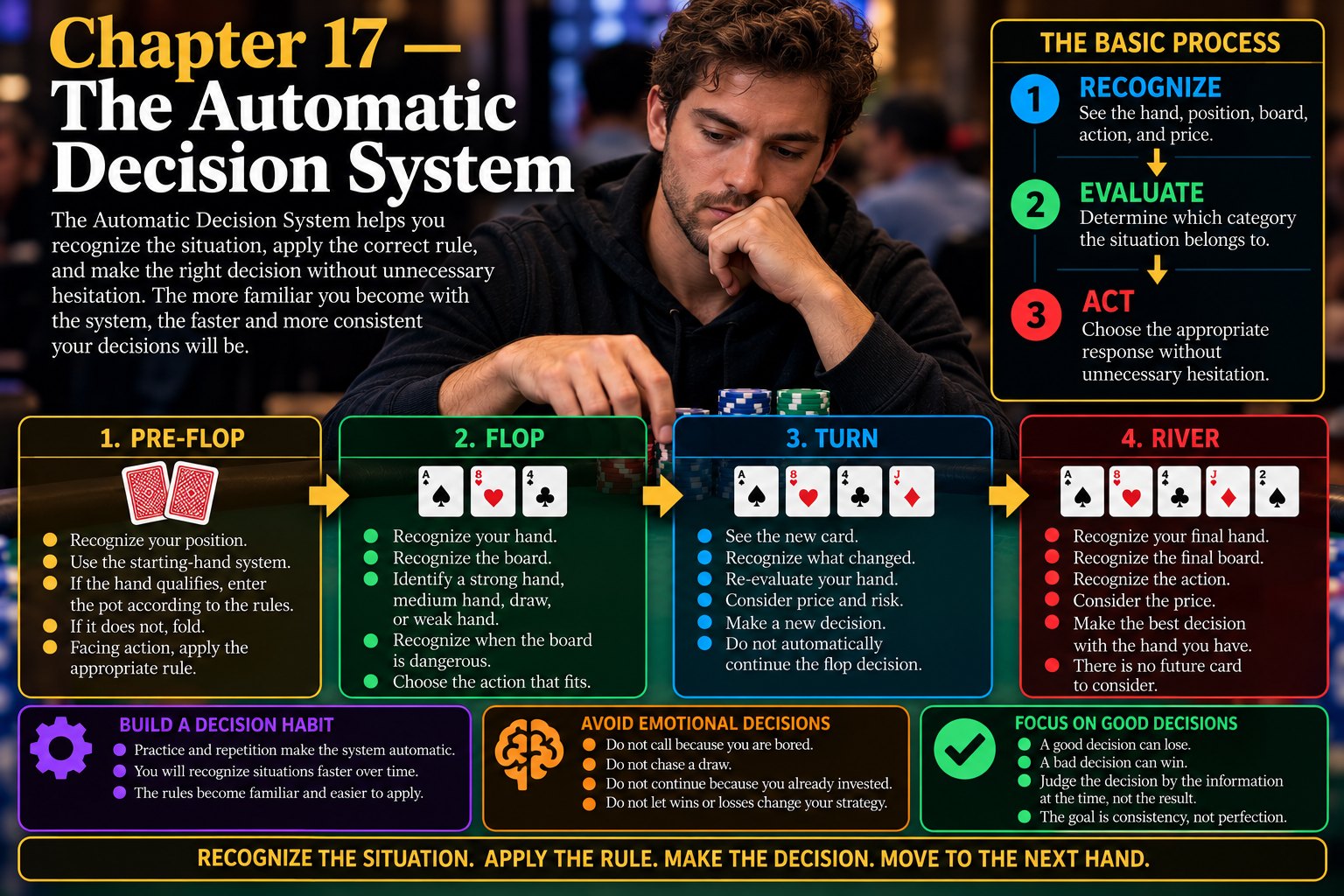
The purpose of One Minute Poker is not simply to teach you what to do. It is to make the correct decisions easier to recognize and execute without unnecessary hesitation. The more familiar the system becomes, the less time you should need to spend debating ordinary poker situations. You should see the situation, recognize the category, and make the appropriate decision.
An automatic decision system does not mean playing without thinking. It means replacing unnecessary thought with trained recognition. Instead of asking the same basic questions from the beginning every time you receive a hand, you recognize familiar situations and respond according to the rules you have learned. This allows you to make decisions quickly while maintaining discipline.
The system begins before the flop. First recognize your position. Then recognize your starting hand. The starting-hand system tells you which hands belong in your normal range for that position. If the hand qualifies, you can enter the pot according to the rules. If it does not, you fold. You do not need to invent a new opinion about every starting hand every time you see it.
When another player enters the pot before you, the situation changes. You recognize that you are facing action and apply the appropriate rule. You do not automatically call because you already planned to play the hand. You do not automatically fold because someone raised. You recognize your hand, your position, and the action, then make the decision that belongs to that situation.
After the flop, the system changes from starting-hand recognition to board and hand recognition. Look at the flop and determine what your hand is now. Recognize a strong made hand. Recognize a medium-strength hand. Recognize a draw. Recognize a weak hand. Recognize when the board is dangerous. Then choose the action that fits what you have recognized.
This is why the system becomes faster with practice. You are not trying to calculate every possible outcome. You are learning to recognize the important categories quickly. A strong hand requires one type of decision. A draw requires another. A weak hand requires another. The board and the action then determine how you respond.
The same process continues on the turn. See the new card. Recognize what changed. Re-evaluate your hand. Recognize the price and risk. Then act. Do not automatically continue the decision you made on the flop. The turn is a new decision because the board and the amount of information have changed.
The river completes the system. Recognize your final hand. Recognize the final board. Recognize the action. Recognize the price. Then decide. There is no future card to consider, so you must make the best decision available with the hand you have.
The automatic system therefore follows a simple pattern throughout the hand: recognize, evaluate, act. Recognition comes first. You identify the hand, position, board, action, and price. Evaluation means determining which basic category the situation belongs to. Action means choosing the appropriate response without unnecessary hesitation.
The system also prevents emotional decisions. A bad hand does not become playable because you are bored. A previous loss does not make the next hand more valuable. A previous investment does not require another call. A missed draw does not deserve another bet simply because you wanted it to complete. A strong hand does not require reckless betting. The system gives you a structure that remains the same regardless of how the previous hand ended.
This is especially important when a hand becomes complicated. When you are uncertain, return to the basic questions. What do I have? What is on the board? What happened before me? What is the price? What action fits the situation? These questions bring the decision back to the system instead of allowing emotion, curiosity, or frustration to take control.
Automatic play also means knowing when not to analyze. Not every hand requires a deep investigation. Many poker situations are ordinary and should be treated as ordinary. If you have a weak starting hand that does not belong in your range, fold. If your flop hand is clearly too weak to continue, fold. If a draw is being offered an unreasonable price, fold. If you have a strong hand and a clear opportunity for value, act. The system becomes powerful because it prevents simple decisions from becoming complicated decisions.
Speed should come from familiarity, not from rushing. One Minute Poker does not mean making careless decisions in sixty seconds or less. It means developing enough familiarity with the system that normal decisions can be made quickly. If a situation genuinely requires more thought, take the time. The goal is efficient decision making, not artificial speed.
Practice makes the system automatic. Repetition strengthens recognition. The more often you review starting hands, position, flop categories, turn changes, river decisions, price, and risk, the less mental effort those decisions require. Eventually, the rules become familiar enough that you recognize the correct category almost immediately.
This is the point of memorization throughout the Basic Strategy system. Memorizing starting hands is not about collecting information for its own sake. It allows you to make pre-flop decisions without repeatedly reconstructing the range. Memorizing the basic decision categories allows you to recognize post-flop situations without beginning a complete analysis every time.
The system should therefore become a decision habit. You do not need to consciously recite every rule in your head. The rules become the structure behind your decisions. You see the situation and recognize the response.
That does not mean every decision will be correct. Poker contains uncertainty, and good decisions can sometimes produce bad results. The purpose of the automatic system is not to guarantee the result of every hand. It is to improve the quality and consistency of the decisions you make.
A good decision can lose. A bad decision can win. The result of one hand does not determine whether the decision was correct. The automatic system keeps you focused on making the appropriate decision rather than judging the quality of your play by whether the last card helped you.
This is one of the most important habits to develop. If you make the correct fold and your opponent later reveals a bluff, the fold does not become a mistake simply because you could have won. If you call with a reasonable hand and lose to a stronger hand, the call does not automatically become wrong. Judge the decision by the information and situation that existed when you made it.
The automatic decision system is therefore designed to create consistency. You want to make similar decisions in similar situations for the same basic reasons. You do not want your strategy to change because you are winning, losing, tired, frustrated, excited, or trying to recover money from an earlier hand.
The system should remain stable.
Pre-flop, recognize your position and starting hand. Facing action, recognize the situation and apply the appropriate rule. On the flop, recognize your hand and the board. On the turn, recognize what changed and consider price and risk. On the river, recognize your final hand, the completed board, and the price of continuing. At every stage, choose the action that fits the situation.
The more you practice this process, the less you will need to think about the mechanics of it. That is the real meaning of automatic decision making in One Minute Poker.
You are not trying to eliminate thought. You are trying to eliminate unnecessary thought.
You are not trying to play blindly. You are trying to recognize familiar situations quickly.
You are not trying to make every decision complicated. You are trying to make the right decisions simple.
The goal is to reach the point where you can sit down at a poker table, see the cards, recognize the situation, and know what to do without hesitation when the situation is straightforward.
Recognize the situation. Apply the rule. Make the decision. Move to the next hand.