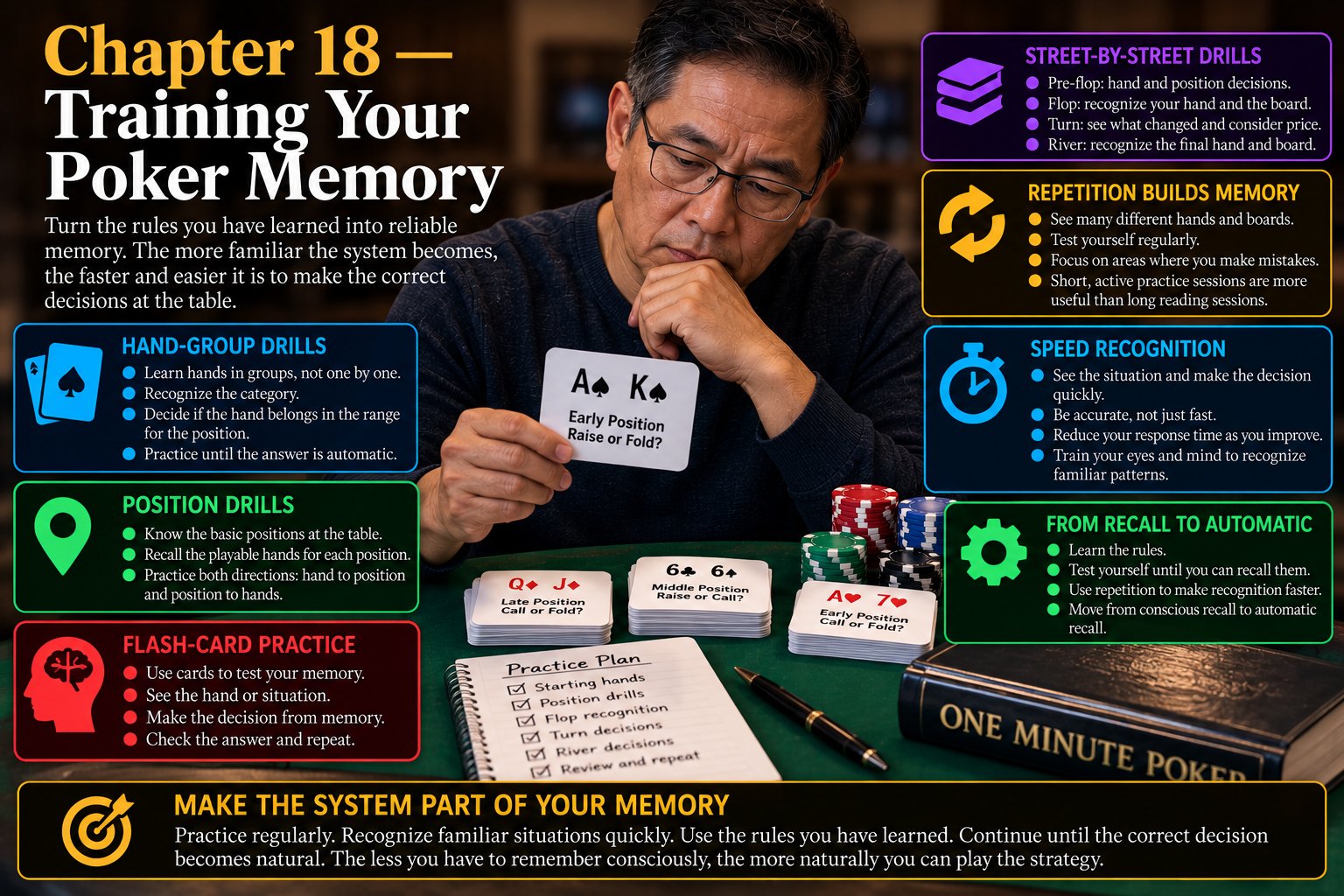
Learning Basic Strategy and remembering Basic Strategy are two different things. You can understand a rule while reading this book and still fail to remember it when you are sitting at the table. The goal of training is to move the information from something you have to think about into something you recognize naturally. The more familiar the system becomes, the less mental effort you need to use it.
Poker memory is not about memorizing thousands of unrelated facts. The Basic Strategy system is organized into recognizable groups. Starting hands belong to groups. Positions belong to groups. Flop situations belong to groups. Turn situations belong to groups. River situations belong to groups. When information is organized this way, it becomes easier to remember because you are not trying to recall isolated pieces of information.
Start with hand groups. Instead of looking at every starting hand as a completely separate item, learn the groups that make up the starting-hand system. Recognize the strong pairs, medium pairs, smaller pairs, strong aces, other playable aces, broadway combinations, suited connectors, and the hands that do not belong in your normal starting range. Grouping hands gives your memory a structure.
Position should be memorized in the same way. You should know the basic positions at the table and understand that the starting-hand system changes according to position. A hand that belongs in your range from one position may not belong in your range from another. The objective is not to stop and rebuild the entire range every time you receive cards. The objective is to recognize the position and quickly connect it with the appropriate starting-hand group.
One useful training method is the hand-group drill. Take one category at a time and test yourself. Look at a hand and identify its group. Then decide whether that group belongs in the range for the position you are practicing. Do not spend several minutes analyzing one hand. The purpose of the drill is recognition. See the hand, identify the group, make the decision, and move to the next hand.
You can also reverse the process. Name a position and then recall the starting-hand groups that belong there. This forces your memory to work in both directions. You are not simply recognizing a hand when you see it. You are also recalling the range when you think about the position.
Flash-card style practice is useful because it creates quick decisions. One side can contain a starting hand and the other side the appropriate response. Another card can show a position and ask you to recall the playable hands. Later, the cards can show a flop and ask you to identify the basic hand category or the appropriate response. The important feature is that the answer should come from memory rather than from looking it up.
The same approach can be used for pre-flop drills. Give yourself a hand and a position and make the decision immediately. Then introduce an opening raise and make the appropriate response. Then introduce another piece of action. The purpose is to make the pre-flop rules familiar enough that you do not have to consciously reconstruct them every time.
Post-flop memory requires a different kind of recognition. You are no longer memorizing a fixed list of starting hands. You are learning to recognize categories. Look at a flop and identify what your hand is. Is it a strong made hand, a medium hand, a draw, a weak hand, or something else covered by the Basic Strategy system? Then recognize the board. Is it relatively safe or dangerous? Once those categories become familiar, the appropriate decision becomes easier to recognize.
Flop recognition drills should therefore be fast. Give yourself different combinations of hole cards and flops and identify the important information. You are training your eyes and mind to recognize the situation rather than spending a long time calculating possibilities. The purpose is not to become an analyst. The purpose is to become familiar with the situations Basic Strategy already covers.
Turn drills build on that recognition. Start with the hand and flop, then add a turn card. Ask yourself what changed. Did the turn improve your hand? Did it complete a draw? Did it create a new draw? Did it make the board more dangerous? Did the price of continuing change? You are training yourself to recognize that the turn is a new decision rather than simply continuing whatever you decided on the flop.
River drills complete the process. Add the river card and recognize the final hand and final board. Did your draw complete or miss? Did the river create a dangerous board? Is your hand strong enough to bet for value? If another player bets, is the price reasonable for your hand? Again, the purpose is recognition rather than lengthy analysis.
Repetition is what makes all of this work. Seeing a starting hand once does not create reliable memory. Seeing the same category repeatedly, testing yourself, making the decision, and correcting mistakes creates familiarity. The same principle applies to position, flop situations, turn situations, and river situations.
Do not make practice unnecessarily long. A short session in which you actively recall information can be more useful than a long session in which you simply reread the book. Reading creates familiarity, but recall strengthens memory. Close the book and see what you can remember. Test yourself before looking at the answer.
One effective method is to practice until you can answer correctly without hesitation, then return to the same material later. If you struggle with a particular group, give that group additional repetition. You do not need to spend equal time on information you already know and information you consistently forget.
This is where speed recognition becomes important. Once you know the material, begin reducing the amount of time you allow yourself to make the basic identification. See the hand. Recognize the position. Make the decision. See the flop. Recognize the category. Make the response. See the turn. Recognize what changed. Make the decision. This gradually trains the system to operate at the speed required at a real poker table.
Speed should not mean rushing. If you are answering quickly because you are guessing, you are not improving your memory. The goal is accurate recognition that becomes faster through repetition. First learn it correctly. Then make the correct recognition faster.
Memory training also helps prevent decision fatigue. If you have to consciously reconstruct every starting-hand decision, every position rule, and every basic post-flop response, poker can require unnecessary mental effort. When those rules become familiar, you preserve your attention for situations that genuinely require more thought.
This is also why Basic Strategy should not become a constant mental checklist. The purpose of training is eventually to make the rules familiar enough that you recognize them without mentally reciting every step. You should not need to say to yourself, “Now I will remember rule one, rule two, rule three.” The system should become a pattern you recognize.
A good memory system therefore moves through three stages: learn, recall, automate. First you learn the information. Then you test whether you can recall it without looking. Finally, through repetition, you reach the point where recognition becomes quick and natural.
The One Minute Poker Memory System fits directly into this process. Its purpose is not to give you more poker information simply for the sake of having more information. Its purpose is to help you remember the Basic Strategy system you are already learning. The value comes from being able to retrieve the right information when you need it.
You can practice with cards, flash cards, written drills, random hands, or imagined situations. The method is less important than the process. Present yourself with a situation, make the decision from memory, check the answer, and repeat. Over time, the correct response becomes easier to retrieve.
You should also practice the areas where you make mistakes. If you consistently forget which hands belong in a particular position, drill that position. If you confuse certain hand groups, drill those groups. If you recognize flops slowly, practice flop recognition. If turn decisions cause hesitation, practice adding turn cards to familiar situations.
Memory improves when you actively retrieve information, not simply when you repeatedly read it. That is why testing yourself is so important. Reading the starting-hand chart and thinking, “I know this,” is different from seeing a hand and immediately knowing what to do without looking at the chart.
The final goal is automatic recall. You want to reach the point where a familiar poker situation produces a familiar response. The starting hand should trigger the appropriate pre-flop decision. The position should already be part of that recognition. The flop should trigger recognition of your hand and the board. The turn should trigger recognition of what changed. The river should trigger recognition of the completed situation.
When that happens, you are no longer spending most of your mental energy trying to remember the system. You are using the system.
That is the purpose of poker memory training. Learn the rules. Organize them into groups. Test yourself. Repeat them. Increase recognition speed. Correct your weak areas. Continue until the decisions become familiar enough to feel automatic.
The objective is not to memorize for the sake of memorizing. The objective is to make Basic Strategy available when you need it.
The less you have to remember consciously, the more naturally you can play the strategy.