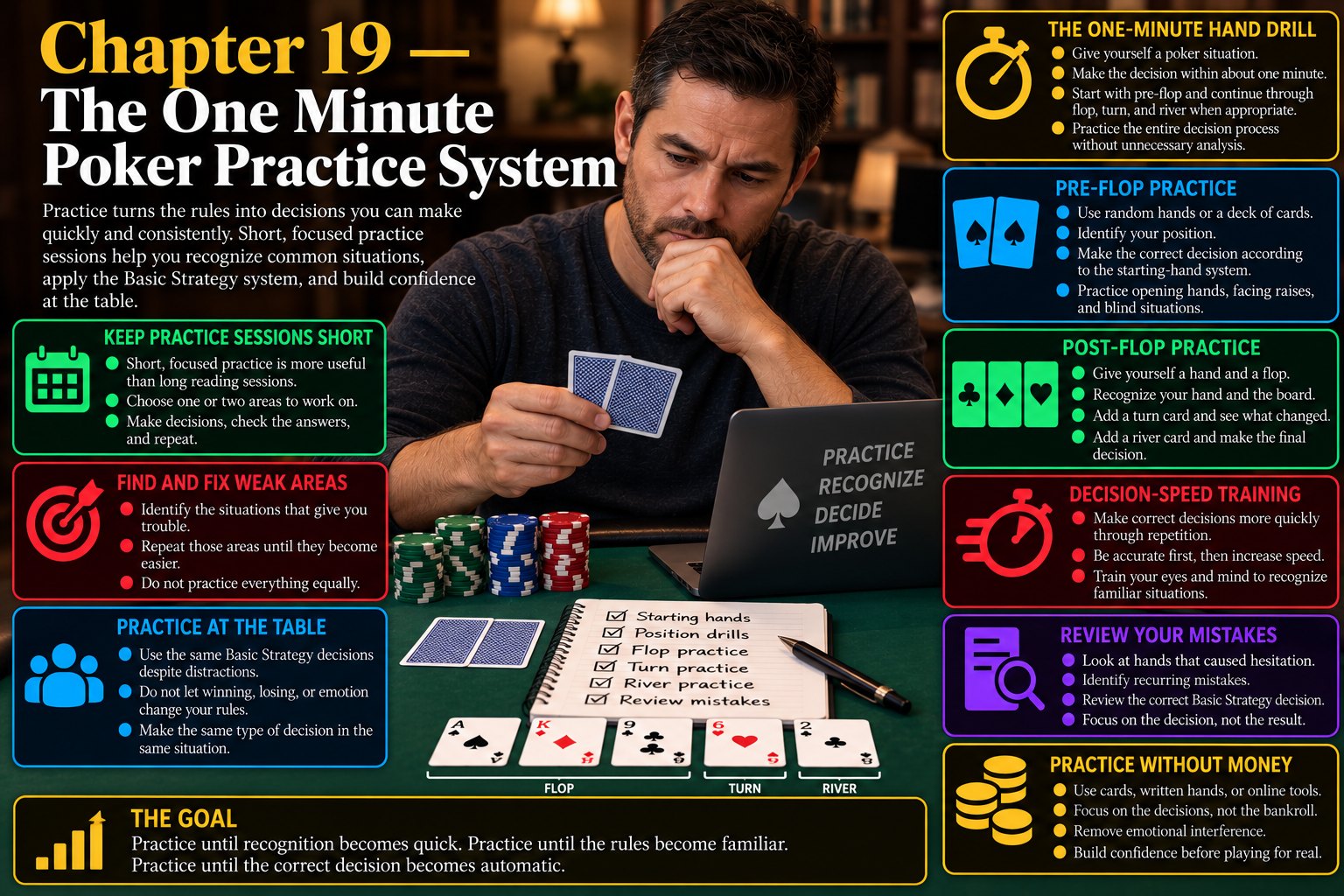
Learning Basic Strategy is only the beginning. Training is what turns the rules into decisions you can make quickly and consistently. The purpose of the One Minute Poker Practice System is not to make you an analyst who spends several minutes examining every hand. The purpose is to make the Basic Strategy system familiar enough that you can recognize common situations, make the appropriate decision, and move on.
Practice should be short, focused, and repeatable. You do not need to spend hours studying poker every day. A short session devoted to one specific skill can be more useful than a long session in which you simply read the same material again. The important thing is to practice actively. You should be making decisions, recalling rules, and identifying mistakes rather than simply looking at information.
The one-minute hand drill is the center of the practice system. Give yourself a poker situation and make the decision within approximately one minute. Start with the pre-flop situation. Identify your position, look at your starting hand, recognize the action, and make the appropriate decision. If the hand continues, move to the flop and make the next decision. Continue through the turn and river when appropriate. The purpose is to practice the entire decision process without getting trapped in unnecessary analysis.
The one-minute limit is not a requirement to rush. It is a training tool. If you cannot make a decision quickly because you do not remember the rule, that tells you what you need to practice. If you are making quick decisions but frequently getting the rules wrong, slow down and learn the material correctly before trying to increase your speed. Accuracy comes first. Speed develops through familiarity and repetition.
Pre-flop repetition should be a regular part of practice. Deal yourself random starting hands or use a random-hand generator and identify the position. Then make the decision according to the starting-hand system. Repeat the process with different positions. The goal is to make the relationship between position and starting hand familiar enough that you do not have to reconstruct it every time.
You can also practice specific situations. Spend a short session on opening hands. Another session can focus on facing raises. Another can focus on blind situations. The advantage of this approach is that you can concentrate on one area until it becomes easier before moving to another.
Post-flop repetition works in the same way. Give yourself a starting hand and a flop. Recognize your hand and the board. Decide what category the situation belongs to and make the appropriate decision. Then add a turn card and determine what changed. Finally, add the river and make the final decision. This creates practice that follows the actual structure of a poker hand.
Do not turn these drills into elaborate theoretical exercises. The purpose is not to examine every possible holding an opponent might have. The purpose is to practice the Basic Strategy decisions covered in this book. Recognize the situation, apply the rule, and make the decision.
Decision-speed training should come after you understand the rules. Once the correct decisions become familiar, begin reducing the time it takes to recognize them. Look at a starting hand and immediately identify the appropriate action. Look at a flop and immediately recognize the important category. See a turn card and identify what changed. Face a river bet and recognize whether the price and your hand justify continuing.
The more often you perform these exercises, the more natural the decisions become. Eventually, you should not need to stop and explain the entire rule to yourself. You recognize the situation and know what to do. That is the purpose of the practice system.
Reviewing hands is another important part of training. After a session, select hands that caused you to hesitate, hands where you were uncertain, or hands where you believe you may have ignored the Basic Strategy rules. Review those hands without judging yourself by the result. Ask what the situation was, what the Basic Strategy rule required, and whether you followed it.
Do not review hands simply because you lost them. A losing hand is not necessarily a mistake, and a winning hand is not necessarily a good decision. The purpose of review is to determine whether you followed the system. If you made the correct decision and lost, there may be nothing to correct. If you made the wrong decision and won, the result does not make the decision correct.
Over time, your reviews should reveal recurring mistakes. Perhaps you play too many starting hands from early position. Perhaps you call too often when facing a raise. Perhaps you continue with draws when the price is too expensive. Perhaps you become uncomfortable on dangerous boards. Perhaps you forget to reconsider your hand on the turn. Perhaps you make unnecessary calls on the river. When the same mistake appears repeatedly, it becomes a clear target for your next practice session.
This is one of the most efficient ways to improve. Do not practice everything equally when one part of your game is creating the majority of your problems. Identify the recurring mistake and drill that specific area until the correct response becomes familiar.
You can practice without money. This is one of the advantages of the system. You do not need to risk a bankroll to improve your decision making. You can use cards, written hands, flash cards, random hands, or imagined situations. The objective is to practice the decisions themselves.
Practicing without money can also remove emotional interference. You can concentrate on whether the decision is correct instead of worrying about winning or losing the pot. Once the rules become familiar, you can take the same system to actual play and see how well you execute it under normal playing conditions.
Practicing at the table is different because real poker introduces distractions. You may be winning or losing. You may be waiting for a playable hand. Other players may be talking. The action may move quickly. You may be tempted to deviate from your normal rules. The purpose of table practice is to maintain the same Basic Strategy decisions despite those distractions.
Do not use live play as an excuse to abandon the system. If the hand is straightforward, make the decision and move on. If the situation genuinely requires more thought, take the time you need. One Minute Poker is about efficient recognition, not reckless speed.
Consistency is the final goal. You want to make the same type of decision in the same type of situation for the same basic reason. You do not want your strategy changing because you are winning, losing, frustrated, excited, or trying to recover money from an earlier hand.
A good practice session therefore has a simple structure. Choose one or two areas to work on. Run several short drills. Make the decisions from memory. Review the mistakes. Repeat the weak areas. Then stop. You do not need to exhaust yourself to make progress.
A useful practice routine might begin with a few minutes of starting-hand drills, followed by several one-minute hands. You can then spend a few minutes practicing flop, turn, or river recognition. Finish by reviewing any decisions that caused hesitation. The exact amount of time is less important than the quality of the practice.
You should also return to material you already know. Familiarity can create the illusion that you no longer need practice. But the purpose of practice is not simply to learn something once. It is to maintain reliable recall so that the information remains available when you need it.
The practice system should gradually move you through three stages: learning, repetition, and automatic execution. At first, you may need to think carefully about the rule. With repetition, the rule becomes easier to recall. Eventually, recognition becomes fast enough that the decision feels natural.
That is what the One Minute Poker Practice System is designed to accomplish. You are not trying to become someone who can discuss poker endlessly. You are trying to become someone who can sit down, see the situation, recognize the appropriate Basic Strategy response, and execute it consistently.
Practice the starting hands.
Practice the positions.
Practice the flop decisions.
Practice the turn decisions.
Practice the river decisions.
Practice the price and risk decisions.
Review your mistakes.
Repeat the situations that give you trouble.
Then take the same discipline to the table.
The objective is not to think more about poker. The objective is to make the right decisions with less unnecessary thought.
Practice until recognition becomes quick. Practice until the rules become familiar. Practice until the correct decision becomes automatic.
PART VI — COMMON BASIC STRATEGY PROBLEMS