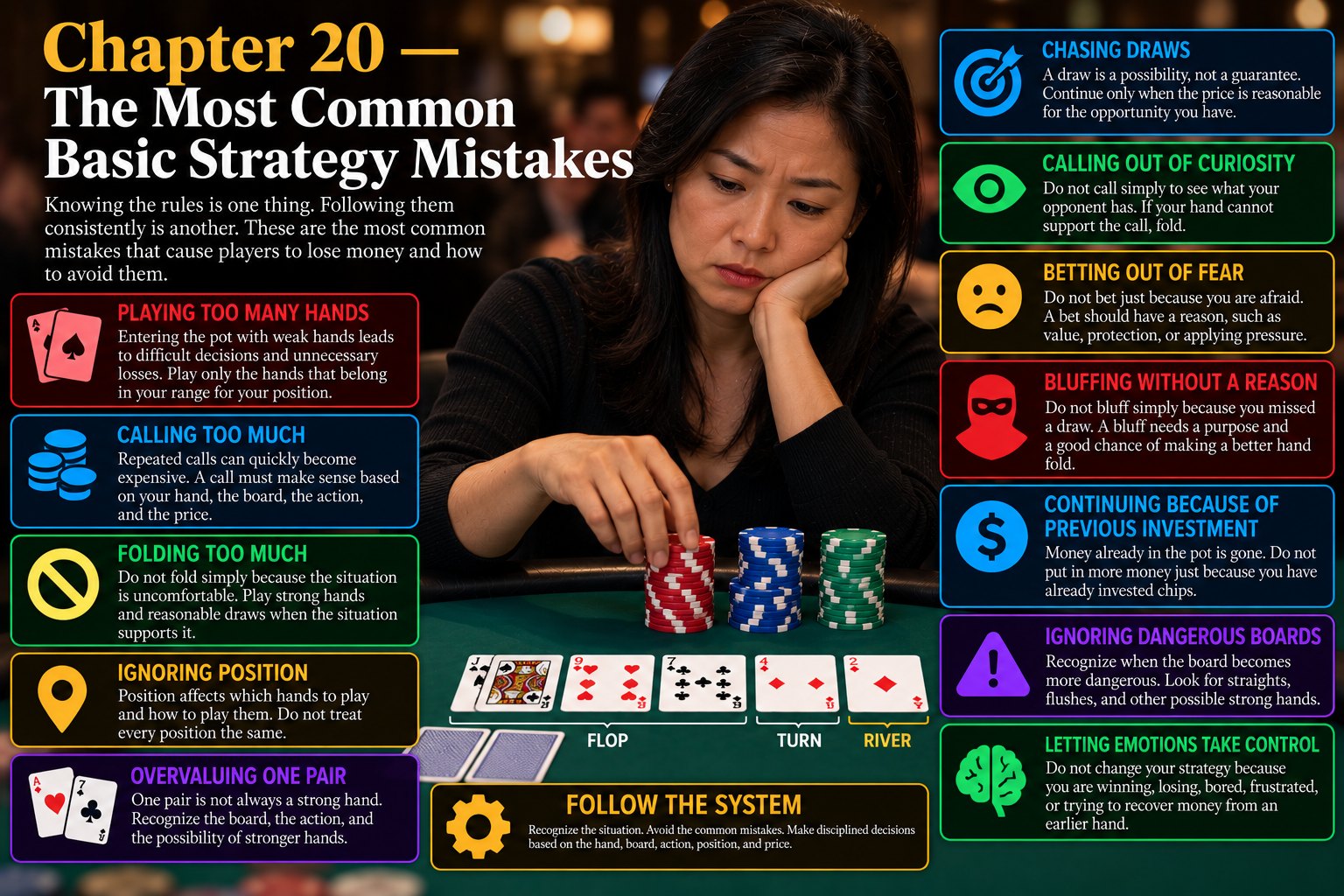
Knowing Basic Strategy is one thing. Following it consistently is another. Most mistakes do not happen because players have never heard the rules. They happen because players abandon simple rules when the hand becomes uncomfortable, exciting, expensive, or confusing. The purpose of this chapter is to identify the mistakes that most often interfere with Basic Strategy and show how to recognize them before they become costly.
Playing too many hands is one of the most common mistakes. Players become bored, see a hand that looks attractive, or convince themselves that a weak hand might work this time. The starting-hand system exists to prevent that problem. If a hand does not belong in your range for your position and situation, you do not need to find a reason to play it. Folding a hand that does not qualify is not missing an opportunity. It is following the system.
Position makes this mistake even more important. A hand that may be playable from a later position may not be appropriate from an earlier position. Ignoring that difference causes players to enter pots with hands that become difficult to play after the flop. The solution is simple: recognize your position before deciding what to do with your starting hand.
Calling too much is another major problem. Calling can feel safer than raising because you are not putting in as much money at once, but repeated calls can become expensive. Players often call because they want to see the next card, because they think the opponent might be bluffing, or because they have already invested chips. None of those reasons automatically makes calling correct. The call must make sense based on your hand, the board, the action, and the price.
The opposite mistake is folding too much. Basic Strategy is not a system that tells you to fold whenever a situation becomes uncomfortable. Strong hands should be played. Good draws can be continued with when the price is reasonable. Medium-strength hands can sometimes continue when the situation supports it. The goal is not maximum caution. The goal is disciplined decisions based on the hand and situation.
Ignoring position creates problems throughout the hand. Position affects the information available to you and the range of hands that should normally be played. A player who treats every position as identical will enter too many pots from early positions and fail to take advantage of later position. Position should therefore become part of your automatic recognition process rather than something you remember only occasionally.
Overvaluing one pair is another common mistake. One pair can be a strong hand, but it is not automatically a strong hand on every board. The value of a pair depends on the rank of the pair, the board, the action, and the possibility that other hands have improved. A player holding an overpair may feel protected by the fact that the pair is higher than the board, but a dangerous board can change the situation quickly. Recognize what your hand actually is rather than what you hoped it would be.
The same principle applies to top pair. Top pair often looks strong because it is the highest pair available from the board and your hole cards. But top pair is still only one pair. If the board develops several connected cards, a flush possibility, or other dangerous combinations, you must recognize the change. Do not automatically treat one pair as a hand that must continue regardless of the action.
Chasing draws is another expensive mistake. A draw is a possibility, not a guarantee. Players often become emotionally attached to the card they hope will arrive. They see a flush draw or straight draw and automatically continue, even when the price has become too high. Basic Strategy requires you to recognize the draw and then consider the price. If continuing costs too much for the opportunity you have, folding is a disciplined decision.
The turn makes this especially important because there is only one card remaining. A draw that was reasonable to pursue on the flop may become too expensive on the turn. You do not have to continue simply because you were willing to continue earlier. Every street creates a new decision.
Calling because you are curious is not a strategy. Sometimes players call because they want to see what the opponent has. They want to know whether the opponent was bluffing. They want to see whether their suspicion was correct. But satisfying curiosity costs money when the call is not justified. If your hand cannot reasonably support the call, you do not need to pay for information.
This mistake becomes particularly common on the river. There is no future card left, so calling simply to see the opponent's hand has no strategic value. If the price is too high and your hand is not strong enough to justify continuing, fold. You do not need to know whether your opponent was bluffing.
Betting because you are afraid is another problem. Players sometimes bet because they are afraid that checking will allow another player to improve or because they are afraid of being bluffed. Fear can make a player put money into the pot without a clear purpose. A bet should have a reason. You may be betting for value, protecting a hand in an appropriate situation, or applying pressure when the strategy calls for it. Fear by itself is not a reason to bet.
The opposite can happen as well. A player may check a strong hand because they are afraid of losing. That can prevent them from getting value from weaker hands. Basic Strategy requires you to recognize when your hand is strong enough to bet. You should not automatically bet every strong hand, but you should not allow fear to prevent reasonable value betting.
Bluffing without a reason is another common mistake. A player misses a draw and decides to bluff simply because the hand is no longer strong. But a missed draw does not automatically create a good bluffing opportunity. A bluff needs a purpose. You are trying to make a better hand fold. If there is little reason to believe a bet will accomplish that, checking or folding may be better.
Bluffing should therefore be a deliberate decision rather than an emotional reaction to weakness. You do not need to bluff simply because you have nothing. Sometimes the best decision with a missed draw is to give up.
Continuing because you have already invested chips is one of the most important mistakes to eliminate. Money already placed in the pot is gone. It should not determine whether you put more money into the pot. The current decision is about the additional money you are being asked to risk.
Suppose you have already invested $30 and now face another $40 bet. The $30 does not become a reason to call the $40. The question is whether calling the additional $40 makes sense based on your current hand, the board, the pot, the action, and the price. If the answer is no, fold. Protecting previous investment by making another bad decision only increases the loss.
Failing to recognize dangerous boards creates another major problem. A board can change dramatically from one street to the next. A turn or river card may complete a straight, complete a flush, pair the board, or create another combination that changes the strength of your hand. A player who continues to treat the hand exactly as they did on the previous street is ignoring new information.
You should therefore look at the board again after every community card. Ask what changed. Did your hand improve? Did the board become more dangerous? Did a draw complete? Did your opponent's possible hands become stronger? You do not need to identify every possible combination. You simply need to recognize the important changes.
Another common mistake is forgetting the basic rules when the pot becomes large. A large pot can make players abandon their normal discipline. They may call because they do not want to lose what is already in the middle. They may bet too much because they want to win the pot immediately. They may chase because the pot looks too large to give up. The size of the pot can create emotional pressure, but it does not change the basic rules.
A large pot is not a reason to make a bad decision. In fact, a large pot can make discipline even more important because mistakes become more expensive.
Players also make mistakes by changing their strategy because of the result of the previous hand. Winning a big pot can make a player feel invincible. Losing a big pot can make a player want to recover the money immediately. Neither result should change the Basic Strategy decision for the next hand. Every hand begins with a new situation.
A good decision can lose. A bad decision can win. The result does not change the rule. If you fold a weak hand and later discover that it would have won, the fold was still reasonable if the hand did not belong in your range or the situation did not justify continuing. If you make a reasonable call and lose to a stronger hand, the loss does not automatically make the call wrong.
Results-oriented thinking can therefore become a hidden Basic Strategy mistake. Judge the decision by the situation when you made it, not by the card that appeared afterward. Poker contains uncertainty. Your job is to make the best decision available with the information you had.
Another mistake is trying to remember everything at once. The purpose of Basic Strategy is to become automatic, not to create a constant mental checklist. You should not have to recite every rule in your head during every hand. The training in the earlier chapters is designed to make the important information familiar enough that recognition becomes natural.
When a situation is straightforward, trust the system. Recognize the position and hand pre-flop. Recognize the hand and board after the flop. Recognize what changed on the turn. Recognize your final hand and the price on the river. The more familiar these categories become, the less unnecessary thought you need.
There is also a mistake in the opposite direction: assuming the system must answer every possible situation. Basic Strategy is designed to provide a clear method for the situations it covers. If a situation falls outside the normal rules, do not invent certainty simply because you feel that you must have an immediate answer. Slow down, recognize that the situation is unusual, and make the best decision you can with the information available.
The goal of Basic Strategy is not to eliminate every difficult poker situation. It is to make ordinary situations easier and more consistent. When the system clearly applies, follow it. When something unusual happens, recognize that it is unusual rather than forcing it into a rule that does not fit.
The most common mistakes can therefore be summarized simply: playing too many hands, calling too much, folding too much, ignoring position, overvaluing one pair, chasing draws, calling out of curiosity, betting out of fear, bluffing without a reason, continuing because of previous investment, ignoring dangerous boards, and forgetting the basic rules when emotions or pot size become distracting.
The solution to these mistakes is not to add dozens of new rules. It is to return to the Basic Strategy system you have already learned. Recognize the situation. Follow the appropriate rule. Consider the hand, board, action, position, and price. Then make the decision.
The more automatic the system becomes, the easier it is to recognize when you are about to make one of these mistakes. You will notice when you are playing a hand simply because you are bored. You will notice when you are calling because you are curious. You will notice when you are chasing a draw without considering the price. You will notice when you are continuing because of the money already invested. That recognition gives you the opportunity to stop the mistake before it costs you more.
Basic Strategy does not require perfect poker. It requires consistent execution of a simple system. The purpose of this chapter is not to make you afraid of mistakes. It is to make the most common mistakes recognizable.
When you recognize them, you can correct them.
Play the hands that belong. Respect position. Do not chase without a reasonable price. Do not call out of curiosity. Do not bet out of fear. Do not bluff without a reason. Do not protect money that is already in the pot. Recognize dangerous boards. Follow the system.