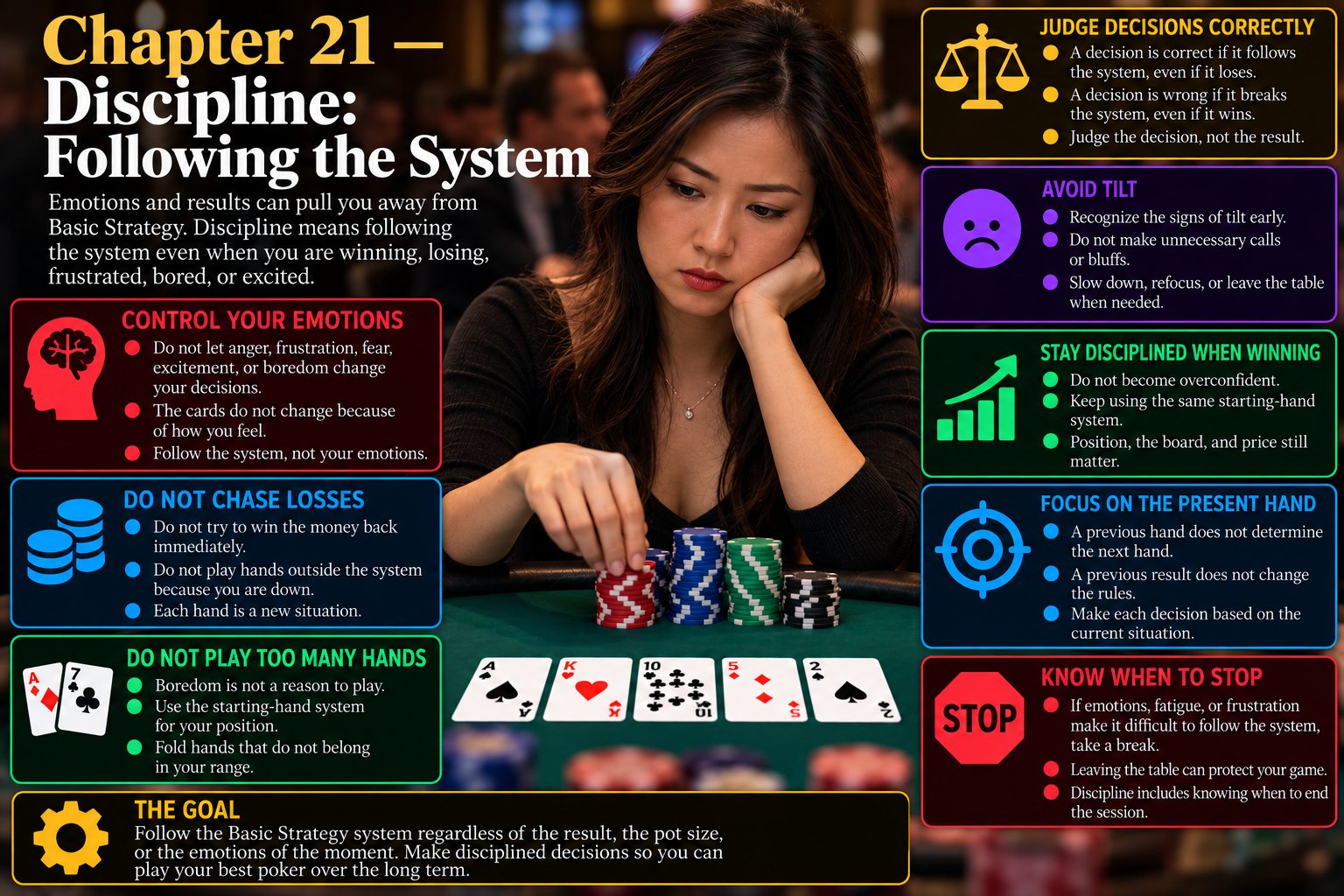
Knowing Basic Strategy does not guarantee that you will follow it. The real test comes when the game creates pressure. You lose a big pot, win a big pot, receive several bad hands in a row, make a strong hand that gets beaten, or become frustrated with the way the cards are running. These situations can make a player abandon rules that were perfectly clear before the pressure began. Discipline means continuing to follow the system even when your emotions are telling you to do something different.
Players often abandon good strategy because they want an immediate result. A player may start playing hands outside the starting-hand system because they have been folding for too long. Another player may begin calling too often after losing several pots because they want to recover the money. Someone who has just won a large pot may suddenly become willing to play almost anything because they feel confident. None of these reactions improves the underlying strategy. They simply replace the system with emotion.
Emotional decisions are decisions influenced more by how you feel than by the situation in front of you. Anger can make you play aggressively without a reason. Fear can make you fold hands that should continue. Excitement can make you play too many hands. Boredom can make a weak starting hand suddenly look playable. The cards do not change because of your emotions, so the rules should not change either.
Tilt is one of the clearest examples. Tilt can begin with a bad beat, a frustrating opponent, a series of losses, or even a mistake you made yourself. Once tilted, a player may try to win the money back immediately, make unnecessary calls, bluff too often, or play hands that would normally be automatic folds. The important point is to recognize the change before it controls your decisions.
Frustration can be especially dangerous because poker naturally contains periods when nothing seems to happen. You may fold hand after hand. You may finally receive a playable hand and lose with it. You may make what you believe is the correct decision and still lose the pot. None of this means the system has stopped working. It means poker contains results you cannot control.
Fear creates a different problem. A player who becomes afraid of losing may begin folding too much, checking strong hands, or avoiding reasonable calls. Fear can also make a player play smaller than the situation requires. Basic Strategy is not about eliminating risk. It is about taking reasonable risks when the situation supports them and avoiding unreasonable ones.
Greed can produce the opposite reaction. After winning several pots, a player may begin believing that every hand is an opportunity to win more. Strong results can create overconfidence just as easily as bad results create frustration. The starting-hand system does not become less important because you are winning. Position does not stop mattering because you are running well. The system remains the system.
One of the most important forms of discipline is avoiding results-oriented thinking. A decision should be judged by the situation when the decision was made, not simply by what happened afterward. A correct decision can lose. A poor decision can win. If you fold a hand correctly and later discover that it would have won, that does not make the fold wrong. If you make a poor call and happen to win, that does not make the call correct.
Bad beats can make this principle difficult to remember. You may play a strong hand correctly, get your money in with the best of it, and still lose because the opponent improves. That result can be frustrating, but it is not a reason to change the strategy. The correct response is to recognize what happened and continue making decisions according to the system.
Losing sessions require the same discipline. You can follow Basic Strategy correctly and still finish the session down money. Poker results are not evenly distributed from hand to hand or session to session. A losing session does not automatically mean that your strategy failed. Review your decisions rather than judging the entire session by the final amount won or lost.
Winning sessions deserve the same discipline. Winning can create its own form of emotional interference. A player may begin taking unnecessary risks because the session is going well. They may loosen their starting-hand requirements, make larger bets without a clear reason, or continue playing simply because they believe they cannot lose. A winning session is not permission to abandon the system.
The goal is to stay with the system. Your position still matters. Your starting hand still matters. The board still matters. The price still matters. A previous hand does not determine the next hand. A previous result does not determine the next decision. Each situation should be treated according to the rules that apply to that situation.
This is especially important because the automatic system you have been building can be disrupted by conscious interference. You have spent time training yourself to recognize situations quickly. If you suddenly begin questioning every decision because you are frustrated or trying to recover losses, you can replace automatic recognition with emotional analysis. Discipline protects the work you have already done.
One useful habit is to recognize the moment when you are beginning to deviate. If you hear yourself thinking, “I have to win this one back,” “I have been folding too long,” “I cannot let them bluff me again,” or “I am running so well that I can play this hand,” you should recognize that the decision is being influenced by something other than the actual poker situation.
The answer is not to become emotionless. The answer is to return to the system. Look at the position. Look at the hand. Look at the action. Look at the board. Look at the price. Then make the decision that belongs to the situation.
There are also times when the best disciplined decision is to end the session. If frustration, fatigue, anger, distraction, or excitement has become strong enough that you can no longer follow your normal decision process, continuing to play may only make the problem worse. Leaving the table is not a failure. It is a way of protecting your ability to make good decisions.
You do not need to quit every time you lose a pot or become mildly frustrated. Poker naturally produces emotional reactions. The important question is whether those reactions are beginning to change your decisions. If they are, recognize the problem and step away when necessary.
Discipline also means accepting that not every hand needs to be played. Boredom is not a reason to enter a pot. Curiosity is not a reason to call. Frustration is not a reason to bluff. Fear is not a reason to fold a strong hand. Greed is not a reason to play a weak hand. The system already provides the structure you need.
The strongest discipline is often quiet. It is folding when the hand does not qualify. It is folding when the price is too high. It is checking when betting has no clear purpose. It is betting when value is available. It is continuing when the situation supports it. It is making the same type of decision whether you won the last hand or lost it.
Basic Strategy becomes truly useful when you can follow it under normal pressure. Memorization gives you the information. Practice gives you familiarity. Automatic recognition gives you speed. Discipline keeps you from abandoning all three when the game becomes emotional.
You do not have to control the cards. You do not have to control the opponent. You do not have to control the result of every hand. You only need to control your decisions.
That is the purpose of discipline in Basic Strategy: follow the system regardless of the result of the previous hand, the size of the pot, the emotions of the moment, or whether you are winning or losing.
When the game becomes emotional, return to the rules.
When the results become distracting, return to the decisions.
When frustration appears, slow down.
When you feel yourself abandoning the system, recognize it.
Then make the next decision according to Basic Strategy.
PART VII — COMPLETE BASIC STRATEGY APPLICATION