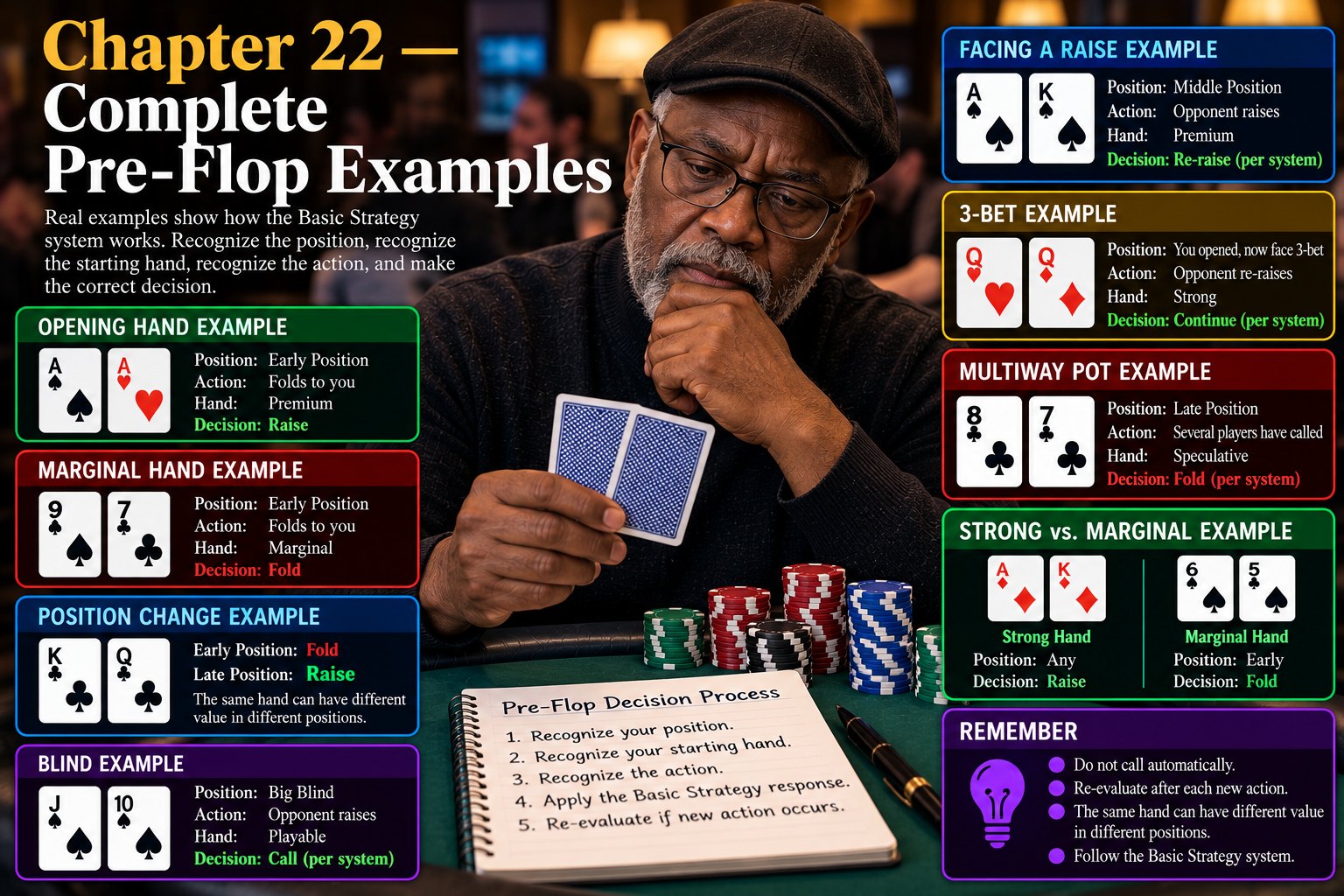
The purpose of this chapter is to take the pre-flop rules from the earlier chapters and show them working in actual situations. The examples are not designed to introduce a new strategy. They are designed to demonstrate how the Basic Strategy system is supposed to operate automatically: recognize the position, recognize the starting hand, recognize the action, and make the appropriate decision. The emphasis is on the decision and the reason for it, not on analyzing the player who happens to be sitting across the table. The Basic Strategy outline specifically calls for examples involving opening hands, facing raises, 3-bet situations, blind situations, multiway pots, position changes, and strong versus marginal hands.
Because the exact starting-hand ranges are learned earlier in the book, these examples use the hand categories established in the system rather than turning this chapter into another starting-hand chart. The basic recognition process is simple: see the hand → recognize the category → know the basic action.
Opening-Hand Examples
Example 1 — Premium Hand in Early Position
You are in early position and receive a premium starting hand.
The decision is straightforward: enter the pot aggressively according to the opening rules.
There is no reason to complicate a premium hand by worrying about every possible response before the action happens. Recognize the hand, recognize the position, and make the normal opening decision.
The lesson is simple: when the hand clearly belongs in your opening range for the position, follow the system.
Example 2 — Marginal Hand in Early Position
You are in early position with a marginal starting hand.
The hand may look playable because it contains a high card, is suited, or has some other attractive feature. But appearance does not determine whether the hand belongs in the range.
If the hand does not qualify for the position, fold it.
This is one of the reasons the starting-hand system exists. You do not need to invent a reason to play a hand that the system has already identified as marginal.
Example 3 — Strong Hand in Middle Position
You are in middle position with a strong starting hand and the action has folded to you.
The hand qualifies for the position, so you enter according to the normal opening rules.
The decision does not require a long analysis. You recognize the position, recognize the hand category, and execute the appropriate action.
Example 4 — Medium Hand in Late Position
You are in late position with a medium-strength hand that belongs in the late-position range.
The later position gives the hand more opportunity to be played than it would have from early position. The important point is that you do not treat the hand's value as fixed regardless of where you are sitting.
The correct decision comes from the combination of hand and position.
Example 5 — The Same Hand in a Different Position
Consider the same starting hand from two different positions.
From early position, the hand may fall outside the normal range and should be folded. From late position, the same hand may qualify for entry.
Nothing about the two cards changed. The position changed.
This is why position must become part of automatic recognition. The question is not simply, "What cards do I have?" The question is, "What cards do I have, and where am I?"
Facing a Raise
Example 6 — Facing a Raise With a Premium Hand
You are in position and another player raises before the action reaches you. You hold a premium starting hand.
This is not a situation where you should automatically call simply because someone has raised. A premium hand belongs in the group of hands that can respond aggressively.
The appropriate response is to follow the predetermined re-raise or other response established by the Basic Strategy rules.
The important lesson is that a raise does not automatically make you passive. Strong hands can respond strongly.
Example 7 — Facing a Raise With a Marginal Hand
You are holding a marginal starting hand when a player raises in front of you.
This is an easy fold.
Do not call simply because you already planned to play the hand. The raise has changed the situation. A hand that was already marginal does not become more attractive because money has entered the pot.
Example 8 — Facing a Raise With a Strong Hand
You hold a strong but non-premium hand and face a raise.
Now the decision depends on the predetermined Basic Strategy response for that hand category, your position, the number of players involved, and the relevant stack considerations. The key is not to make an emotional decision simply because someone raised.
If the hand qualifies to continue, continue according to the system. If it does not, fold.
The important point is that calling is not automatic. The earlier outline specifically identifies avoiding automatic calls as part of the facing-a-raise system.
3-Bet Situations
Example 9 — Strong Hand Facing a 3-Bet
You open with a qualifying starting hand and another player re-raises.
The action has now changed. You should not simply continue with your original plan because you were the original raiser. Recognize the new action and apply the appropriate response for the strength of your hand.
A strong hand may continue. A marginal hand may not.
The important habit is re-evaluation. Pre-flop decisions are not one continuous decision. Each new action creates a new situation.
Example 10 — Marginal Hand Facing a 3-Bet
You open with a hand that was acceptable for the original position. Another player 3-bets, and you are now facing significantly stronger action.
This is exactly where discipline matters.
You do not say, "I already raised, so I have to continue." The money already invested does not create an obligation to put in more money. If the hand no longer qualifies for the situation, fold it.
This is one of the clearest examples of why previous investment should not control the current decision.
Example 11 — Premium Hand Facing a 3-Bet
You open with a premium hand and face a 3-bet.
The strength of your hand gives you a clear reason to continue, but the correct response still comes from the Basic Strategy rules rather than emotion. Follow the predetermined action for a premium hand in this situation.
You do not need to guess what the other player has. You do not need to profile the opponent. You recognize your hand, recognize the action, and execute.
Blind Situations
Example 12 — Big Blind With a Playable Hand
The action reaches the big blind and you have a hand that qualifies for the situation.
You have already posted a blind, but that does not mean you must defend every hand. The starting-hand system still matters.
If the hand qualifies for the appropriate response, continue according to the rules. If it does not, fold.
The big blind does not turn every starting hand into a playable hand.
Example 13 — Big Blind With a Weak Hand
You are in the big blind with a weak starting hand and face action.
It can be tempting to continue because you already have money invested. That is the wrong reason.
The blind is already in the pot. The current question is whether the hand justifies putting additional money into the pot.
If it does not, fold.
Example 14 — Small Blind
You are in the small blind with a playable starting hand.
The small blind is a different position from the big blind, and you should not treat the two positions as identical. The Basic Strategy system gives each position its own role.
Recognize the position first. Then recognize the hand. Then make the appropriate decision.
The goal is not to memorize a complicated explanation every time. The goal is to recognize the position and immediately connect it to the correct range.
Multiway Pots
Example 15 — Opening Into Several Players
You are in position and several players have already entered the pot.
A hand that might be reasonable in a simpler situation may become less attractive when several players are involved. The more players entering the pot, the more important it becomes to follow the predetermined multiway rules rather than treating the situation like heads-up action.
The correct decision comes from the hand category, position, and number of players.
Example 16 — Strong Hand in a Multiway Pot
You hold a strong starting hand and several players have entered.
Do not become passive simply because there are multiple players. A strong hand remains a strong hand. At the same time, recognize that multiway situations are different from heads-up situations.
Follow the Basic Strategy response for the situation.
The system is designed to keep the decision structured rather than allowing the number of players to create confusion.
Example 17 — Speculative Hand in a Multiway Pot
You hold a speculative hand and several players have entered.
This is where players often become attracted to the possibility of making a big hand. But speculative hands are not automatically playable simply because several players are in the pot.
The decision must still fit the Basic Strategy rules for the hand, position, and action.
Do not turn speculation into an excuse for entering pots with hands that do not qualify.
Position Changes the Decision
Example 18 — Same Hand, Early Position
You receive a medium-strength hand in early position.
The hand may look good enough to play, but early position requires greater discipline. There are still many players who can act after you.
If the hand falls outside the appropriate opening range, fold it.
Example 19 — Same Hand, Late Position
You receive that same hand in late position.
Now the situation is different. Fewer players remain to act, and the hand may qualify for the wider range associated with the position.
If it qualifies, enter according to the normal rule.
The cards are identical. The decision changes because the position changes.
This is one of the most important ideas in the Basic Strategy system: the same hand can have different value in different positions.
Strong Versus Marginal Hands
Example 20 — Strong Hand, No Reason to Hide
You receive a strong starting hand in a position where it qualifies.
Do not weaken the decision simply because you are afraid that everyone will fold. The purpose of entering with a strong hand is not to make the hand look weak. Follow the opening rules and allow the situation to develop.
Basic Strategy does not require you to disguise every strong hand.
Example 21 — Marginal Hand That Looks Attractive
You receive a marginal hand with attractive-looking cards.
Maybe the cards are suited. Maybe they are connected. Maybe they contain a high card. The hand can still be outside your normal range.
This is where memorization protects you from temptation.
If the hand does not qualify, fold it.
You do not need to create a special exception simply because the hand looks interesting.
Example 22 — Speculative Hand
You receive a speculative hand in a position where the system permits it under the appropriate conditions.
The important word is appropriate. A speculative hand is not a premium hand. It should not be treated like one. Its value depends on whether the situation fits the rules established for that category.
When the conditions of the Basic Strategy system allow the hand to enter, enter according to the system. When they do not, fold.
The Automatic Pre-Flop Routine
These examples all reduce to the same process.
First, recognize your position.
Second, recognize your starting-hand category.
Third, recognize the action in front of you.
Fourth, apply the predetermined Basic Strategy response.
Fifth, if new action occurs, re-evaluate the situation rather than automatically continuing.
That routine covers opening hands, facing raises, re-raises, blind situations, and multiway pots. The purpose is not to make you think through a completely new strategy every time. The purpose is to make familiar situations produce familiar responses.
The Basic Strategy player should not need to ask, "What would a Predator do here?" Predator Strategy is not part of this decision process. This chapter deliberately stays inside the Basic Strategy system. The source outline specifically requires these examples to demonstrate what the Basic Strategy player does and why, without drifting into Predator analysis.
The most important lesson from the examples is that pre-flop decisions are built around recognition. Position tells you which range to consider. Your starting hand tells you which category you are holding. The action tells you which decision you are facing. The system then tells you what to do.
You do not need to make every hand complicated.
You do not need to read the opponent.
You do not need to invent a new strategy because someone raised.
You need to recognize the situation and execute the Basic Strategy response.
That is what makes the system automatic.
Position → Starting Hand → Action → Basic Strategy Response.
Recognize it. Decide it. Move on.