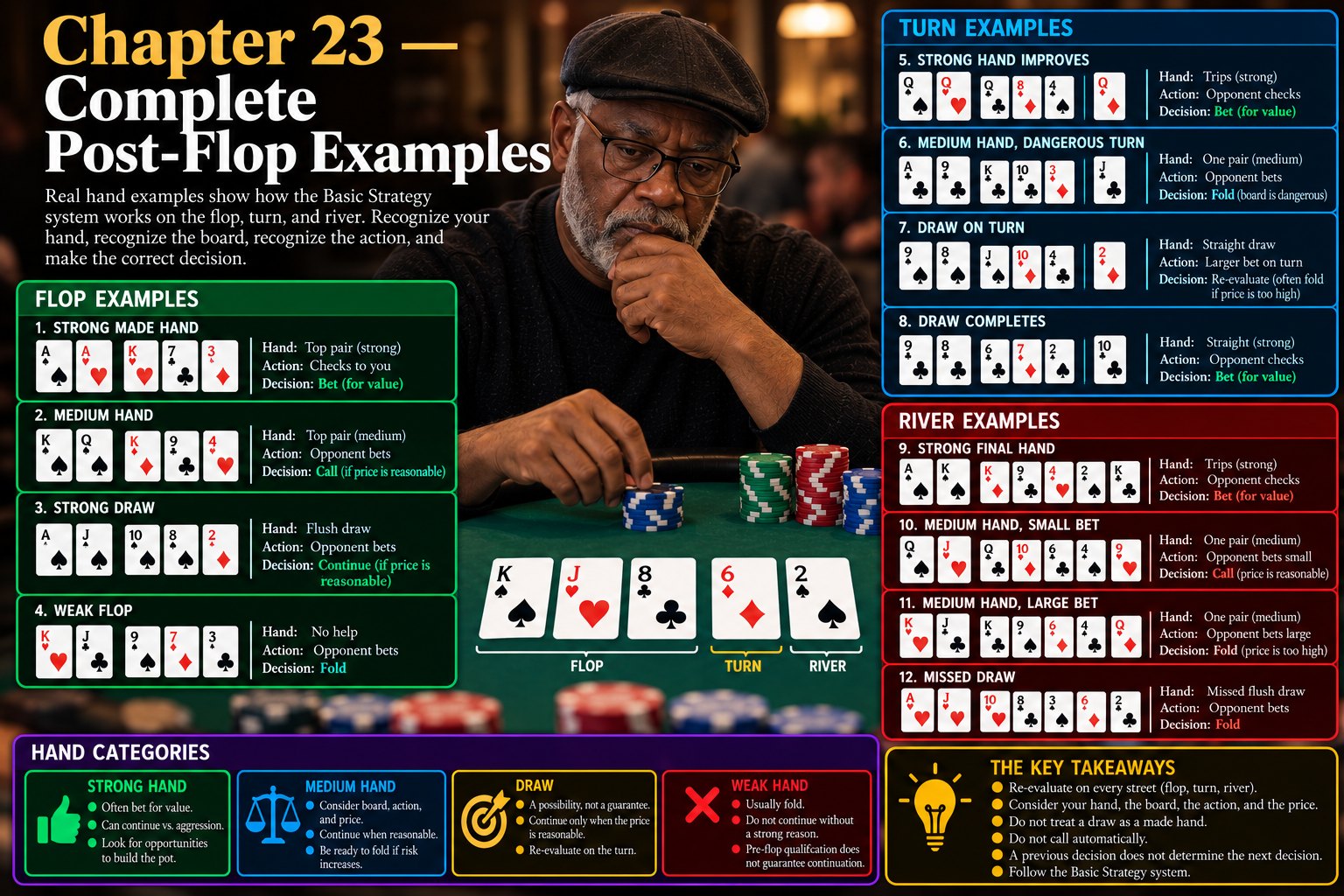
The pre-flop decision gets you into the hand. The post-flop decision determines how you continue. Once the flop arrives, the starting-hand system has done its job. Now you must recognize what your hand has become, recognize the board, recognize the action, and choose the Basic Strategy response that fits the situation. The purpose of these examples is to show that process in actual hands. The goal is not to analyze every possible hand an opponent could have. The goal is to recognize your own hand, recognize the board, recognize the action, and make the appropriate decision.
Flop Decisions
Example 1 — Strong Made Hand
You raise before the flop with a strong starting hand and receive a flop that gives you a strong made hand. The action checks to you.
This is a straightforward situation. You recognize that you have a strong hand and that there is an opportunity to bet. A strong hand should not automatically be played passively simply because you are afraid someone might improve. If weaker hands can continue, betting can build the pot while you have the advantage.
The important point is recognition. You do not need to create a complicated explanation for why you have a strong hand. Recognize it and choose the appropriate aggressive action.
Example 2 — Medium Hand
You enter the pot with a playable starting hand and the flop gives you a medium-strength made hand.
This is different from having a very strong hand. You should not automatically treat the hand as though it must build a large pot. Look at the board and the action. If the situation allows you to continue comfortably, continue according to the Basic Strategy rules. If the action becomes too strong or the board becomes dangerous, be prepared to reconsider.
A medium hand requires recognition and discipline. It does not require fear, but it does not justify automatic aggression either.
Example 3 — A Strong Draw
You reach the flop with a draw that has meaningful potential to improve.
The first mistake would be to treat the draw as though it were already a made hand. It is not. You have potential, but you still need to consider the action and the price.
If the price is reasonable, continuing may make sense. If the price becomes too high, folding can be correct. The important distinction is between having a draw and having a completed hand.
Example 4 — A Weak Flop
You enter the pot with a playable starting hand, but the flop does not help you.
There is no reason to continue simply because the hand was good enough to play before the flop. The flop has created a new situation. If you have no meaningful hand, no reasonable draw, and no appropriate reason to continue, folding may be the correct decision.
Pre-flop qualification does not guarantee post-flop continuation.
Recognizing What the Flop Changed
Every flop should cause you to reassess the hand. The question is not, "What did I have before the flop?" The question is, "What do I have now?"
A premium starting hand can become only a medium-strength hand. A speculative starting hand can become a strong made hand. A starting hand that looked promising can completely miss the board. A draw can appear. A dangerous board can develop. The cards have changed, so the decision must be based on the new situation.
A useful recognition process is simple: What is my hand? What is the board? What happened before me? What action fits this situation?
Turn Decisions
Example 5 — Strong Hand Improves
You have a strong made hand on the flop and the turn improves it further.
The hand has become stronger, so you should recognize the opportunity to continue aggressively when the situation calls for it. Do not become so focused on protecting the hand that you fail to get value from weaker hands.
The turn is a new decision. Recognize what changed and choose the action that fits the stronger hand.
Example 6 — Medium Hand on a Dangerous Turn
You have a medium-strength hand on the flop. The turn completes a possible straight or flush and your opponent now bets.
This is where players often make the mistake of continuing automatically. The hand may have been reasonable on the flop, but the turn has changed the board and increased the risk.
Recognize the new board. Recognize the strength of your hand. Consider the price. If continuing is no longer reasonable, fold.
Example 7 — Draw on the Turn
You have a draw on the flop and continue because the price is reasonable. The turn does not complete the draw, and your opponent makes a larger bet.
There is now only one card left to come. The fact that you called on the flop does not mean you should call again. Re-evaluate the price and the remaining opportunity to improve.
If the new price is too high, let the hand go.
This is one of the most important turn habits in Basic Strategy: a reasonable flop call does not create an automatic turn call.
Example 8 — Draw Completes
You have a draw on the flop and the turn completes it.
Now you have a made hand. Recognize the change immediately. You are no longer deciding whether to chase the draw. You are deciding how to play the completed hand.
If the hand is strong and weaker hands can continue, look for value. If the board creates a situation where your completed hand is vulnerable, recognize that as well. The important thing is that your decision changes because your hand changed.
Price and Risk on the Turn
The turn is where price becomes particularly important because only one card remains. If you are facing a bet, compare what you must risk with what is already in the pot. A small call may be reasonable for a draw or medium hand. A large call may not be.
Do not confuse a draw with a guarantee. You are paying for the opportunity to improve. The price must justify that opportunity.
Also remember that money already invested is gone. If you called $20 on the flop, that does not mean you should call another $40 on the turn. The current decision concerns the additional $40.
River Decisions
Example 9 — Strong Final Hand
You reach the river with a strong made hand. Your opponent checks.
The river is the final opportunity to win additional money from weaker hands. If weaker hands can reasonably call, a value bet may be appropriate. The important point is to recognize the strength of your final hand and the opportunity available.
Do not automatically check a strong hand because you are afraid of being raised. If the situation supports value, consider taking it.
Example 10 — Medium Hand Facing a River Bet
You reach the river with a medium-strength hand and your opponent makes a small bet.
The hand may be strong enough to call because the price is reasonable. You do not need to have a premium hand to make a river call. You need a hand that can reasonably justify the price.
Recognize the difference between a small bet and a large bet. The same medium-strength hand may be able to call one and fold to the other.
Example 11 — Medium Hand Facing a Large Bet
You have the same type of medium-strength hand, but this time your opponent makes a large river bet.
The price has changed dramatically. You cannot make the decision simply by saying, "I have a pair."
You must ask whether the hand is strong enough to justify the amount you are being asked to risk. If it is not, fold.
This is why river decisions cannot be based on hand strength alone. Hand strength and price must be considered together.
Example 12 — Missed Draw
You have a straight draw or flush draw that misses on the river. Your opponent bets.
There is no additional card coming. Your draw has failed to complete. You must now evaluate the hand you actually have rather than the hand you hoped to make.
If your remaining hand does not justify a call, fold. Do not call simply because you invested money trying to complete the draw.
Aggressive Situations
Example 13 — Opponent Bets the Flop
You hold a reasonable made hand and your opponent bets.
Do not automatically fold simply because someone has shown aggression. First recognize your hand. Then recognize the board and the size of the bet. If the price is reasonable and your hand can continue, continue. If the bet is too large for your hand and situation, fold.
Aggression from another player creates a decision. It does not automatically create a fold.
Example 14 — Opponent Raises Your Flop Bet
You bet a strong hand on the flop and your opponent raises.
Your first reaction should not be emotional. Recognize what happened. You have a strong hand, but the opponent has now increased the price and the level of aggression.
Consider the strength of your hand, the board, the size of the raise, and the Basic Strategy rules. If your hand is strong enough to continue, continue. If the situation has become too dangerous for the hand you have, reconsider.
Example 15 — Heavy Turn Action
You continue to the turn with a reasonable hand, but the turn produces heavy betting.
This is a situation where discipline matters. Do not continue simply because you were comfortable on the flop. The turn has created new information and increased the price.
Recognize the new situation. If your hand remains strong enough and the price is reasonable, continue. If the action has become too expensive for the hand you have, fold.
Difficult Decisions
Not every post-flop decision will be obvious. Some situations will fall between a clear call and a clear fold. When that happens, return to the basic structure instead of inventing complicated analysis.
Start with your hand. Then look at the board. Then consider the action. Then consider the price. Finally, decide whether the situation gives you enough reason to continue.
The purpose of Basic Strategy is not to pretend that every poker situation is simple. It is to give you a reliable way to approach the situations that are difficult.
Example 16 — A Marginal Call
You have a medium-strength hand and face a moderate bet on the turn. You believe you may be ahead, but you are not certain.
Do not make the decision simply because you think the opponent might be bluffing. Consider the price. If the price is reasonable for the strength of your hand, calling may be justified. If the price requires you to be correct too often for the hand you have, folding may be better.
You do not need certainty. You need a reasonable decision.
Example 17 — A Marginal River Decision
You reach the river with a hand that may beat some of the opponent's possible hands but loses to stronger hands. The opponent makes a bet that is large enough to create a difficult decision.
This is where discipline matters most. You may be tempted to call because you believe the opponent could be bluffing. But the possibility of a bluff does not automatically justify the price.
If the call is too expensive for the hand you have, fold. You do not have to prove that the opponent has a strong hand. You only have to recognize that the current price does not justify continuing.
Folding Situations
Example 18 — Folding a Weak Flop
You miss the flop and face a bet.
You have no meaningful made hand, no reasonable draw, and no Basic Strategy reason to continue.
Fold.
There is nothing wrong with giving up a hand that has failed to develop. The fact that you entered the pot before the flop does not create an obligation to continue after the flop.
Example 19 — Folding a Turn Draw
You have a draw on the flop and call a reasonable bet. The turn misses you, and the opponent makes a large bet.
You now have one card left and an expensive price.
Fold if the price is not justified.
This is not giving up too early. It is recognizing that the situation has changed.
Example 20 — Folding the River
You reach the river with a weak hand and face a substantial bet.
There is no future card to improve you. If your hand cannot reasonably justify the call, fold.
The river is not the place to pay for information simply because you want to know what the opponent had.
Strong Hands, Medium Hands, Draws, and Weak Hands
The examples throughout this chapter demonstrate a larger principle. Post-flop decisions become easier when you first recognize the category of your hand.
A strong hand can often support aggressive action and value betting.
A medium hand requires more attention to the board, action, and price.
A draw requires recognition that you have potential rather than a completed hand, followed by a price-and-risk decision.
A weak hand often has little reason to continue unless the Basic Strategy situation provides a specific reason to do so.
These categories prevent you from treating every hand the same way.
The Complete Post-Flop Recognition Process
The process should remain consistent from street to street.
On the flop, recognize what your starting hand has become. Identify strong hands, medium hands, draws, and weak hands. Recognize the board and the action.
On the turn, recognize what changed. Your hand may have improved, weakened, or remained the same. The board may have become more dangerous. The price may have changed. Re-evaluate.
On the river, recognize the final hand and final board. There is no future card. Consider the action and the price, then make the final decision.
This is not a complicated checklist that you must recite aloud during every hand. With practice, these recognitions become increasingly automatic.
The Main Lesson
The purpose of these examples is to show that Basic Strategy remains consistent even though the situations change. A strong hand is recognized as a strong hand. A medium hand is treated according to the board, action, and price. A draw is not treated as a made hand. A weak hand is not kept alive simply because money has already been invested. A dangerous board is recognized when it appears. A large bet creates a different price from a small bet.
The most important habit is re-evaluation. The decision you made on the flop does not automatically determine the turn decision. The turn decision does not automatically determine the river decision. Every new street gives you new information and creates a new decision.
Do not become attached to the decision you made earlier. Become attached to the system.
You should recognize the situation, apply the Basic Strategy rules, and make the decision that fits what you see now.
You are not trying to predict everything that might happen.
You are not trying to read every opponent.
You are not trying to turn every hand into a complicated analysis.
You are trying to recognize your hand, recognize the board, recognize the action, recognize the price, and choose the appropriate response.
That is how the Basic Strategy system moves from the pre-flop into the rest of the hand.
Recognize the flop. Re-evaluate the turn. Finish the river. Make each decision according to the situation in front of you.