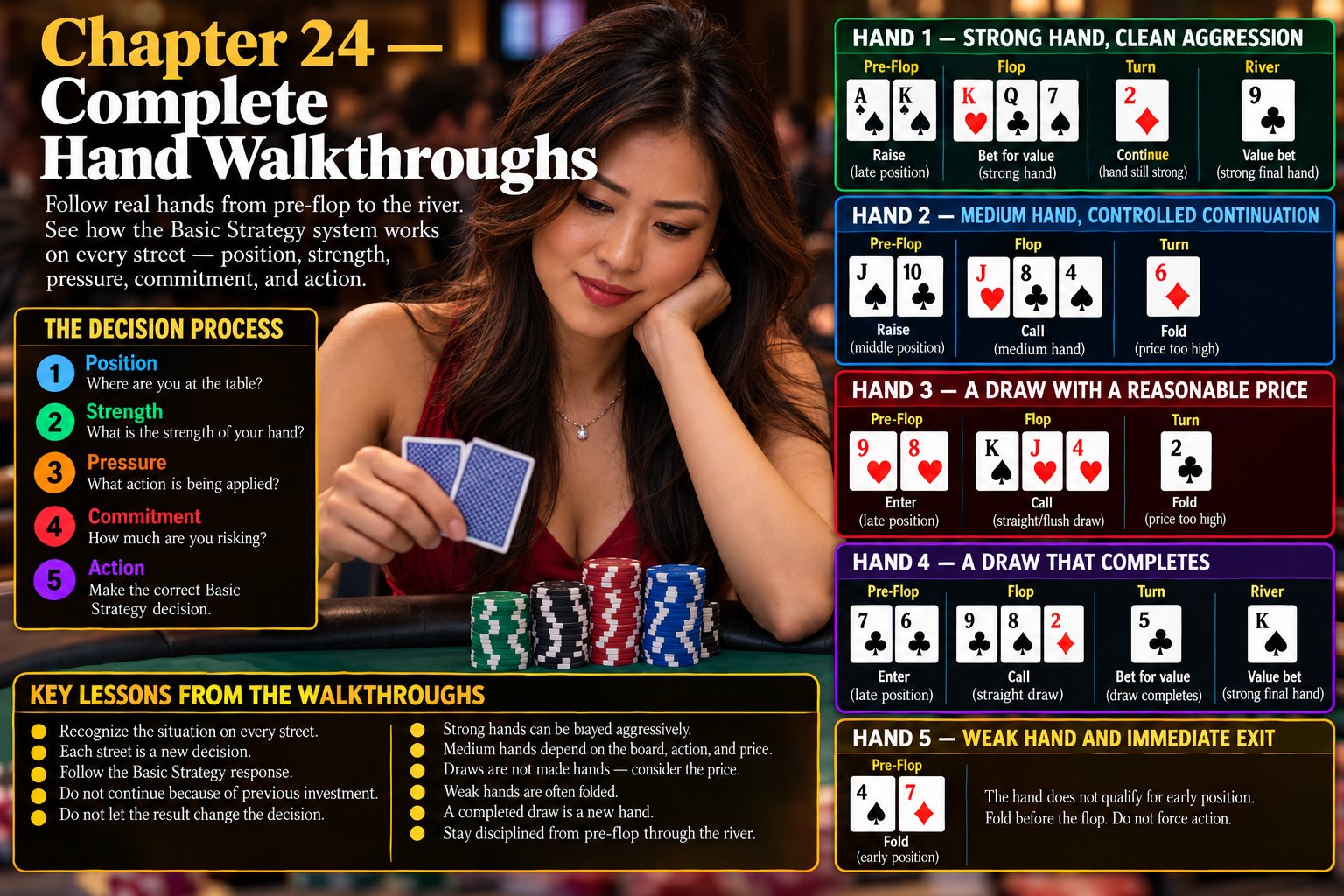
The previous chapters have separated poker decisions into individual parts. You have learned the starting-hand system, position, pre-flop action, flop recognition, turn decisions, river decisions, price, risk, discipline, memory, and practice. Now those pieces need to work together.
A real poker hand does not arrive in separate lessons. You receive two cards, make a pre-flop decision, see a flop, make another decision, see a turn, make another decision, and eventually reach the river. The entire process is connected.
That is what this chapter demonstrates.
Each walkthrough follows the hand from beginning to end. The purpose is not to show a perfect result. The purpose is to show consistent execution of Basic Strategy from one street to the next.
The system remains simple:
Position → Strength → Pressure → Commitment → Action
You recognize where you are. You recognize the strength of your hand. You recognize the pressure created by the action. You recognize how much you are committing. Then you make the appropriate decision.
There are no player reads in these examples. You are not trying to determine whether an opponent is aggressive, passive, tight, loose, clever, emotional, or deceptive. You are not trying to guess what a particular opponent is thinking.
You are playing the situation in front of you.
Hand 1 — Strong Hand, Clean Aggression
You are in late position with a strong starting hand. The action folds to you.
Pre-Flop
Your position is favorable. Your starting hand belongs in the range for that position. There is no previous pressure that requires a defensive decision.
Decision: Raise.
There is no reason to complicate this situation. You have position and a strong hand. The Basic Strategy response is to enter aggressively.
One opponent calls.
The hand continues to the flop.
Flop
The flop connects well with your hand and gives you a strong made hand. Your opponent checks.
You now have a strong hand, and there is no immediate pressure being applied to you.
Decision: Bet for value.
The purpose of the bet is straightforward. You have a strong hand and weaker hands may be willing to continue. There is no reason to slow down simply because you are afraid that the opponent might improve.
Your opponent calls.
The hand continues to the turn.
Turn
The turn does not weaken your hand. Your opponent now bets.
The situation has changed because pressure has been applied, but your hand remains strong.
Decision: Continue.
You do not need to invent a story about why the opponent bet. The fact that the opponent has bet is simply the new action. Your job is to recognize your hand and respond according to the Basic Strategy rules.
You call.
The hand reaches the river.
River
The river does not materially weaken your hand. Your opponent checks.
You still have a strong hand, and the opponent has given you an opportunity to act.
Decision: Bet for value.
You complete the hand by making the appropriate river decision based on the strength of your final hand.
The important part of this example is not whether the opponent calls or folds. The result is secondary.
The important part is the sequence:
Strong starting hand → aggressive entry → strong flop → value bet → strong turn → continue → strong river → value bet.
Nothing complicated was added.
The system recognized the situation at each street and produced the appropriate action.
Hand 2 — Medium Hand, Controlled Continuation
You are in middle position with a medium-strength starting hand that qualifies for the position. The action folds to you.
Pre-Flop
Your hand qualifies, but it is not a premium hand.
Decision: Enter according to the normal opening rule.
You raise and one opponent calls.
The flop arrives.
Flop
The flop gives you a medium-strength made hand. Your opponent bets.
You are not holding a premium hand, but you are not holding a completely weak hand either.
Decision: Evaluate the price and continue if the situation remains reasonable.
The important point is that you do not automatically treat a medium hand like a strong hand. You also do not automatically fold simply because another player has bet.
The hand continues because the situation remains within the range of decisions supported by Basic Strategy.
Turn
The turn does not improve your hand. Your opponent bets again.
Now the pressure has increased.
Your hand is still only medium strength, while the amount you must risk has increased.
Decision: Fold if the price and risk no longer justify continuing.
This is an important part of automatic play. You are not required to defend a decision simply because you made it on the previous street.
The flop decision was correct for the flop.
The turn is a new decision.
You fold.
The hand is over.
Notice what did not happen. You did not say, "I already called on the flop, so I have to call again." You did not say, "Maybe the opponent is bluffing." You did not continue simply because you had already invested chips.
You recognized that the situation had changed.
Hand 3 — A Draw With a Reasonable Price
You are in late position with a starting hand that qualifies for the situation. You enter the pot and see the flop.
Pre-Flop
The hand fits the starting-hand system for your position.
Decision: Enter.
One opponent calls as well.
Flop
The flop gives you a meaningful draw.
A draw is not a completed hand. It is a hand with the potential to improve.
Your opponent bets a reasonable amount.
Decision: Continue if the price is reasonable.
You are not calling because you are certain that the next card will complete your draw. You are calling because the opportunity to improve is reasonable relative to what you are being asked to risk.
You call.
Turn
The turn does not complete the draw.
Your opponent now makes a much larger bet.
The situation has changed considerably. There is only one card left to come, and the amount required to continue has increased.
Decision: Re-evaluate the price.
The fact that you called the flop does not create an obligation to call the turn. You now have to make a new decision.
The new price is too high for the situation.
Decision: Fold.
This is disciplined play.
You did not make a mistake by calling the flop and folding the turn. Those were two different decisions made under two different sets of circumstances.
The draw gave you a reasonable opportunity on the flop.
The turn created an unreasonable price.
You stopped.
That is exactly what the system is supposed to do.
Hand 4 — A Draw That Completes
You enter the pot with a playable starting hand and see a flop that gives you a draw.
Pre-Flop
Your position and starting hand qualify.
Decision: Enter.
Flop
You have a meaningful draw. Your opponent checks.
You recognize that you have potential but not yet a completed hand.
Decision: Continue according to the Basic Strategy situation.
You proceed to the turn.
Turn
The turn completes your draw and gives you a strong made hand.
This is an important recognition point.
Your hand is no longer merely a draw.
Decision: Treat the hand according to its new strength.
Your previous objective was to improve.
You have now improved.
The decision should change with the hand.
Your opponent checks.
Decision: Bet for value.
You are no longer paying for the possibility of improvement. You have the completed hand and can now seek value from weaker hands that can continue.
The opponent calls.
River
The river does not materially weaken your hand.
You still have a strong final hand.
Your opponent checks.
Decision: Consider the value available and make the appropriate river bet.
Again, the result does not matter as much as the process.
The important sequence was:
Draw → reasonable continuation → draw completes → recognize new hand strength → value betting.
You did not remain mentally attached to the old description of your hand.
The hand changed.
Your decision changed with it.
Hand 5 — Weak Hand and Immediate Exit
You are in early position with a starting hand that does not qualify for your position.
Pre-Flop
The hand is weak for the position.
Decision: Fold.
The hand is finished before the flop.
This may seem like the simplest example in the chapter, but it demonstrates one of the most important parts of the system.
There is no requirement to create action.
You do not need to find a reason to play.
You do not need to enter the pot because you have been folding for several hands.
You do not need to wait for the flop to see whether you would have connected.
The starting-hand system has already answered the question.
Fold.
The discipline to make this decision repeatedly is part of what makes Basic Strategy work.
Hand 6 — Strong Pre-Flop, Dangerous Turn
You are in a position where your strong starting hand qualifies. You raise and receive one caller.
Pre-Flop
Your hand is strong.
Decision: Raise.
The opponent calls.
Flop
The flop gives you a strong made hand.
The opponent checks.
Decision: Bet for value.
The opponent calls.
You proceed to the turn.
Turn
The turn creates a significantly more dangerous board. Your hand remains strong, but the board now contains possibilities that were not present on the flop.
Your opponent bets.
This is the point where automatic play matters.
You should not say, "I had a strong hand on the flop, so I have to continue."
You had a strong hand on the flop.
Now you have a new board, new action, and a new price.
Decision: Re-evaluate.
Your hand is still strong, but strength is not the only information that matters. Board danger and the amount you are being asked to risk must also be recognized.
If the Basic Strategy rules for the situation support continuing, continue.
If the new board and price make continuation unreasonable, fold.
The important lesson is that strong does not mean automatic.
A strong hand can remain strong while the situation around it becomes more dangerous.
River
If you continue to the river, you again recognize the final board, the final strength of your hand, and the action.
The river does not simply continue the turn decision.
It creates another decision.
That is the recurring structure of the system.
Recognize. Re-evaluate. Act.
Hand 7 — Missed Draw on the River
You enter the pot with a playable starting hand and develop a draw on the flop.
Pre-Flop
The hand qualifies.
Decision: Enter.
Flop
You develop a meaningful draw. The opponent bets a reasonable amount.
Decision: Continue if the price supports it.
You call.
Turn
The draw remains incomplete. The opponent checks.
There is no need to invent unnecessary action simply because you have a draw.
You continue according to the Basic Strategy response for the situation.
The river arrives.
River
The draw misses.
This is the moment when many players make a costly mistake. They continue thinking about the hand they wanted to make rather than the hand they actually have.
The draw did not complete.
There is no future card coming.
If the opponent now bets, you must evaluate the hand you actually hold.
Decision: Fold when your final hand does not justify the price.
You do not call because you were close.
You do not call because you invested money on earlier streets.
You do not call because you want to know what the opponent had.
The draw missed.
The hand is evaluated as it exists now.
Hand 8 — Medium Hand Becomes Too Expensive
You are in position with a medium-strength starting hand that qualifies. You enter the pot and receive a flop that gives you a medium made hand.
Pre-Flop
Decision: Enter.
Flop
Your opponent bets a moderate amount.
Your hand is strong enough to continue at the current price.
Decision: Call.
Turn
The turn does not improve you. Your opponent bets again, this time for a much larger amount.
The hand has not become stronger, but the price has become worse.
This is where price and risk become critical.
You do not need to determine exactly what your opponent holds. You only need to recognize that you are being asked to risk significantly more money with a hand that has not improved.
Decision: Fold.
This is not weakness.
It is controlled commitment.
The purpose of Basic Strategy is not to continue every hand as far as possible. It is to continue when the situation supports continuation and stop when it does not.
Hand 9 — Strong Hand Reaches the River
You enter with a strong starting hand and make a strong hand on the flop.
Pre-Flop
Decision: Raise.
Flop
You connect strongly with the board.
Decision: Bet for value.
Your opponent calls.
Turn
The turn does not materially change the strength of your hand.
Your opponent checks.
Decision: Continue according to the value opportunity.
You bet and receive a call.
River
The river completes the board.
Your final hand remains strong.
Your opponent checks.
This is the final decision.
Decision: Bet for value when weaker hands can reasonably continue.
You have now completed the entire hand.
The decision on the river is not based on what happened on the flop alone. It is based on what the hand has become after five community cards and all the action that occurred along the way.
That is the point of a complete walkthrough.
You did not decide the entire hand on the flop.
You made the correct decision at each street.
What These Hands Have in Common
The hands are different, but the process remains the same.
A strong hand can be played aggressively.
A medium hand can continue when the situation supports it and fold when the price becomes unreasonable.
A draw can be continued when the price makes sense and abandoned when the price becomes too high.
A weak hand can be discarded without regret.
A completed draw must be recognized as a made hand.
A dangerous board must be recognized when it appears.
A river decision must be based on the final hand and final price rather than on what you hoped would happen earlier.
Most importantly, each street is a new decision.
You should not become attached to your previous decision.
If you raised pre-flop, that does not mean you must bet the flop.
If you bet the flop, that does not mean you must bet the turn.
If you called the turn, that does not mean you must call the river.
The system continues to operate because you continue to recognize the current situation.
The Complete Hand Loop
A complete hand can therefore be viewed as a series of connected decisions rather than one giant calculation.
Pre-Flop: What is my position? What is my starting hand? What is the action?
Flop: What did the flop create? What is my hand now? What is the board? What is the action?
Turn: What changed? Did my hand improve? Did the board become more dangerous? What is the price?
River: What is my final hand? What is the final board? What is the action? Is the price reasonable?
At every stage, the same principle applies:
Recognize the situation. Make the appropriate decision. Move forward.
You are not required to remember the entire hand as one continuous argument.
You are required to make the current decision correctly.
Do Not Replay the Hand While Playing It
One of the worst habits a player can develop is replaying an earlier decision while the hand is still happening.
You call the flop and immediately begin wondering whether you should have folded.
The turn arrives and you are still thinking about the flop.
Then the river arrives and you are trying to remember what you thought two streets earlier.
That creates unnecessary mental interference.
Once a decision is made, it is complete.
Stay with the current street.
If you made a mistake, review it later.
During the hand, continue executing the system.
This is particularly important for One Minute Poker because the objective is clean execution rather than endless analysis. The supporting material emphasizes that after acting, the decision is complete; evaluation belongs later, not in the middle of the hand.
Do Not Let the Result Rewrite the Decision
Suppose you fold a draw on the turn because the price is too high, and the river would have completed your draw.
You do not need to regret the fold.
Suppose you call with a strong hand and lose on the river.
You do not need to decide that the call was automatically wrong.
Suppose you bet a strong hand for value and your opponent folds.
That does not mean the bet was wrong simply because you did not get a call.
The decision must be judged by the information available when you made it.
Poker results are uncertain.
Your process does not have to be.
The Purpose of Complete Walkthroughs
These hands demonstrate why the Basic Strategy system should become automatic.
You should not have to invent a new approach every time the cards change.
You recognize the position.
You recognize the strength of your hand.
You recognize the pressure.
You recognize the commitment.
You make the action.
Then the next card arrives and you do it again.
The system does not require you to read the opponent.
It does not require you to predict the future.
It does not require you to analyze every possible holding.
It requires you to recognize the situation you are actually facing and respond according to the rules you have trained.
That is what makes the system practical.
The goal is not to make poker complicated enough to occupy your mind constantly.
The goal is to make the important decisions familiar enough that they can be made cleanly.
Position → Strength → Pressure → Commitment → Action.
Run the process.
Make the decision.
Move to the next street.
Do not replay the hand.
Do not let the result change what the decision meant.
And when the hand is over, move on to the next one.
Basic Strategy works as a complete system when every street is treated as a new decision within the same disciplined process.
PART VIII — THE COMPLETE SYSTEM