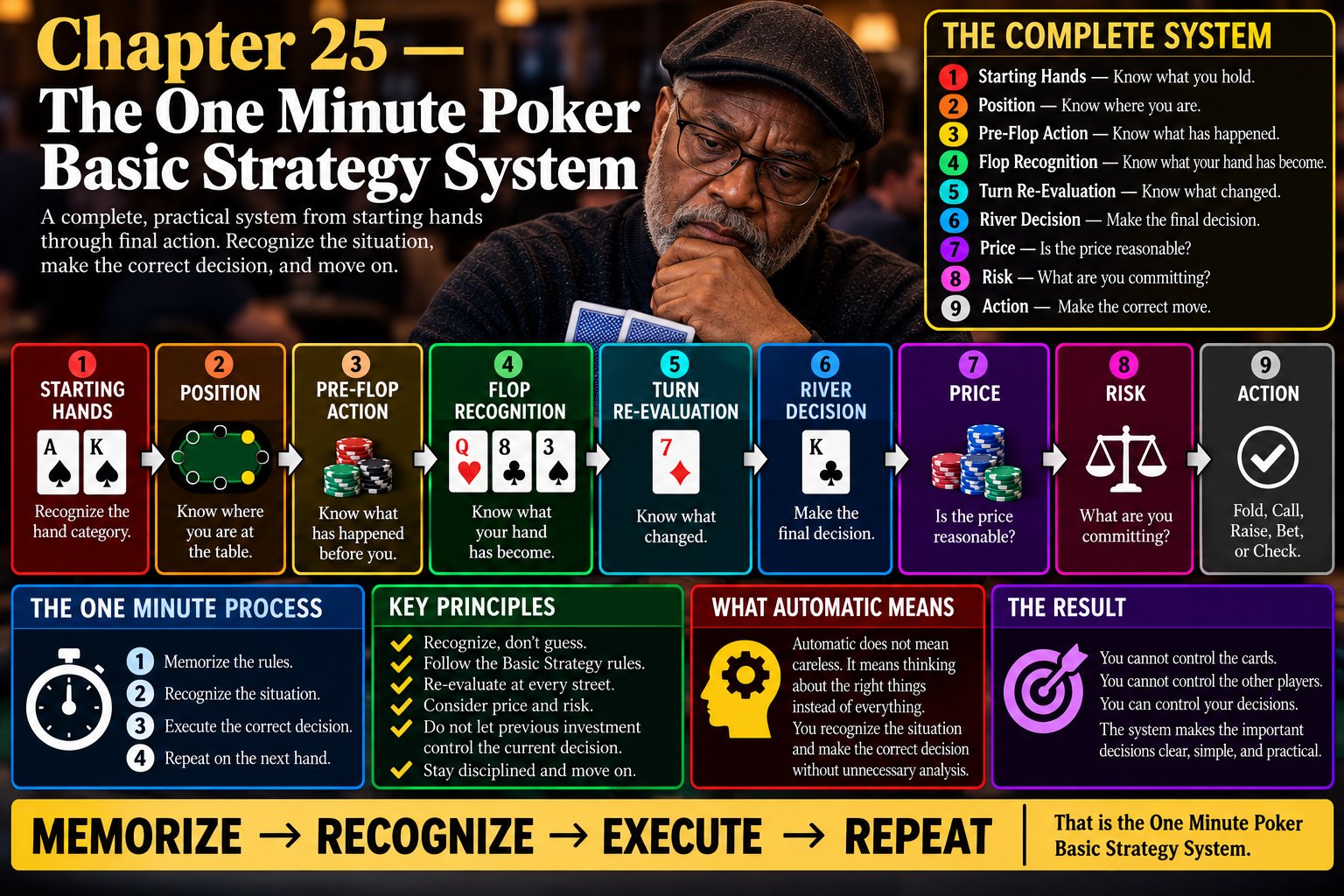
You have now learned the individual parts of the One Minute Poker Basic Strategy system: starting hands, position, pre-flop decisions, flop recognition, turn decisions, river decisions, price, risk, discipline, memory, practice, and complete hand examples. Now those parts become one system. The purpose of this chapter is not to introduce another rule or another collection of exceptions. It is to reduce everything you have learned to the process you can actually take to the table.
Starting Hands → Position → Pre-Flop Action → Flop Recognition → Turn Re-Evaluation → River Decision → Price → Risk → Action
That is the One Minute Poker Basic Strategy System. The objective is simple: recognize the situation, make the appropriate decision, and move on. You are not trying to analyze everything, predict every possible outcome, read the personality of every player, or turn every hand into a complicated mathematical exercise. You are executing a system you have already learned.
The System Begins Before the Cards Arrive
Basic Strategy begins with preparation. You already know the starting-hand groups. You already know the importance of position. You have practiced recognizing which hands belong in which positions. That means the first decision should not begin with emotion. You should not think, "I have been folding too long," "I need to win a pot," or "This hand looks interesting." You should recognize the hand and its position. If it qualifies, play it according to the system. If it does not qualify, fold it. That is the beginning of automatic poker.
Step One — Recognize the Starting Hand
Your first task is to know what you are holding. You do not need to stare at the cards and debate their possibilities. You recognize the category. Is the hand premium, strong, medium, marginal, speculative, or outside the range? The purpose of the starting-hand system is to make this recognition fast. The more you practice, the less time it should take. You see the cards, recognize the category, and know the appropriate action. That is what memorization is for. Memorization is not the final goal. It is what allows recognition to become automatic.
Step Two — Recognize Position
The same starting hand does not have the same value in every position. Early position requires greater discipline because many players remain behind you. Later position gives you more information and generally permits a wider range of playable hands. The important thing is not to turn position into a complicated calculation. Know where you are, then connect that position to the starting-hand system.
Position + Starting Hand = Pre-Flop Decision
That connection should become automatic. You should not have to reconstruct the entire strategy every time you receive two cards. You recognize the position, recognize the hand, and execute the appropriate action.
Step Three — Recognize the Pre-Flop Action
Your decision changes depending on what happened before you. Sometimes the action folds to you. Sometimes someone has already entered the pot. Sometimes you face a raise. Sometimes you face a re-raise. Sometimes you are in one of the blinds. The hand itself has not changed, but the situation has. That means you cannot simply memorize one action for every hand. You must recognize both the hand and the action.
A hand that qualifies as an opening hand does not automatically mean you should respond the same way after another player has raised. The system tells you how to respond to the situation. This is why the complete pre-flop examples were important. They demonstrated the difference between having a hand and having a hand in a particular situation.
Step Four — Recognize the Flop
Once the flop arrives, the starting-hand system has done its job. Now you have a new decision. You should recognize what your starting hand has become. You may have a strong made hand, a medium-strength hand, a draw, a weak hand, or you may have completely missed. The important thing is to recognize the hand you actually have rather than the hand you hoped to make.
A strong starting hand can miss the flop. A modest starting hand can connect strongly. A draw can become a made hand. A dangerous board can weaken the value of a hand that initially looked strong. The flop creates a new situation. Recognize it, then act.
Step Five — Recognize the Action
Once you know your hand, recognize what the other players have done. Has everyone checked? Has someone bet? How large is the bet? Are you facing a raise? Are several players involved? You do not need to create a detailed profile of the person making the bet. The action itself gives you the information you need for Basic Strategy.
You have a hand. There is a board. There is an action. There is a price. Now you decide. This keeps the decision focused on the game rather than on speculation about the person playing it.
Step Six — Re-Evaluate the Turn
The turn is not simply an extension of the flop. It is another decision. A new card has appeared. That card may improve your hand, complete a draw, create a dangerous board, change the relative strength of your hand, or change the price you are being offered. That means you must re-evaluate.
Do not automatically continue because you continued on the flop. Do not automatically bet because you bet the flop. Do not automatically call because you called earlier. The turn is a new situation. Ask the basic questions again: What is my hand now? What changed on the board? What action am I facing? What am I being asked to risk? Then make the appropriate decision.
Step Seven — Recognize the River
The river is the final decision. There is no future card. A draw either completed or it did not. Your final hand is now known. The board is complete. The remaining decision is about what you should do with the hand you actually have.
A strong hand may justify a value bet. A medium hand may justify a call when the price is reasonable. A weak hand may need to fold. A missed draw may need to be abandoned. The river is where players often make the mistake of thinking about what they wanted to happen rather than what actually happened. Do not do that. Recognize the final hand, recognize the final board, recognize the action, recognize the price, and then decide.
Step Eight — Understand Price Without Overcomplicating It
Price matters throughout poker, but Basic Strategy does not require you to turn every decision into a mathematical exercise. You need practical judgment. You need to recognize when the price is reasonable and when the price is poor. You need to recognize when a call is obviously too expensive for the hand and situation.
If you have a draw and are asked to risk a small amount for a reasonable opportunity to improve, that may be a sensible continuation. If you have the same draw and are suddenly asked to risk a large amount with only one card remaining, the situation may no longer justify continuing. The cards did not necessarily change your category. The price changed the decision. That is why price must be recognized along with hand strength.
Step Nine — Recognize Risk
Price and risk are connected. Every time you continue, you are committing additional chips. The question is not how much you have already invested. The question is whether the additional commitment makes sense now.
Money already placed in the pot is gone. Do not allow previous investment to force you into another decision. This principle applies pre-flop, on the flop, on the turn, and on the river. You can have invested heavily in a hand and still fold. You can have invested very little and still make a large commitment when the situation supports it. The amount already invested does not determine what you should do next. The current situation does.
Step Ten — Make the Action
Once you recognize the situation, act. Do not endlessly reconsider a decision that the system has already made clear. If the correct action is fold, fold. If the correct action is call, call. If the correct action is raise, raise. If the correct action is bet, bet. If the correct action is check, check.
The system exists to make action easier. You are not trying to prove that you can think about poker for a long time. You are trying to make good decisions consistently. That is the meaning of One Minute Poker.
The Complete One Minute Process
The entire system can now be reduced to a simple sequence. Pre-Flop: Recognize your position, recognize your starting hand, recognize the action, and make the appropriate pre-flop decision. Flop: Recognize what your hand has become, recognize the board and the action, and choose the appropriate response. Turn: Recognize what changed, re-evaluate your hand and the board, recognize the action and price, and make the new decision. River: Recognize your final hand and final board, recognize the action, consider the price and risk, and make the final decision.
At every street, the same principle applies: Recognize the situation. Make the appropriate decision. Move forward.
You are not required to remember the entire hand as one continuous argument. You are required to make the current decision correctly.
Memorize → Recognize → Execute → Repeat
This is the heart of the system.
Memorize. Learn the starting hands, position rules, actions, and basic responses.
Recognize. See the situation and identify what applies.
Execute. Make the decision without unnecessary analysis.
Repeat. Do the same thing on the next hand.
This is how knowledge becomes automatic. You do not want to spend your entire poker session consciously reciting rules. You want the rules to become familiar enough that the appropriate decision comes to mind quickly. That is why the memory training and practice system are part of the book. The system cannot become automatic if you never practice recognizing it.
What Automatic Really Means
Automatic does not mean careless. It does not mean playing without thinking. It means thinking about the right things instead of everything.
When you see a starting hand, you recognize its category. When you see your position, you know how that affects the range. When you face a raise, you know that the situation has changed. When the flop arrives, you recognize what your hand has become. When the turn changes the board, you re-evaluate. When you reach the river, you recognize the final situation.
You are still making decisions. You are simply not rebuilding the entire strategy from scratch every time. That is the difference between learning poker and being able to play poker.
Discipline Protects the System
Knowing the system is not enough. You must also follow it. That means resisting the temptation to play a weak hand because you are bored, refusing to chase a draw simply because you want to see the next card, folding when the price is too high, and not calling merely because you have already invested chips. It means not changing your strategy because you just lost a large pot and not becoming reckless because you just won one. It means recognizing when emotion is beginning to interfere with your decisions.
The system works only when you allow it to work.
Do Not Add Unnecessary Complexity
One of the greatest advantages of a complete system is that you do not need to invent additional rules every time something unusual happens. Basic Strategy is designed to provide a practical structure for ordinary poker decisions. Use it.
Do not turn a simple decision into an investigation. You do not need to know everything. You need to know enough to make the appropriate decision. That is why the system emphasizes recognition rather than endless analysis.
You recognize the hand. You recognize the position. You recognize the board. You recognize the action. You recognize the price. You recognize the risk. Then you act.
The System Is Complete
At this point, you should be able to see the entire Basic Strategy system as one connected process. It begins with the starting hand. Position determines how that hand should be treated. Pre-flop action determines the next decision. The flop changes the hand and creates a new situation. The turn requires re-evaluation. The river requires a final decision. Price determines whether continuing is reasonable. Risk determines how much you are committing. Action is the final result of the recognition process.
The complete sequence is:
Starting Hands → Position → Pre-Flop Action → Flop Recognition → Turn Re-Evaluation → River Decision → Price → Risk → Action
That is the system.
The One Minute Standard
The goal is not to make every poker decision in exactly sixty seconds. The one-minute idea represents something more important: you should be able to reach a clear decision without becoming trapped in unnecessary analysis.
Simple situations should be simple. A starting hand that does not qualify should be folded. A strong hand in an appropriate situation should be played appropriately. A missed flop should be recognized. A draw should be recognized as a draw. A dangerous board should be recognized. An expensive price should be recognized. A completed hand should be recognized. Then the decision should follow.
The more you practice, the faster this recognition becomes.
When the Hand Is Over, Let It Go
One of the final disciplines of One Minute Poker is learning to move on. You made the decision. The hand produced a result. The result is now history.
Do not carry the previous hand into the next one. A bad beat does not change the next starting hand. A big win does not change the next position. A missed draw does not create an obligation to win the next pot. A bad decision does not require you to make another bad decision to recover from it.
The next hand is a new situation. Return to the system.
The Final Basic Strategy Mindset
You do not need to control the cards. You do not need to control the other players. You do not need to predict every outcome. You need to control your decisions.
You need to recognize what you have. You need to recognize where you are. You need to recognize what has happened. You need to recognize what the current price and risk require. Then you act.
That is the discipline of One Minute Poker.
The system is not designed to make poker complicated. It is designed to make the important decisions clear. The more you memorize, the faster you recognize. The faster you recognize, the more naturally you execute. The more consistently you execute, the less often emotion, curiosity, boredom, or frustration can interfere.
Eventually, the process becomes familiar. You see the situation. You recognize the answer. You act. Then you move on.
Memorize → Recognize → Execute → Repeat.
That is the One Minute Poker Basic Strategy System.